





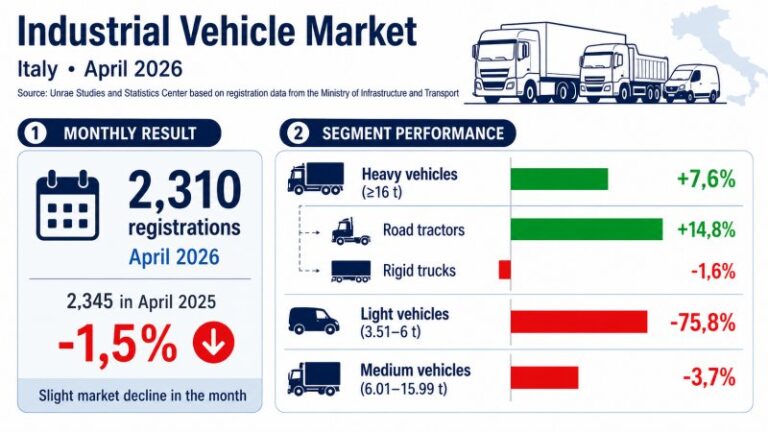
The Italian market for industrial vehicles with a gross vehicle weight of more than 3.5 tonnes closed April 2026 slightly down, according to estimates prepared by Centro Studi e Statistiche Unrae (Unrae Study and Statistics Centre) based on registration data provided by ministero dei Trasporti (Ministry of Transport). During the month, 2,310 units were registered, compared with 2,345 in April 2025, a decline of 1.5%. The figure comes at a time when road haulage companies are continuing to assess fleet renewal, but remain exposed to rising operating costs linked to geopolitical tensions and energy prices.
The monthly trend, however, shows a sharp divergence between weight categories. Heavy vehicles, with a gross vehicle weight of 16 tonnes or more, rose by 7.6%, supported mainly by road tractors, which posted double-digit growth of 14.8%. Within the same segment, however, rigid trucks recorded a slight contraction of 1.6%. Demand therefore remains selective and appears to be concentrated on vehicles most closely linked to linehaul operations and road traction. The other categories ended April in negative territory. Light vehicles between 3.51 and 6 tonnes fell by 75.8%, while vehicles between 6.01 and 15.99 tonnes declined by 3.7%.
The result for the first four months remains positive overall. From January to April 2026, registrations reached 9,841 units, up 4.1% from 9,450 in the same period of 2025. The figure indicates that cumulative demand is still favourable, but April’s slowdown introduces an element of caution into the market outlook, particularly for operators planning investments in fleets, powertrains and vehicle replacement schedules.
Giovanni Dattoli, president of Sezione Veicoli Industriali di Unrae (Unrae Industrial Vehicles Section), links the resilience of road tractors to companies’ willingness to continue modernising their fleets. At the same time, he notes that geopolitical tensions are affecting energy prices, increasing companies’ operating costs and fuelling a climate of uncertainty. Against this backdrop, according to Unrae, the €590 million multi-year fund for vehicle replacement over the 2027-2031 period could help companies plan investments, provided the implementing measure fully confirms the allocation. The association is calling for the resources not to be diverted towards emergency measures related to high fuel prices and for a priority share to be reserved for zero-emission vehicles above 16 tonnes. For Unrae, the effectiveness of the incentives will depend on their ability to provide targeted support for the decarbonisation of the heavy vehicle fleet, where purchase costs remain one of the main barriers to the spread of alternative powertrains.
The issue of incentives is closely linked to that of excise duties. Recent measures by the Government to reduce excise duties across the board are intended to limit the impact of the international crisis on energy prices for citizens and businesses. Unrae, however, considers them to be emergency and cross-cutting measures that require significant public resources, without having an effective impact on the specific costs faced by road haulage. According to the association, any future support for the sector should be directed towards the most modern Euro VI vehicles, whether powered by conventional or alternative fuels. In the same vein, Unrae proposes ending the extension of the excise duty rebate on commercial diesel to Euro V vehicles, as this mechanism risks maintaining a benefit for vehicles that are almost 20 years old, slowing the renewal of the circulating fleet.
Dattoli also stresses that vehicle purchase is not the only issue in the transition. Energy, tolls and infrastructure remain central items in road haulage companies’ accounts. In this context, Italy’s delay in transposing the Eurovignette directive, which would allow tolls to be adjusted according to vehicle emissions, deprives the sector of an operational tool to steer choices towards lower-impact vehicles.
At European level, Unrae refers to the temporary five-year mechanism approved by Parliament and Council, which will allow heavy vehicle manufacturers to accumulate emissions credits before 2030. Dattoli clarifies that this is not a derogation, as carbon dioxide reduction targets remain unchanged. The association therefore hopes that the regulatory review scheduled for 2027 will introduce greater flexibility, avoiding penalties for companies that have already invested substantial resources to bring zero-emission vehicles to market.