






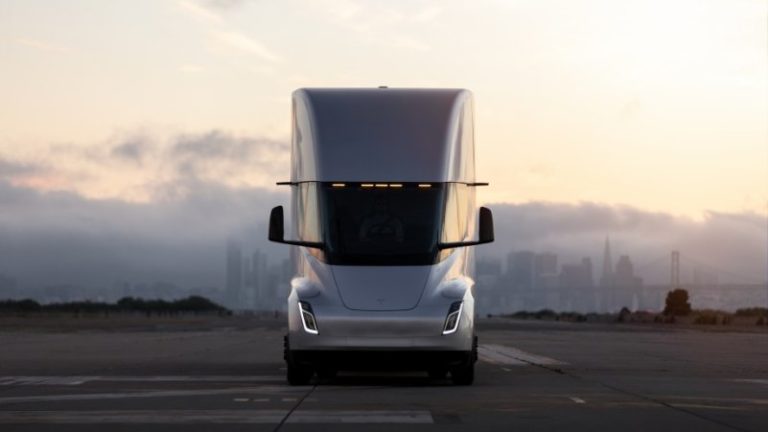
Tesla has started series production in the United States of the Semi, the heavy-duty electric tractor unit unveiled in 2017 and so far delivered in limited volumes to selected operators. The first series-production unit rolled off the new high-volume line at Gigafactory Nevada on 29 April 2026, inside a dedicated 158,000-square-metre facility. After years of delays, the company led by Elon Musk says it has completed at least the first part of the industrial path needed to build the truck on a larger scale. For fleets, logistics operators and rival manufacturers, however, the key issue is not the first vehicle coming off the line, but how quickly Tesla can increase volumes.
The Nevada factory is designed for a theoretical capacity of 50,000 trucks a year, but several analysts remain cautious. One of the doubts most often cited by US sources concerns battery availability. According to Eletric Vehicles, the Nevada site’s advantage is production integration: the 4680 cells intended for the Semi are made in the same industrial complex. This should ease a bottleneck that has helped slow the programme for years, but it does not automatically remove the risk of upstream constraints. If cell production capacity does not grow at the same pace as the truck line, final output will remain limited. In addition, 2026 comes at a time of strong pressure on Tesla’s industrial capacity, as the company is also trying to scale up the Cybercab and Megapack 3 projects, as well as the Semi. In this context, batteries remain a strategic resource to be allocated across several programmes, and the truck must compete internally with products that may have different priorities in terms of margins, commercial visibility or investor value.
Another factor is the economic context in which series production is beginning. In this case, success depends on total cost of ownership, and therefore not only on vehicle technology, but also on the balance between purchase price, energy, maintenance, operational availability and residual value. On this reading, the Semi becomes more attractive in a scenario with oil at least at 100 dollars a barrel. In reality, the analysis needs to be more precise, as it must include the pump price of fossil fuel, the cost of electricity, mission profiles, any incentives, available charging and annual mileage.
Assessing Tesla’s stated production target for the Semi also means considering its segment, which at present appears to be that of day-cab tractor units, meaning vehicles without a sleeper and therefore intended for daily missions. According to Investing.com, this market in the United States is worth less than 100,000 units a year, compared with the 50,000 units stated for the Tesla Semi. In other words, this electric truck would have to reach a share equal to half of its market, a rather bold assumption.
Another important factor for the future of this truck is the charging network. The Tesla Semi could be recharged quickly using Megacharger stations with power of up to 1.2 megawatts, but these are fairly expensive installations and are not widely available. This raises the issue of the vehicle’s real operating conditions. Trials carried out so far with selected customers have made it possible to test the truck in controlled environments, but wider adoption will require more transparent information on technical availability, battery degradation, maintenance, real charging times and economic performance by mission type.
Traditional Tesla competitors do not currently appear especially concerned by the start of series production of the Semi, although they are monitoring its progress. However, if Tesla really managed to build thousands of units a year, the electrification of part of US heavy-duty transport would become more credible and would force groups such as Daimler, Volvo and Paccar to accelerate on electric vehicles, batteries and charging services. Competition would therefore shift from the individual truck to an integrated system of vehicle, energy, software and assistance.
The Semi programme is also a test of Tesla’s industrial model applied to freight transport. In passenger cars, the company has shown that it focuses on vertical integration, control of the energy supply chain, proprietary software and direct management of key components such as batteries and charging. If this model also worked in industrial vehicles, competition would not only concern consumption and purchase price, but the entire operating ecosystem made available to fleets.
Pietro Rossoni