




At IAA Transportation 2026 in Hanover, Kässbohrer presented a range of semi-trailers built around a clear idea: the trailer is no longer simply passive equipment pulled by a truck, but a platform integrating technology, weight reduction, safety and energy efficiency. The manufacturer has brought these developments together under its "Power of Engineering" concept. For general cargo transport, the flagship model is the K.SCS NG X+, a new generation of curtainsider designed for strength and durability. Its structure has undergone tests equivalent to 2.5 million kilometres. To provide flexibility in loading operations, the semi-trailer incorporates K-Fix, a load-securing system offering up to 17,000 fastening options, allowing the load bed to be adapted to different types of goods.
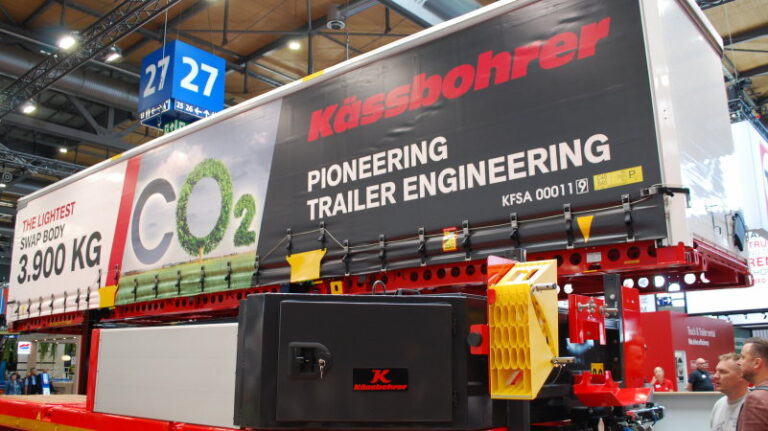
In intermodal transport, weight is the key parameter. The 45-foot K.SWAU CL swap body has an unladen weight starting at approximately 3,900 kg and can carry up to 34 Euro pallets. Its low weight becomes particularly important with the introduction of electric tractor units, as it partly offsets the additional weight of the batteries without reducing payload capacity. Electrification also extends to the operations performed by the semi-trailer itself. The new K.SSL 33 E is a 33 m³ cement silo trailer equipped with an integrated electric compressor, eliminating the need for a separate diesel-powered unit for unloading. Electrification therefore extends beyond the tractor unit to the entire vehicle combination.
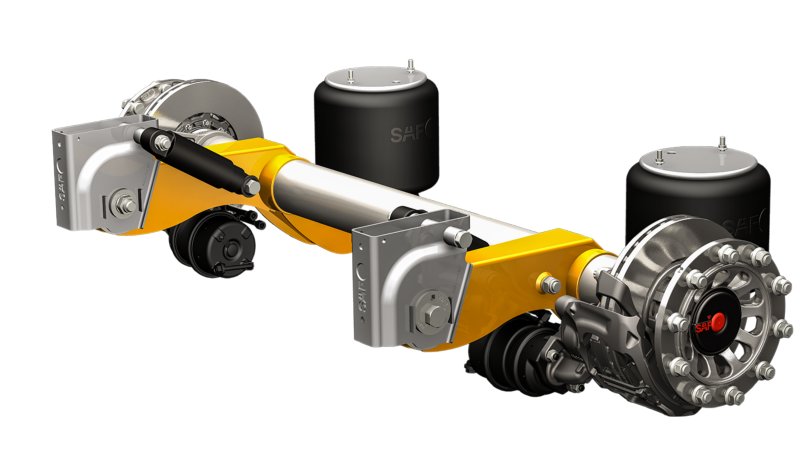
Kässbohrer also brought to Hanover the results of the European Zefes project, developed with ZF using TrailTrax electric axles. The aim is to recover energy while driving and improve the energy efficiency of the vehicle combination through an active trailer. Tests carried out with a container chassis have shown that the semi-trailer can contribute directly to the vehicle's energy management. A similar engineering approach is applied to heavy and special transport in the new K.SLH S HS 3, a three-axle low-loader semi-trailer with a hydraulic gooseneck and steering axles. This configuration combines high load capacity with manoeuvrability, essential requirements when transporting construction machinery, industrial vehicles or indivisible loads. Completing the range are the K.SLL P low-loader, the K.SKS B 27 tipper, the K.STC 37.5e chemical tanker and the K.STB E 42 fuel tanker. Together, these models demonstrate that improving efficiency cannot be achieved through a single technology.
Massimiliano Barberis