








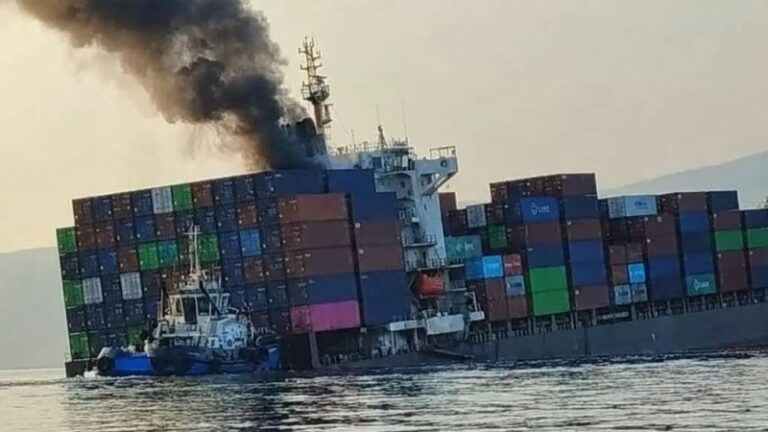
Tankers are no longer the only targets in the naval conflict in the Strait of Hormuz: container ships and bulk carriers are now coming under attack too. On 14 October 2026, Singapore's Maritime and Port Authority (Mpa) reported that two Singapore-registered container ships, Gfs Pride and Gfs Giselle, had been struck by projectiles of unknown origin while transiting the Strait on 13 and 14 October, respectively. The first vessel, a feeder container ship built in 2008 with a capacity of 2,824 teu, sank after a fire broke out on board. All 21 crew members evacuated safely, with no injuries reported. Around the same time, the Cape Dao, a bulk carrier struck on 23 September, also sank.
These two losses bring the number of cargo ships sunk since the start of the war launched by Israel and the United States against Iran on 28 February to three. The first was the container ship Safeen Prestige, which was struck in March and sank north of the Strait. The second Singapore-registered vessel, Gfs Giselle, fared better. Despite sustaining hull damage, it managed to reach a safe anchorage, with all 22 seafarers unharmed. The Mpa said it was in contact with the company managing both vessels and described the attacks as unprovoked, unjustifiable and a violation of international law, citing the United Nations Convention on the Law of the Sea.
Two conflicting accounts have emerged of what caused Gfs Pride to sink. While Singapore reported that the ship had been struck by an unidentified projectile, Iran's state news agency Tasnim carried a statement from the Islamic Revolutionary Guard Corps Navy on 14 October claiming that a container ship had exploded and sunk after striking a mine while sailing along a route Tehran considers unauthorised. Maritime security company Marisks noted that there was no independent evidence to support this account and interpreted it as part of a psychological warfare strategy intended to spread fear and uncertainty across regional commercial shipping. The wreck of Gfs Pride now poses a serious navigational hazard in the Strait, adding to the threat from mines, missiles and drones used by the warring parties. On 14 October, Pakistan's hydrographic authorities issued a notice to mariners locating the sinking approximately four nautical miles north-west of Ras al-Sheikh Masud, on Oman's Musandam Peninsula, and warning of drifting containers.
The container ship belongs to the Global Feeder Shipping fleet and is managed by Gfs Ship Management, a company based in the United Arab Emirates and 80% owned by the UAE state-owned AD Ports Group, which acquired the stake in 2022 for $800 million. The Gfs fleet had already come under attack in July 2026, when the container ship Gfs Galaxy was struck and left drifting following a fire and severe damage to its engine room, with one seafarer missing. The United States blamed Iran for the attack and launched further strikes against the country, prompting Tehran to declare the Strait closed.
The bulk carrier Cape Dao, sailing under the flag of Antigua and Barbuda, was struck by an unidentified projectile at 06:30 Utc on 23 September and subsequently remained ablaze and adrift. The vessel is a Capesize bulk carrier with a deadweight tonnage of 191,074 tonnes, managed by UAE-based Peonies Shipmanagement. Sources differ on the location of the attack. The Imo's incident record places it approximately 15 nautical miles north-east of Khasab, while Oman's Maritime Security Centre puts it around 2.5 nautical miles off the Musandam Governorate. There has also been no official confirmation of the weapon used. The Indian union Forward Seamen's Union of India reported that the ship had been struck twice on its port side, once near the engine room and once in the accommodation area, while several Indian sources referred to two torpedoes. Neither Iran nor the United States has claimed responsibility for the attack. The vessel had departed Mina Saqr in the UAE and was bound for India with 28 seafarers on board, including 20 Indian nationals. One seafarer was killed, another injured and 27 were rescued by the Omani Navy. The vessel was ultimately lost after weeks of salvage attempts.
These sinkings come amid an escalation in attacks on cargo vessels since the beginning of October. The UK's maritime security agency Ukmto has recorded more than twenty vessels attacked in October alone, most of them tankers. The human toll is rising accordingly. By 23 September, the Imo's incident register had recorded 83 confirmed incidents and 23 seafarer deaths in the Strait and surrounding waters since the conflict began. The escalation is further reducing the already small number of vessels willing to risk the passage through Hormuz.
Antonio Illariuzzi