







Since its official presentation in 2017, news about the Tesla Semi electric truck has followed a stop-and-go pattern: periods of major announcements have been interspersed with long silences. November 2025 belongs to the former category: during Tesla’s Annual Shareholder Meeting in Austin, Texas, the company introduced a new generation of the vehicle while simultaneously announcing a further delay in commercial rollout to the second quarter of 2026 (the first date announced was 2019). Founder and CEO Elon Musk confirmed that production will begin at the company’s North Nevada plant.
The new generation of the Tesla Semi has been developed through operational trials conducted with several units assigned to large US companies. According to Tesla, the updated model delivers 15% higher energy efficiency than the current version, with consumption reduced to 1.7 kWh per mile (about 1.06 kWh per kilometre), giving it a range of roughly 800 kilometres on a full charge. During tests carried out by DHL in the summer of 2024, the Semi covered 390 miles (around 625 km) fully loaded with a gross weight of 75,000 pounds (34 tonnes). Motor output remains at 800 kW, but Tesla has upgraded the cooling system, software and thermal management.
The new Tesla Semi also stands out for its redesigned cab, aimed at improving aerodynamics. The front end now features a light bar inspired by the Model Y, replacing traditional headlights with a more modern, integrated lighting system. The wraparound windscreen has been made smaller, improving both aerodynamics and weight reduction, while the roof has been reshaped with a more rounded profile to enhance airflow and cut drag. The side panels, bumpers and wheel surrounds have also been restyled.
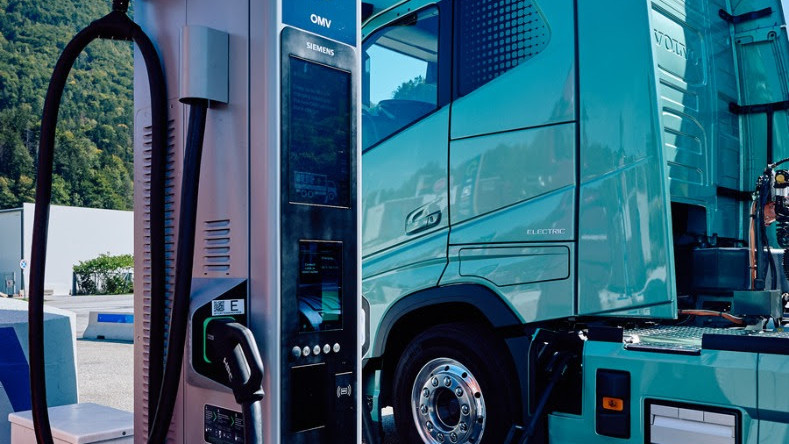
A key factor in electric mobility is battery charging, and Tesla has addressed this as well. The new Semi introduces a next-generation ultra-fast charging system capable of supporting a peak charging power of 1.2 MW, exceeding the current Megacharger specification. This will significantly shorten charging times. Tesla is also expanding its Megacharger network, which is expected to reach 46 stations by 2027.
Tesla has announced that the new Semi will offer higher payload capacity, although no specific figures have been disclosed. This improvement is likely due to lighter, more efficient batteries that reduce the vehicle’s tare weight. US regulations set a maximum gross vehicle weight of 82,000 pounds (around 37 tonnes). The new 4680 Gen 2 battery cells have a lighter casing and improved energy density, and the Semi’s tare weight is estimated to drop to around 23,000 pounds (about 10,500 kilograms).
The new Tesla Semi has also been engineered to accommodate autonomous driving, though Musk stopped short of indicating when Level 5 – full self-driving with no driver on board – might become feasible. Lars Moravy, Tesla’s Vice President of Vehicle Engineering, previously said autonomous driving could first be implemented in loading and unloading operations. From a technical standpoint, Ashok Elluswamy, Vice President of Autopilot/AI software, explained that the Semi’s autonomous system will be derived from Tesla’s passenger car technology.
Mass production of the Tesla Semi depends on the completion of the North Nevada factory, located next to the Gigafactory. According to company executives, the building has been completed, and installation of internal equipment and assembly lines is underway. The facility covers around 158,000 square metres and will have an annual capacity of 50,000 units, a target expected to be reached by the end of 2026. Currently, the pilot vehicles supplied to testing customers are being built at the Fremont plant in California. Tesla itself will be the first commercial customer, using the trucks for internal logistics.
No official pricing has yet been released. When the Semi was first introduced in 2017, Tesla announced a price of 150,000 dollars for the 300-mile range version and 180,000 dollars for the 500-mile model. Those prices were later removed from the company’s website when preorders were suspended in August 2022. Since then, Tesla has provided no updates, but independent analysts suggest that the actual price is likely to fall between 250,000 and 400,000 dollars.
Despite its higher purchase price, the Tesla Semi could still offer substantial long-term economic benefits due to lower operating costs. Electricity is generally much cheaper than diesel, and electric vehicles require less maintenance because of their simpler mechanics. A detailed analysis estimates that cutting a 400 kW demand peak could save around 67,200 dollars a year at current rates. Factoring in savings on fuel, maintenance and other operational costs over a ten-year lifecycle, a single Semi could recover between 300,000 and 400,000 dollars of its purchase cost – figures that remain to be confirmed.