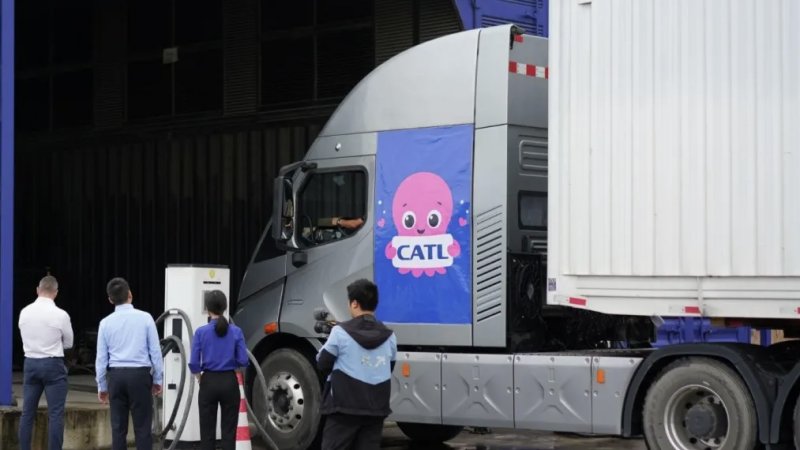






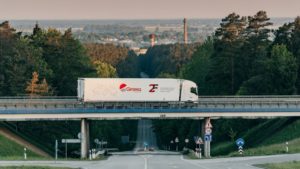
Girteka Transport announced in early May 2026 the arrival of its first Brazilian drivers, a development that CEO Mindaugas Paulauskas described as the start of a strategy to diversify the company’s workforce internationally. The new recruits completed their training at the Girteka Drivers Academy, where they obtained the qualifications needed to operate in Europe, including the mandatory CQC certification for professional drivers. Paulauskas said the Brazilian drivers had approached the transition with openness and commitment, despite coming from a very different regulatory environment.
Girteka’s initiative is not an isolated case. In recent years, several private intermediaries have built recruitment and training channels for non-EU drivers, with Brazil emerging as one of the main recruitment pools. The initial phase is handled entirely remotely: candidates submit their documents online, are assessed by specialist agencies and, once selected, begin a preparatory process before departure.
One of the most active operators in this segment is Marcelo Toledo, who, through the company M/Brazil, also known as Caterer Brazil, acts as an intermediary between South American drivers and European hauliers. Toledo already works with companies in several European countries, collecting from each of them their estimated staffing needs for the following 12 months. The system, which Toledo himself describes as a kind of "driver auction", is aimed in particular at small hauliers that lack the resources to turn to large recruitment agencies. In two years of activity, M/Brazil has placed around 95 drivers, mainly in Austria and Lithuania, with others waiting to complete visa procedures in Poland. Toledo estimates current demand at 2,000 drivers for this year, although he stresses that the figure is based on requests received through the system and forms submitted by employers, not on contracts already signed.
Before departure, drivers must submit a document package including a passport, Brazilian and international driving licences, a criminal record certificate, a driving record extract, medical checks and reference letters. On costs, Toledo says that in 90% of cases the employer covers the main expenses: the flight, initial accommodation, CQC training and the agency fee. Some companies also cover meals. Drivers are nevertheless asked to arrive with around €800 in cash for day-to-day expenses until they receive their first salary.
Alongside recruitment, M/Brazil also runs a preparatory programme called Viking, which lasts around three months and takes place before relocation. The aim is to prepare drivers not only for regulatory requirements but also for the personal challenges involved: distance from family, different work expectations and a harsher climate than in Brazil. The programme involves Brazilian drivers already working in Europe as mentors for new arrivals. Toledo also says he continues to support drivers after they arrive: if they lose their job, he seeks new interviews to avoid their forced return to Brazil; if the driver wants to change company, he first attempts mediation and, if the decision stands, starts looking for a new employer. Contracts are translated into Portuguese before being signed.
A second Brazilian operator active in this area is The One Driver programme, created by a promoter identified as James. It does not yet have a signed agreement with a "pilot" employer but already has around 70 drivers on its waiting list. Under its cost model, the employer covers flights, training, assessments and qualifications, while the driver pays the costs linked to the residence permit: around €200 in Poland and €800 in Spain, with an average of about €600 depending on the country. The training programme runs over four days in the country of origin: one day in the classroom and three days dedicated to road awareness, risk management, loading, fatigue, EU rules on driving and rest times, life and work in Europe, company expectations, basic language support and permit-related issues. Cognitive assessments, knowledge tests and practical tests are also planned. Once in Europe, drivers complete their CQC training while already employed, before moving into full-time work.
James says he also applies selective criteria to employers: companies must sign an agreement covering welfare and protection obligations, and those with a poor record on pay, accommodation or regulatory compliance are excluded. Before starting a partnership, the programme also gathers information through the European Transport Workers’ Federation, the International Transport Workers’ Federation and Investigate Europe. One of the main requirements concerns regular weekly rest: companies must guarantee accommodation outside the truck, in line with EU road transport rules, which prohibit regular weekly rest from being taken in the cab. Any company unable to guarantee this condition is not admitted to the programme. The One Driver also provides up to six months of independent social support after arrival, allowing drivers to report problems via WhatsApp or email and receive mediation with the company.
The most sensitive issue in the whole system remains work permits. In many Member States, the permit is tied to the company that sponsored the worker’s entry: if the employment relationship ends, the ability to remain in the country depends on how quickly a new employer can be found, under the applicable national rules. In Lithuania, for example, if the worker does not apply to change employer or role after the contract ends, they are required to leave the country. After the residence permit is withdrawn, the worker has only a short period; in some cases, they have three months to find a new employer before the permit is revoked. Neither Toledo nor James believes they have fully solved this problem within their respective models.
This creates a significant imbalance of power: a newly arrived driver who has incurred relocation costs and finds himself in an unfamiliar environment has very limited room for negotiation with the employer, especially in the first few weeks. If the job falls through quickly, the investment made, even when partly covered by the company, becomes an additional risk. The European Commission says the new single permit framework allows non-EU workers to change employer under certain conditions and that, during the validity of the permit, workers may remain unemployed for at least three or six months, depending on the length of their previous stay. However, national rules on visas and residence remain decisive and may in practice restrict this flexibility, as the Lithuanian case shows. The gap between the EU framework and its implementation in individual Member States remains one of the system’s structural limits.
The European Union has also launched the EU Talent Pool project, a platform designed to connect workers from third countries with European employers. The platform is free for jobseekers and prohibits the charging of recruitment fees or undeclared costs. However, the EU Talent Pool does not replace national visa and work permit procedures, which remain the responsibility of individual states. The contrast between this official channel, which promises clear rules and transparency, and the private channels already in operation, with their own systems of intermediation and bilateral negotiation, illustrates the transitional phase now facing Europe’s road transport labour market.
M.L.