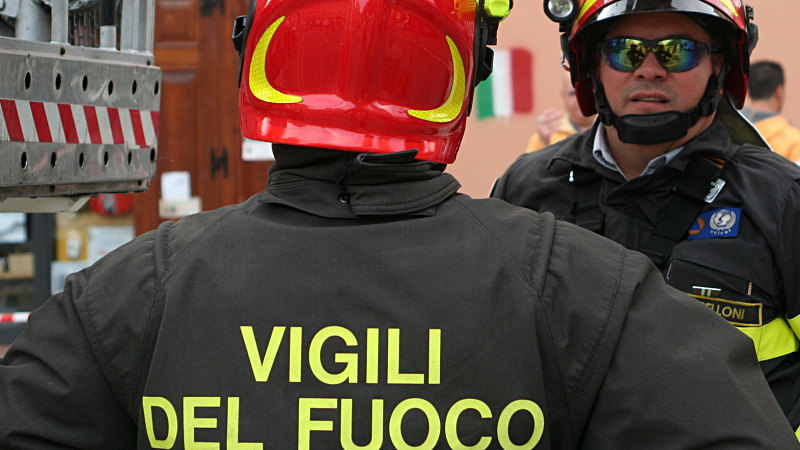








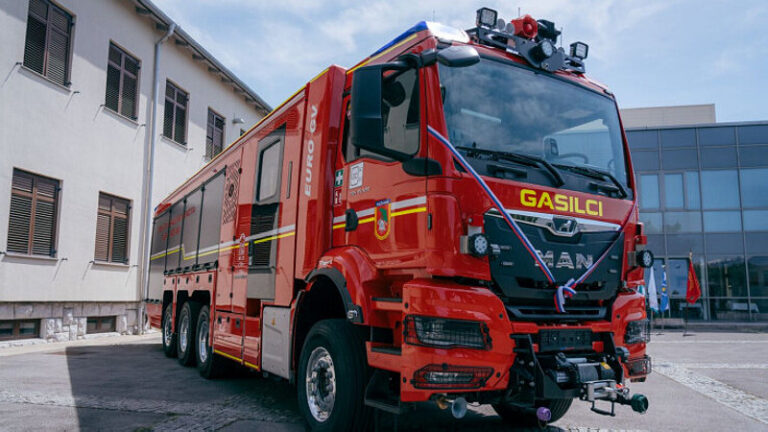
2Tdk, the Slovenian company managing the Divača-Koper railway project, delivered a bimodal fire-fighting and rescue vehicle to the Sežana Fire Brigade on 17 June 2026. The vehicle is intended for operations in the railway tunnels of the new line to the port of Koper. Assigned to Zgrs, it forms part of the safety system planned for the so-called second track and is included in a broader supply package of two specialised vehicles, one for Koper and one for Sežana, identified during the infrastructure planning phase.
The vehicle’s main technical feature is its bimodal configuration, which allows it to operate both on roads and on railway tracks thanks to an additional rail undercarriage. It is equipped with water and foam tanks, making it a fire-attack platform for confined environments rather than a simple logistics support vehicle. It also has a detection system for hazardous gases and high temperatures, designed to monitor the atmosphere inside tunnels, as well as a thermal imaging camera to locate fire sources and carry out thermal checks on wagons and infrastructure in low-visibility conditions.
Among the safety equipment for the crew, an onboard air tank enables a team of six firefighters to evacuate safely in difficult conditions. In a railway tunnel environment, where distances from the portal can be considerable and side access is minimal, this is a key element of the vehicle’s design, which is geared not only towards fire attack but also towards the orderly withdrawal of the crew in the presence of smoke or oxygen deficiency.
2Tdk describes the vehicle’s main role as emergency response in the railway tunnels of the Divača-Koper line, with a profile focused on fires, accidents, technical rescue and incidents involving smoke or hazardous substances. The vehicle will also be used for training, exercises and operational readiness checks, in the hope that it will not have to respond to major real emergencies. The presence of two vehicles, one for Koper and one for Sežana, provides distributed coverage along the route, with the aim of reducing access times to tunnel portals and limiting the risk that an incident in a tunnel could disrupt the continuity of the corridor to the port of Koper for an extended period.