






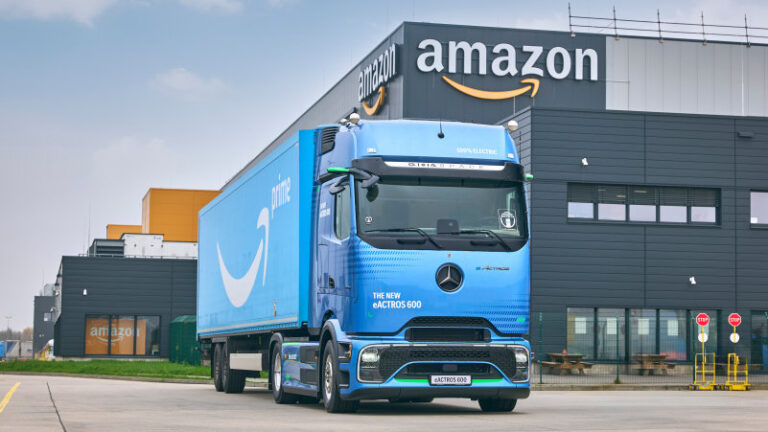
On 3 May 2026, Amazon announced the launch of Amazon Supply Chain Services (ASCS), a commercial offering that makes the Seattle-based group’s entire logistics infrastructure available to external companies. It is no longer a service reserved for sellers on its marketplace, but a proposition open to any industrial or commercial operator needing to move goods, manage warehouses or ship parcels.
The offering is divided into three categories. The first, Freight, covers the transport of goods and raw materials. The second, Distribution and fulfilment, includes the storage and distribution of finished products. The third, Parcel shipping, concerns the delivery of parcels to the final recipient. The first customers announced include Procter & Gamble, 3M, Lands’ End and American Eagle Outfitters, large companies with complex logistics flows and significant volumes. Procter & Gamble uses Amazon transport services to move raw materials to production plants and distribute finished products through the group’s network; 3M uses them to move products from manufacturing sites to global distribution centres.
The news had an immediate impact on financial markets. According to Bloomberg, on 4 May 2026 FedEx shares fell by as much as 10%, with some sources indicating a decline of 7.4%. UPS recorded similar losses, ranging between 8.9% and 10%. These figures refer either to maximum intraday falls or to closing declines. The downturn also affected other operators in the sector: Forward Air and GXO Logistics suffered double-digit falls, while Old Dominion Freight Line lost more than 5-6%. These were substantial stock market moves, reflecting investor concern over the structural consequences of Amazon’s new service for the North American logistics market.
The move is not entirely unexpected. Amazon has been operating in logistics for years, first by progressively internalising its own logistics needs and building an extensive network of distribution centres, air fleets and last-mile delivery services. According to ShipMatrix data, in 2025 Amazon delivered more than a quarter of the 23.9 billion parcels shipped in the United States, recently overtaking USPS as the country’s largest delivery provider by volume. FedEx and UPS together handled about a third of total volumes over the same period.
Morgan Stanley described the announcement as "a watershed moment for North American freight transport companies", indicating that the greatest effects will be felt by cargo airlines and express couriers. Analysts at the investment bank point out that the transition had long been expected: Amazon had already offered parts of its logistics chain as services to third-party marketplace sellers, and opening up to the external market represents the natural evolution of that strategy. The launch of ASCS comes at a time when relations between Amazon and its traditional logistics providers are being redefined. UPS had already announced in early 2025 that it would cut delivery volumes for Amazon by more than 50% by mid-2026, with the aim of shifting towards more profitable shipments. That decision, presented at the time as a customer portfolio diversification strategy, now also appears to have been an anticipatory response to a competitive scenario that the Seattle-based group was already preparing.