






The Bosphorus Strait is a bottleneck for rail traffic between Europe and Asia. Limited capacity is due to inadequate infrastructure and heavy traffic that is increasing, particularly following changes in the geopolitical landscape between the two continents. Turkey is playing a leading role, as it does not want to miss the opportunity to become an increasingly important transport crossroads. Through careful diplomatic action, it is involving major international institutions, which have so far guaranteed funding of just under €6 billion. The latest contribution is a €1.7 billion loan from(World Bank. The funds will support the Inrail project (Istanbul North Rail Crossing Project), whose total cost is estimated at just over €7 billion. In March 2026, €500 million in financing had already been provided by European Bank for Reconstruction and Development.
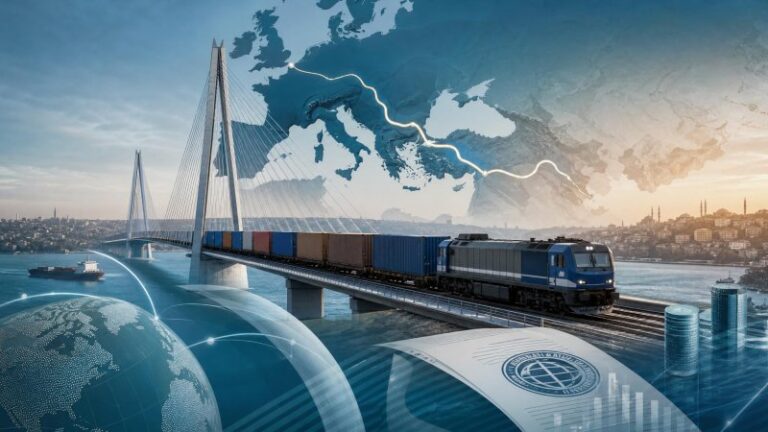
The Inrail project will create an alternative rail crossing of the Bosphorus Strait, where several national and cross-border routes currently converge, including the Trans-Caspian Transport Corridor, or Middle Corridor, the route between Turkey and the European Union, and the future Iraq Development Road (IDR) corridor. The proposed solution is the construction of a high-capacity railway line for mixed passenger and freight traffic. The line will be 127 kilometres long, with a design speed of 160 km/h and gradients suitable for freight operations. Also referred to as the “northern ring railway”, it will avoid crossing the Istanbul metropolitan area and, above all, provide an alternative for freight transport, which currently relies solely on the Marmaray undersea tunnel. Marmaray has limited capacity, partly because it carries heavy passenger traffic, which is given priority.
[caption id="attachment_78376" align="alignnone" width="2048"] Illustrazione: TrasportoEuropa - IA[/caption]
The civil engineering works will be substantial, with about 40 tunnels, a similar number of viaducts and a series of connections to link the line with the existing network, including towards the Bulgarian border. The new rail corridor is designed to bring total annual transport capacity across the Bosphorus to 50 million tonnes of freight. The route will start in the south at the Çayırova rail hub on the Asian side of the Istanbul Strait, currently a key junction for the Marmaray railway, and will end at Çatalca on the European side, crossing the Strait via the existing Yavuz Sultan Selim Bridge (YSS Bridge). According to World Bank, which has provided the largest share of support for the initiative, the Inrail project is not merely the construction of a new rail link, but the most functional connection between the two continents.
Piermario Curti Sacchi