








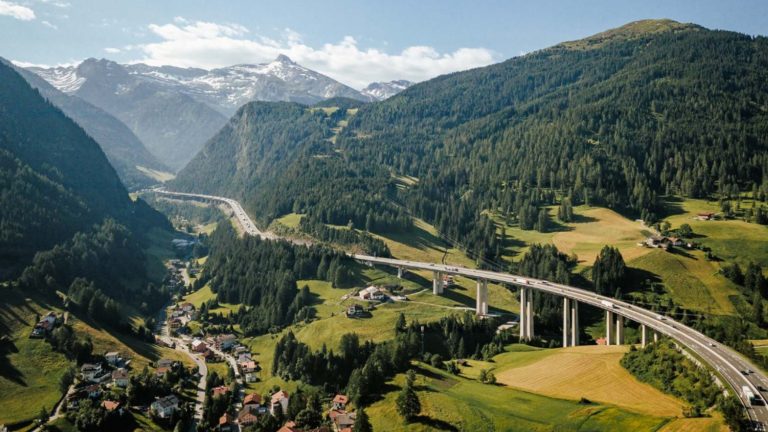
From 12 October, resurfacing work on the Lueg Bridge, on Austria’s A13 Brenner motorway, will result in two night-time traffic bans. The motorway operator Asfinag has announced two four-day periods, from 12 to 15 October and from 19 to 22 October 2026. During the day, only one lane will be available in each direction.
The first ban applies to the A12 Inntal and A13 Brenner motorways in both directions. Between 9pm and 5am the following morning, trucks with a gross vehicle weight exceeding 3.5 tonnes will not be allowed to travel through Tyrol if their destination can only be reached by crossing the Lueg Bridge. This includes vehicles travelling north or south along the Brenner route, both transit traffic between Germany and Italy and vehicles heading to Austrian destinations beyond the bridge, such as the Wipptal valley or the Brenner Pass. Vehicles whose destinations can be reached without crossing the bridge are exempt. The second ban applies to a specific section of the A13 motorway, between the Matrei-Steinach and Brenner-Nord junctions, where the Lueg Bridge is located. Between 10pm and 5am the following morning, several categories of vehicles weighing more than 3.5 tonnes, including buses and motorhomes, will be prohibited from using this section.
To enforce the restrictions on commercial vehicles, Austrian police are carrying out checks at Pettnau, in the Oberland region, and at Kufstein, just after vehicles enter Tyrol. Trucks whose destinations require them to cross the Lueg Bridge will be turned back. Further checks and penalties for violations are also planned at Matrei-Steinach and Brenner-Nord.
Since 1 January 2025, traffic on the 1.8-kilometre bridge has normally been restricted to one lane in each direction to reduce the load on the structure, which is more than 55 years old. Asfinag’s 2026 traffic calendar allows two lanes in each direction on approximately 180 days of heavy traffic. Construction of the replacement bridge began in late March 2025, with the first new bridge deck expected to be completed by the end of 2027. The entire project is scheduled for completion by the end of 2030.