







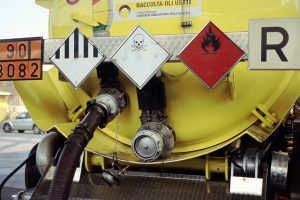
The European Commission has published Delegated Directive (EU) 2025/1801 in the Official Journal of the European Union of 13 October 2025, updating the regulatory framework for roadside checks on the transport of dangerous goods under the ADR regime. The measure, adopted on 23 June 2025, amends Annexes I and II to Directive (EU) 2022/1999, introducing a new inspection checklist and a revised classification of risk categories for infringements. The Commission aims to strengthen the consistency and transparency of ADR checks across the European Union, raising safety levels throughout the logistics chain. The measure incorporates the periodic technical updates to the ADR system and the recommendations of the United Nations Committee of Experts on the Transport of Dangerous Goods.
The main operational change is the introduction of a harmonised checklist for roadside inspections, which will become mandatory for all national enforcement authorities from 24 June 2026. The document, annexed to the Directive, sets out the criteria for checking the compliance of ADR vehicles, tanks and containers, the presence and validity of approval certificates, the accuracy of transport documentation and the provision of onboard safety equipment. Each item on the list is linked to a specific ADR reference, ensuring uniform application across Member States and reducing the differences in interpretation that have previously created unequal conditions for companies operating in several national markets.
The other structural change introduced by the Directive concerns the redefinition of risk categories for infringements, now divided into three levels. Category I covers infringements that require the immediate administrative immobilisation of the vehicle, including the leakage of dangerous substances, the absence of mandatory documentation or the driver’s ADR certificate, as well as events involving a high risk of death, serious injury or significant environmental damage. Category II includes intermediate-level infringements, such as non-functioning fire extinguishers or incorrect markings, which require immediate correction, as well as events involving a risk of injury or environmental damage. Category III covers minor or formal errors that may be corrected at a later stage, corresponding to events with a low risk of injury or limited environmental impact.
The Directive also strengthens the tracking of responsibilities along the logistics chain. The text explicitly refers to the roles of consignor, carrier, consignee, loader, packer, filler, tank operator and unloader, assigning each party the duty to verify compliance with ADR provisions. This clarification reduces the areas of interpretative ambiguity that have previously made it difficult to allocate responsibility in cases of non-compliance, and aims to make all parties in the supply chain accountable, not only the carrier physically transporting the goods.
Directive 2025/1801 requires all mandatory documents, including training certificates, vehicle approvals and ADR written instructions, to be kept in the driver’s cab and made immediately available for inspection. Digital documentation is permitted only where rapid and verifiable access is guaranteed, in line with the practices defined by ADR. The absence or irregularity of these documents may lead to the immobilisation of the vehicle and administrative or criminal penalties. The measure also takes account of the updates introduced by ADR 2025, including new UN numbers and revised danger thresholds for certain goods, such as lithium batteries, lead compounds and metal waste. The updated tables, published in the annexes to the Directive, reflect alignment with both the ADR system and Unece recommendations.
For transport and logistics companies, the Directive requires adjustments to internal procedures and training programmes. Companies will need to check whether the materials they handle fall within the new risk classes, update documentation and operating instructions, and ensure that staff hold up-to-date ADR certifications. They will also need to reassess the requirement to appoint an ADR safety adviser in light of the new thresholds and exemptions provided for by the Directive.
Pietro Rossoni