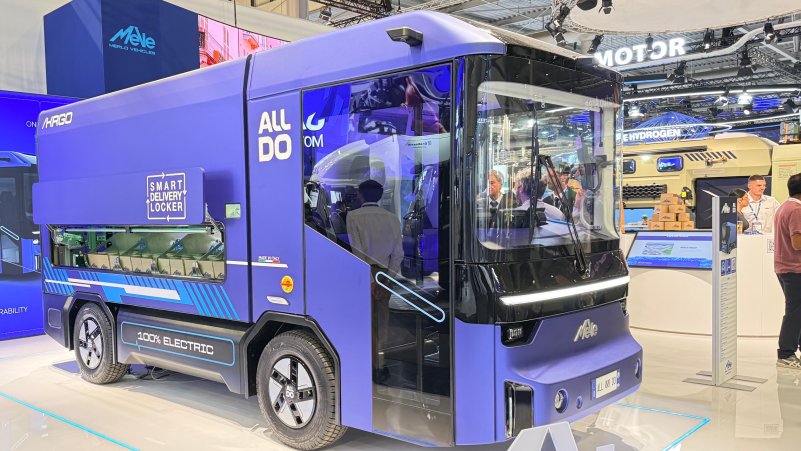



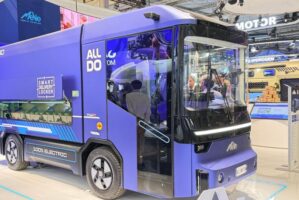
Lidl Deutschland and Einride launched a trial distribution service on 15 September 2026 in Edermünde, Hesse, using a Level 4 autonomous electric truck with no cab. This means there is no safety operator on board, as is generally the case in such trials. The project has been authorised by the Kba (German Federal Motor Transport Authority), the federal authority responsible for vehicle type approval, marking the first time in Germany that a fully autonomous vehicle without anyone on board has received such approval. The vehicle is the Einride Pod, designed from the outset without a driver's cab, and is being used to transport goods from Lidl's distribution centre in the Kassel area to a nearby store as part of routine replenishment operations. The truck can carry 15 Euro pallets and make up to three trips a day, covering the supermarket's entire dry-goods requirements. During the four-month trial, Lidl expects to move more than 3,000 pallets.
Germany has had a regulatory framework for Level 4 autonomous driving since 2021, and similar trials have already taken place, but never on public roads with cabless vehicles making daily journeys. This does not mean, however, that there is no human oversight. Germany's road traffic law, amended on 28 July 2021, allows an autonomous vehicle to perform the driving task without a driver, but only within a locally and geographically defined area of public roads. The legislation also requires external technical supervision by a person who can deactivate the vehicle, authorise certain manoeuvres and manage hazardous situations without being physically on board. In the event of a malfunction, the vehicle must be able to reach a minimal-risk condition autonomously, stopping in the safest possible way and activating its hazard warning lights.
For Lidl and the Schwarz Group, the project is also a test of scalability. Lidl Deutschland has 39 logistics platforms and more than 3,250 stores, and if the Edermünde trial produces positive results, the company plans a second phase at another facility using a multi-drop model, known as a milk run. Lidl says its reasons for using fully autonomous distribution vehicles include driver shortages on some repetitive routes, greater operational predictability on routes with known demand and decarbonisation, as the vehicle used is electric.