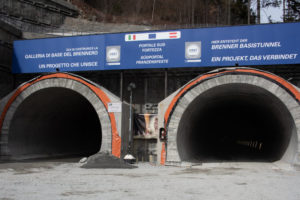
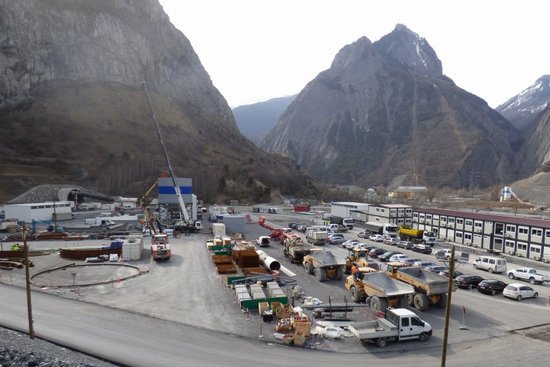








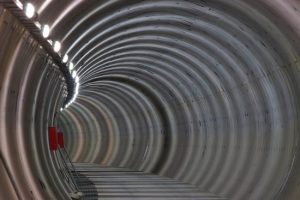
The Brenner Base Tunnel will enter service in 2034, two years later than the previous target, with a whole-life cost of €11.73 billion. The announcement came on 21 October 2026 from BBT, the Italian-Austrian company building the tunnel, following the completion of the railway systems design and a review of the project timetable and costs. The final design dates back to 2008 and must now take account of technological developments and new safety regulations. Experience gained from the Gotthard Base Tunnel has also prompted a decision to convert the exploratory tunnel, the project's third tunnel, into a service tunnel. Much of the railway equipment originally intended for the two running tunnels will be relocated there. According to BBT, this will reduce exposure to dust and other risk factors, allowing most preventive maintenance to be carried out without disrupting rail traffic. Maintenance teams will be able to use road vehicles inside the service tunnel.
Under BBT's revised timetable, construction will be completed in 2033, with testing, trial operations, statutory approvals and ancillary works not required for operation scheduled for 2034. The aim is to bring into service a system that complies with EU regulations and is coordinated between Italy and Austria. The project has also faced difficulties arising from differences between Italian and Austrian regulations, particularly concerning signalling and procurement procedures.
The latest postponement follows a series of previous delays. Initial forecasts envisaged an opening between 2015 and 2016, and as late as 2005 the tunnel was still expected to enter service in 2015. In 2011, when the main construction phase began, the European Commission referred to completion by the end of 2025, while in 2019 the opening date was set for 2028. In May 2021, BBT's Supervisory Board acknowledged a delay caused by the suspension of work on the Pfons-Brenner construction lot following a dispute with the contractor consortium. It subsequently set 2031 as the target for completing construction, with operations beginning in 2032 in the best-case scenario and 2034 in the worst. Compared with the 2028 target announced in 2019, the opening has therefore slipped by six years.
Costs have also risen steadily, although the various estimates are not directly comparable because they use different reference years for prices and include different cost items. In 2009, an estimate put the cost at €6 billion at 2006 prices. In 2011, the European Commission reported an agreed total cost of €8 billion, including risk provisions. In 2019, BBT estimated the base cost at €7.8 billion at 2017 prices and the overall cost at €8.384 billion, including risks and projected price adjustments through to 2028. In 2023, the whole-life cost was revised to €10.5 billion, comprising €8.54 billion in base costs, including railway systems, €1.092 billion in risk provisions and €903 million for anticipated inflation adjustments. In August, the Cipess (Interministerial Committee for Economic Planning and Sustainable Development) approved a spending ceiling of approximately €10.5 billion, of which around €5.3 billion was attributable to Italy. The €11.73 billion estimate announced in October exceeds that ceiling by approximately €1.2 billion. BBT's press release attributes the increase to three factors: modifications to the civil engineering works to accommodate the service tunnel and the extended construction timetable, railway systems upgrades required by new safety regulations, and inflation.
Antonio Illariuzzi