








Between 20 and 21 January 2026, the severe weather associated with the Mediterranean cyclone Harry hit Sicily, Calabria and Sardinia with particular intensity, heavily affecting road networks, rail connections, maritime transport and the airport system. The event combined sirocco gusts of up to 120 kilometres per hour, storm surges with waves reaching ten metres and exceptional rainfall, with local accumulations exceeding 300 millimetres. Operationally, the impact translated into service suspensions, precautionary closures, safety-related restrictions and a prolonged recovery phase affecting coastal infrastructure and logistics nodes. No fatalities were recorded in Italy, but the toll included the evacuation of around 190 people in Sicily and about 150 in Sardinia, as well as damage estimated at more than €500 million in Sicily alone, according to statements by the president of the Region.
The overall picture was one of a “multimodal” shutdown: rail traffic halted at several strategic nodes and lines, near-total suspension of links to minor islands, port operations closed or slowed with vessels forced to remain at anchor, severe flight irregularities due to crosswinds and safety procedures, and loss of continuity on main road corridors caused by landslides, flooding and fallen trees. Operational management followed a precautionary approach, with extensive restrictions imposed to protect staff, users and equipment, and a gradual easing of critical issues during the latter part of 21 January, while closures and safety works remain in place on the most exposed sections.
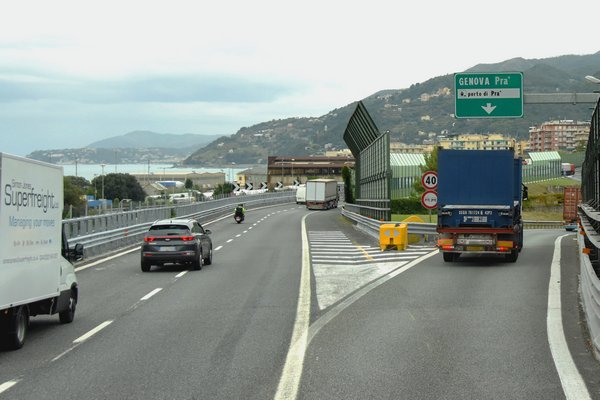
The road network was the most heavily affected infrastructure in terms of the number of interruption points, with closures due to flooding, landslides, waterlogging and fallen trees, alongside parallel restoration works on multiple arteries. In Sicily, the most serious issues were concentrated along the SS 114, with three separate interruptions caused by flooding of the Agrò river and landslides between Messina, Sant’Alessio Siculo and Giardini Naxos. This directly affected continuity along the Ionian coastal corridor and routing between the Messina, Catania and Siracusa areas. The SS 288 was closed due to a landslide inland, while in the province of Siracusa several coastal roads were closed for safety reasons near industrial plants and areas, with practical consequences for vehicle routing and access times.
In Calabria, closures on the SS 106, a key artery along the Ionian coast, had an immediate impact given the limited availability of alternative routes. Between Bianco and other sections, flooding and fallen trees caused stoppages and delays that affected local traffic and freight transport. Other state roads and mountain links were also blocked by fallen trees and flooding, extending the impact to cross-connections and access routes to smaller towns and productive areas.
In Sardinia, the most acute issue concerned the SS 195 Sulcitana between Cagliari and Capoterra, closed in both directions after seawater, debris and damage affected the carriageway along the coastal section. Such events require initial clearance and debris removal, followed by structural inspections and finally restoration and safety works, with timelines dependent not only on the end of the bad weather but also on inspection outcomes. Other routes also experienced temporary closures, but the Cagliari area represented the point of greatest pressure, consistent with hydraulic alerts and the combination of storm surge and intense rainfall.
Rail transport suffered its most severe consequences in Sicily on 20 January, when Catania central station was hit by storm surges and the control infrastructure was compromised, making traffic management impossible. This led to the cancellation of arriving and departing services at the Etna hub and suspensions on routes supporting mobility in eastern Sicily and internal connections. Lines affected by stoppages and major service reductions included Messina–Catania–Siracusa, Acireale–Siracusa, Palermo–Catania, Siracusa–Caltanissetta and Catania–Caltagirone. On 21 January, with alerts still high in some areas, traffic remained suspended on the Messina–Catania–Siracusa and Catania–Caltanissetta Xirbi lines, underlining that the issues were not only meteorological but also infrastructural, with technical time required for inspections and debris removal near coastal sections.
In Calabria, rail impacts were concentrated mainly along the Ionian corridor, where reduced services affected both regional and long-distance connections. On 20 January, the Reggio Calabria–Catanzaro Lido and Lamezia Terme–Catanzaro Lido lines saw significant cutbacks, as did the Catanzaro Lido–Taranto and Paola–Reggio Calabria via Tropea routes, with delays exceeding 60 minutes, route diversions and cancellations. Bus replacement services were introduced to ensure minimum continuity for local flows through intermediate stations and towns, but capacity was inevitably limited compared with normal volumes, particularly during peak demand periods.
In Sardinia, the rail system returned to near-normal conditions more quickly on 21 January, although at least one residual issue remained on the Cagliari–Elmas line, which stayed closed as safety measures linked to hydraulic alerts and the management of urban and school traffic were extended. The island showed a pattern in which the primary impact fell on the road network and coastal areas, with rail less affected than in eastern Sicily.
Maritime transport came closest to a general suspension in terms of territorial continuity with Sicily’s minor islands. Between 19 and 21 January, the Aeolian Islands were largely isolated, with hydrofoils halted and ferry services reduced and dependent on narrow weather and sea-condition windows, with departures and arrivals subject to safety assessments. In the Egadi Islands, cancellations affected multiple time slots between 20 and 21 January, while Pantelleria and the Pelagie Islands experienced cancellations of both inbound and outbound services over several consecutive days, with immediate effects on supplies and essential mobility. From a logistics perspective, the halt of fast services and sharp reduction in ordinary ones led to delays in the delivery of high-frequency goods, accumulation of cargo at embarkation ports and the need to reschedule local distribution chains, particularly for foodstuffs and fast-moving supplies.
Within the Sicilian maritime context, the Strait of Messina was an exception, with ferry services between Villa San Giovanni and Messina remaining regular, albeit with potential operational reorganisation. This helped mitigate the risk of Sicily being isolated from the mainland for ro-ro flows and combined road–sea transport chains, although it did not offset internal disruptions on the island or the isolation of minor islands.
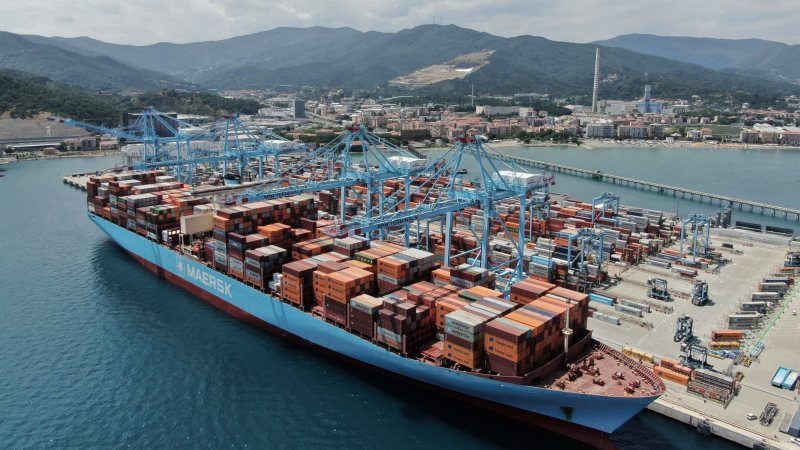
On the port side, the most significant case was the port of Gioia Tauro, shut down from the evening of 19 January due to winds incompatible with crane operations. The suspension triggered a cascade effect, with vessels unmooring and remaining at anchor, loading and unloading sequences slowed and operational delays accumulating, affecting subsequent berthing windows and scheduled land connections. Resumption was assessed only on the evening of 20 January, when conditions allowed an initial return towards normality, but with the need to realign shifts, yards and stowage plans.
In Calabria, in addition to Gioia Tauro, port closure orders affected smaller ports, with bans on inbound and outbound navigation and restricted access to quays, piers and yards. These measures aimed to reduce risks to people and equipment during the most intense phases of storm surge and wind, but they also froze local activities linked to small-scale handling and short-range maritime services.
In Sicily, the port of Catania suffered damage with the sinking of a fishing vessel, while in Siracusa, in the area of the Porto Piccolo of Ortigia, the destruction of floating pontoons and debris dispersed at sea created additional risks for navigation safety and recovery operations, requiring clean-up and inspections before full resumption. In other ports and landings, the closure of port areas served to contain risk, but at an inevitable operational cost in terms of stoppages and rescheduling.
Air transport experienced severe irregularity, particularly in Sicily and Calabria, with diversions and cancellations linked to wind conditions and safety procedures. In Catania, airport space was reorganised with the precautionary closure of one terminal on 19 and 20 January and operations concentrated in a single area, a decision typically aimed at minimising risk exposure and management complexity during such events. In Palermo, repeated failed landing attempts and diversions to other airports highlighted the impact of sirocco winds on the ability to absorb inbound flights, with immediate effects on aircraft rotation and departure punctuality on the morning of 20 January, when several flights were cancelled due to the unavailability of aircraft left elsewhere.
In Calabria, Reggio Calabria airport recorded diversions and cancellations on domestic routes, with a typical operational case of wind and turbulence in which a flight carried out holding patterns and approach attempts before diverting to an alternate airport. Pantelleria saw flights cancelled, and Comiso also experienced disruption, outlining a scenario in which the meteorological event reduced the resilience of the entire regional airport system and its short-term recovery capacity, particularly when multiple airports within the same macro-area are affected simultaneously.
Beyond individual disruptions, the event left a visible infrastructural legacy along the coastlines, with seafronts and protective works damaged in several locations. In eastern Sicily, flooding and erosion affected urban and peri-urban sections, with local collapses and loss of roadbed in some areas, conditions that require prolonged traffic restrictions and consolidation works before full restoration. In Sardinia, the Cagliari coastline recorded marine intrusion and damage to facilities and structures, while in Calabria the coastal strip in the Crotone area saw accumulations of sand and debris damaging street furniture and seafront structures. Although not always directly linked to primary freight corridors, these factors affect urban accessibility and secondary routes.
From a logistics perspective, the temporary shutdown of a major container port, the isolation of minor islands and simultaneous rail and road disruptions across large parts of Sicily and Calabria led to longer transit times, build-ups at origin and destination points and reduced short-term recovery capacity. In island contexts, the effect is amplified because territorial continuity is a structural factor: when services are cancelled for several days, supply chains become more fragile and backlogs must be cleared within narrow operational windows, often prioritising essential cargo.
Pietro Rossoni