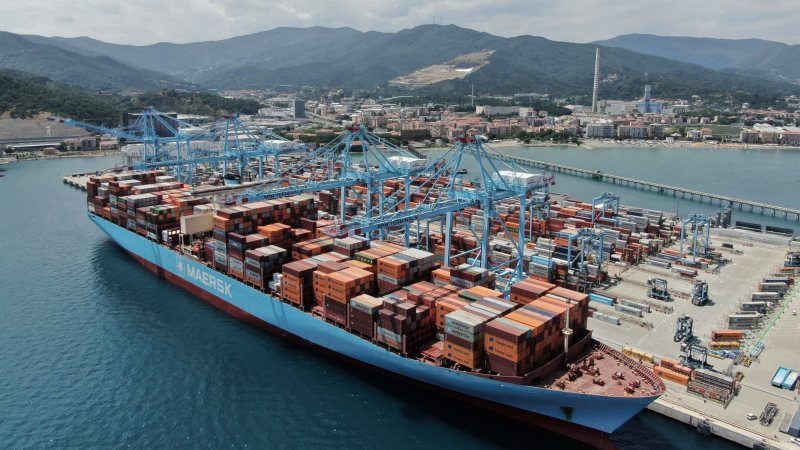







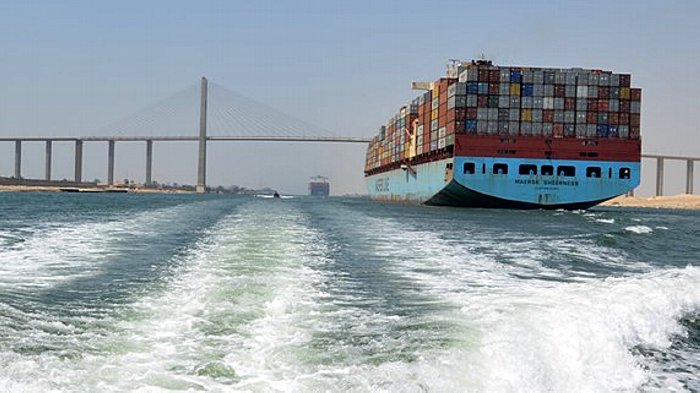
While the Strait of Hormuz remains largely blocked, the southern gateway to the Suez Canal, the Bab el-Mandeb Strait, seems gradually to be opening up. In late August, MSC joined CMA CGM, Maersk and Hapag-Lloyd in gradually bringing container ships travelling between Asia and Europe back to this route, partly reversing the diversion around the Cape of Good Hope introduced in late 2023 after the Houthi attacks. On 24 August 2026, the Italian-Swiss carrier informed customers that it would reinstate five sailings across four east-west services, Jade and Tiger between Asia and the Mediterranean, Albatros between Asia and northern Europe, and Himalaya between the Indian subcontinent and the Mediterranean, following a "thorough review of safety and operational conditions" in the area. The first container ships heading towards Suez will be MSC Michel Cappellini, MSC Josefina, MSC Beryl, MSC Anna and MSC Tina.
The other three major global carriers are also returning to Suez, although at different speeds. CMA CGM is the boldest: according to the Suez Canal Authority, it has sent 199 ships through the canal since the start of 2026, with a net tonnage of 25.2 million tonnes, compared with 212 ships and 18.8 million tonnes for the whole of 2025. Maersk is more cautious, with 11 weekly transits in both directions, according to Linerlytica data. Chief executive Vincent Clerc said that "the conditions for a full return have been met", putting Asia-Europe volumes already back on the shorter route at around one third. Hapag-Lloyd is more cautious still, taking part in the return to Suez through some Gemini services shared with Maersk, while Linerlytica did not attribute any independent transits to the carrier in the three weeks before the end of August.
In the risk area, which includes the southern Red Sea and the Bab el-Mandeb Strait between Yemen, Djibouti and Eritrea, Lloyd's List Intelligence recorded 223 traceable transits between 10 and 16 August, rising to at least 252 when ships without an active identifying signal are included. This was nevertheless unchanged from the previous week. In the Suez Canal, transits in the four weeks between 20 July and 16 August totalled 1,088, compared with 1,070 in the previous four weeks. This is the highest level since January 2024, but still 41% below pre-crisis levels. On the Asia-Europe trade, Sea-Intelligence estimates that 19% of capacity is now routed via the canal.
The return to Suez is being driven more by a shortage of vessel capacity than by any firm perception of security. Linerlytica calculates that, at the end of August, 4.31 million TEU were waiting for berths at ports worldwide, exceeding the previous peak of 4 million reached in 2022 during the post-pandemic surge. As a share of the total fleet, this equates to 12.6% of capacity, estimated at 34.4 million TEU. That is lower than the 15.7% reached in 2022, when the fleet stood at 25.3 million TEU. Typhoons in east Asia have worsened congestion at major Chinese ports, while the circumnavigation of Africa lengthens vessel cycles, reducing the margin for absorbing delays and forcing carriers to deploy more ships to maintain the same weekly frequencies.
The impact on freight rates depends on overall TEU-miles. Sea-Intelligence calculates that a full return of head-haul services would reduce growth in global demand measured in TEU-miles by 8.7% year on year in the first half of 2027, against estimated physical demand growth of 6.6%. With only 19% of capacity already back, growth would fall to 3.8%, while a return of 50% of services would turn it into a contraction of 1.1%. Lars Jensen, chief executive of consultancy Vespucci Maritime, described the current pace as consistent with "normalisation by the end of 2026", noting that MSC's return completes the presence on the canal of the three main alliances: Gemini, formed by Maersk and Hapag-Lloyd; Ocean Alliance, formed by CMA CGM and Cosco; and Premier Alliance, formed by ONE, HMM and Yang Ming, the latter through capacity-sharing agreements with MSC.
But the risk remains relatively high. The Joint Maritime Information Center continues to classify the risk to commercial shipping as substantial, pointing to greater exposure for vessels linked to Saudi Arabia, as threatened by the Houthis. MSC has therefore structured its return around three safeguards: the assessment of safety and operational conditions, a gradual service-by-service approach, and contingency plans allowing a single rotation to be moved back via the Cape if the situation deteriorates. This caution also reflects the fact that the carrier has previously been described by the Houthis and Iran as linked to Israel, with its ships attacked even outside the Red Sea, near Djibouti and in the Gulf of Aden. The European naval mission EUNAVFOR Aspides remains active, with its mandate extended to early 2027. Since its launch in February 2024, it has assisted more than 2,390 merchant ships and provided close protection to more than 720.
For European ports, freight forwarders and shippers, the effects remain mixed. Shorter transit times and greater availability of empty containers are the most immediate benefits, but uncertainty remains over the possible concentration of arrivals at European and Mediterranean terminals if more services return to Suez within a short period. Greater effective capacity and the reduction in overall TEU-miles will also tend to put pressure on freight rates, with the impact depending on carrier discipline in managing sailings. There will also be consequences for the Mediterranean transhipment ports of Gioia Tauro, Malta, Algeciras, Tanger Med and Port Said, which will have to adjust to a different rhythm of arrivals compared with Cape routings.
M.L.