





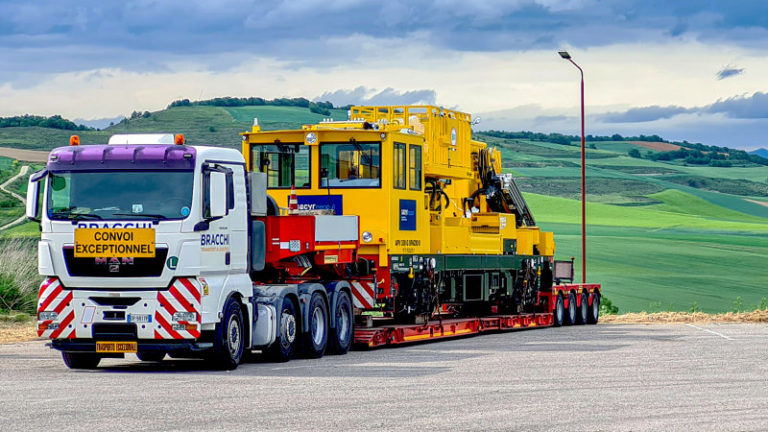
Imagine an exceptional convoy leaving a plant in Bergamo with an oversize agricultural machine bound for a port in Northern Europe. The driver takes the Brenner motorway, crosses Austria and southern Germany, heads north towards Hamburg and then turns east along the Baltic coast to Rostock. It is a journey that requires special permits, coordination with road authorities in three countries, escort vehicles and a chain of local subcontractors with whom trust has to be built over time. Today, that convoy could be managed by a single group: Bracchi, based in Grassobbio, in the province of Bergamo (Italy), which over the past two years has completed two strategic acquisitions to become one of the few European operators able to cover the entire route from Italy to the Baltic in heavy and specialised transport.
Behind this transformation is Argos Wityu, a Paris-based private equity fund active across European markets, and in particular its vehicle dedicated to the decarbonisation of small and medium-sized enterprises: Argos Climate Action. The fund was created with a clear investment thesis that could be described as “Grey to Green”: identifying European companies operating in emissions-intensive sectors, known in English as hard-to-abate, and supporting their transition towards cleaner production and logistics models. Argos Climate Action has chosen as its benchmark a reduction in CO2 intensity of at least 7.5% a year across its portfolio companies, with part of the investment team’s incentives directly linked to the environmental results achieved. This is therefore not a fund that applies ESG criteria as a reputational framework: decarbonisation is structurally embedded in its return logic.
Bracchi was the fund’s first investment. In 2023, Argos Climate Action acquired a majority stake in the Bergamo-based group, an operator with roots in local transport that over the decades has become a European specialist in complex logistics. Bracchi’s story is that of many manufacturing and services companies in northern Italy: founded to meet a local need, it grew through specialisation in niche segments requiring technical expertise that is difficult to replicate. The group’s main activities include the transport of lifts and escalators, large agricultural machinery, industrial project cargo and integrated logistics for sectors with high technical complexity. These are loads that cannot be handled through mass transport: they require special vehicles, authorisations, route planning and often coordination with final installation. This specialisation has made Bracchi a natural supplier for leading Italian and European manufacturers of plants, machinery and infrastructure.
Choosing Bracchi as Argos Climate Action’s first portfolio company reflects an industrial logic consistent with the fund’s thesis. A niche operator with industrial customers, established technical expertise and a presence already spread across several European markets is the best starting point for building a consolidation platform in European road transport, a historically fragmented market dominated by regional operators and squeezed margins. The idea is the so-called progressive acquisition model: building a larger group by bringing together businesses that complement each other in geography, specialisation and operational capacity, while also integrating a structured emissions reduction plan.
The first element of this strategy came in 2024 with the acquisition of the entire share capital of Mateco. An Italian operator specialising in exceptional transport above 100 tonnes, Mateco enabled Bracchi to establish itself as Italy’s leading operator in heavy transport, or heavy-haul. The deal expanded the scope of the markets served, particularly in the electromechanical sector, which is growing as a result of the energy and industrial transitions, and brought fleets, commercial relationships and specific technical expertise for the most complex transport operations. Operational synergies between the two companies concern both fleet rationalisation and the ability to offer customers broader coverage in terms of load types and geographical destinations.
The second element is the acquisition of Rostock Trans, a German logistics operator active in the port city of Rostock, on the Baltic Sea coast in northern Germany. The choice is no coincidence from a geographical standpoint: Rostock is one of Northern Europe’s main maritime hubs, a key gateway for freight flows linking Scandinavia, the Baltic countries and the wider Baltic basin with the heart of the continent. By integrating an operator rooted in this node, Bracchi gains not only a physical presence in Germany but also the ability to manage multimodal flows, combining road transport and port handling for project cargo contracts that cross the European Union from north to south. The deal strengthens the group’s ability to cover complex routes connecting the industrial areas of northern Italy, central Europe and the Rhine basin with northern maritime gateways, a corridor of direct interest to many Italian manufacturers exporting machinery and plants to Scandinavian and eastern European markets.
With these two acquisitions, Bracchi has reached total turnover of about €240 million, consolidating its profile as a mid-sized European company in heavy transport and specialised logistics. The group now operates across several countries, with sites in Italy, where Grassobbio remains its operational centre of gravity and management headquarters, and a structured presence in Germany. The sectors served range from plant engineering to agriculture, and from electromechanics to heavy manufacturing, with a customer base made up mainly of large industrial groups seeking logistics partners able to manage transport, storage and delivery coordination for project-based contracts in an integrated way.
The model Argos Climate Action is applying through Bracchi is structured around two parallel levels of integration. The first is industrial: bringing together complementary companies to create economies of scale, rationalise fleets, unify information systems and build a commercial network able to offer customers end-to-end solutions that none of the regional operators could provide on their own. The second is environmental: introducing structured processes in each acquired company to measure and reduce emissions throughout the logistics chain, from direct vehicle emissions (Scope 1) to indirect emissions linked to energy consumption (Scope 2), and those generated across the entire supplier and subcontractor chain (Scope 3).
The implications of this strategy for the European road transport market are significant. The sector has historically consisted of a galaxy of regional and national operators, often family-run, with limited individual investment capacity and little presence beyond their home country’s borders. The arrival of private equity funds with an active consolidation thesis tends to redraw the competitive structure quickly: a small number of operators with critical mass, greater investment capacity, integrated tracking systems and ESG reporting begin to set the terms for the supply chains of large industrial customers. EU regulatory pressure and growing demands from shippers to report Scope 3 emissions across their supply chains are accelerating this dynamic: large industrial customers prefer to work with a limited number of logistics providers able to supply certified emissions data, rather than manage dozens of local operators without reporting tools.
There are challenges, however. Integrating businesses with different corporate cultures, operating systems and management styles has historically been the critical point in any progressive acquisition strategy, particularly in labour-intensive sectors where service quality depends largely on people. European road haulage is also facing a structural shortage of qualified drivers, with the average age of the workforce steadily rising and companies struggling to bring in younger replacements. Decarbonising heavy fleets requires substantial capital investment and depends on the availability of refuelling infrastructure for alternative fuels, such as hydrogen, liquefied natural gas and electric charging, which remains scarce along Europe’s main routes. These structural constraints could slow the pace of integration and squeeze operating margins in the short term.
In the coming years, it will be worth watching whether and how Bracchi continues its geographical expansion, particularly towards central and eastern Europe, where industrial road transport is growing and operator fragmentation remains pronounced. Another possible direction is the strengthening of logistics chains linked to energy and renewable energy infrastructure: the installation of wind turbines, the transport of large photovoltaic modules and logistics for major infrastructure sites are fast-growing segments that require precisely the technical expertise and project-management capability in which Bracchi specialises.
Pietro Rossoni