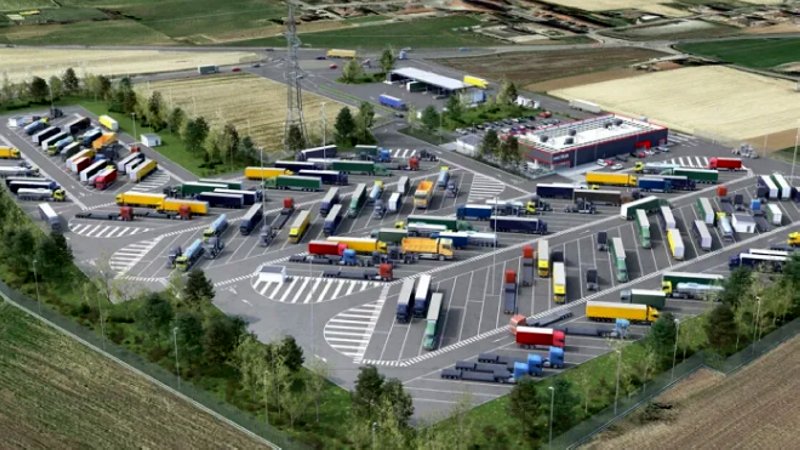








Even in 2024, certain industrial vehicle rest areas were utilised by international transport companies as parking spots during the Christmas holidays, while drivers were transported back to their home countries. This was evidenced by the Belgian union Btv-Abvv through a survey conducted at around 40 parking areas nationwide. According to the news portal Pitane.blue, the union discovered dozens of foreign trucks—mostly with plates from Eastern Europe and Portugal—left idle for several days as their drivers returned home for the holidays.
Tom Peeters, the union’s deputy secretary, stated that many of these trucks are used for freight transport by Belgian companies that employ foreign drivers to avoid paying the higher wages required for Belgian drivers. This, the union claims, constitutes social dumping. It further highlighted that some foreign drivers remain abroad for extended periods—up to 50 weeks per year—sometimes even spending their weekly rest breaks in the vehicle.
Frank Moreels, president of Btv-Abvv, has called on Belgian authorities, particularly the Social Inspection Service (Siod), to enforce stricter controls on national and EU regulations regarding cabotage and driving and rest times. The union’s dossier shows that the “Christmas parking” phenomenon affects both public rest areas and private yards of Belgian transport companies. It is worth noting that leaving a vehicle in a foreign country is no longer considered a violation following a European Court of Justice ruling that mandates only the return of the driver. However, the union views this as a sign of social dumping, which remains an irregular practice.
The issue of “Christmas parking” is not limited to Belgium. Investigations by other European unions, such as the European Transport Workers’ Federation (ETF), have identified similar practices in other countries. The ETF has previously reported cases involving drivers from Central Asia working under exploitative conditions within the European Union. A report by the Dutch foundation Rtdd, which advocates for improved working conditions for drivers, has documented the precarious employment of these workers, often with wages below European standards.
The prevalence of such social dumping practices has prompted both the International Road Transport Union (IRU) and ETF to issue a joint declaration committing to collaboration aimed at improving the working conditions of third-country drivers operating within the EU. Additionally, the European Trade Union Confederation (ETUC) has launched a research project on “shell companies” to better understand the issue and develop concrete recommendations to combat it. This project, involving several European trade union federations, seeks to document the practical consequences of using such fictitious companies and to propose solutions ensuring workers’ rights and fair competition in the transport sector.