





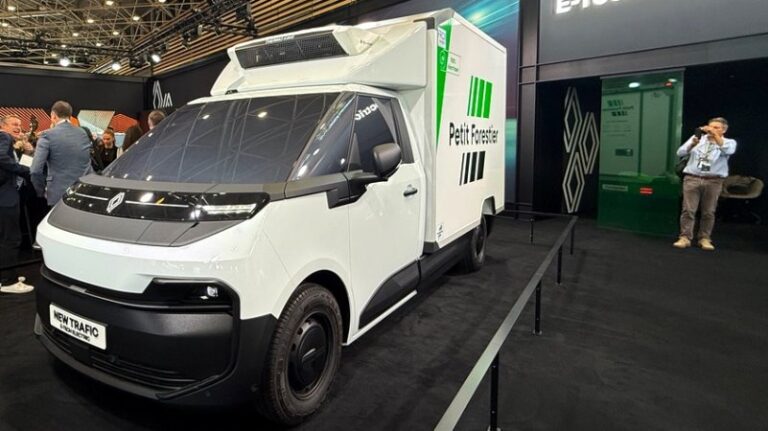
Renault chose Solutrans 2025 to present the new Trafic Van E-Tech Electric, the French manufacturer’s first commercial vehicle designed as a Software Defined Vehicle and built on Ampere technology. Sales are scheduled to start at the end of 2026. The project has been developed to meet the needs of urban distribution, supported by the new 800-volt electrical architecture that enables fast charging and a declared range of up to 450 km on the WLTP cycle, enough to cover an entire working day without intermediate charging during the most demanding city operations.
According to the information released in Lyon, the vehicle uses a new-generation skateboard platform that optimises the ratio between exterior dimensions and load capacity. The height of 1.90 metres facilitates access to underground car parks, while volumes between 5.1 and 5.8 cubic metres support the flows typical of e-commerce and multi-stop delivery routes. The rear motor and short front overhang contribute to a turning circle of 10.3 metres, close to that of a compact car and suited to manoeuvring in congested areas or historic centres.
The exterior design introduces a new language for Renault’s professional range: a front end with illuminated lozenge, LED headlights and linear surfaces that improve visibility. Black plastic protection elements and laser-etched detailing aim to reinforce the perception of robustness, while at the rear a dedicated three-dimensional light signature for commercial vehicles makes its debut.
The cabin focuses on functionality and operational management. The completely redesigned dashboard integrates a 10-inch digital instrument cluster and a 12-inch central screen with the OpenR multimedia system and Google services. Storage spaces are abundant, including a shelf made of recycled material visible from the outside, designed for operators who require quick-access solutions for documents, scanners or work tools. Renault notes that more than 23 per cent of components come from the circular economy, with recycled plastics exceeding 15 per cent.
The range includes two batteries. The Comfort Range version uses NMC cells and reaches a declared maximum range of 450 km, while the Urban Range adopts an LFP chemistry, free of rare metals, offering around 350 km and targeted primarily at urban missions. Charging from 15 to 80 per cent takes around twenty minutes thanks to the 800-volt architecture, a useful feature for making the most of short stops at city depots. The 150 kW, 345 Nm motor enables a towing capacity of up to two tonnes, a relevant figure for service activities requiring additional equipment.
The model introduces V2L and V2G functions that allow the powering of external electrical equipment or the return of energy to the grid, a useful feature for urban assistance work and minor road maintenance. As a Software Defined Vehicle, the new Trafic offers remote updates and predictive maintenance tools, as well as integration with fleet-management systems to monitor consumption, routes and utilisation.
Produced in Sandouville and available for conversions such as dropsides, chassis or flatbeds, the new Trafic Van E-Tech Electric enters a segment increasingly oriented towards the electrification of urban distribution. The balance between compact dimensions, range and rapid charging times is intended to support intensive use in metropolitan areas, where environmental restrictions and efficiency requirements are driving technological progress in goods-transport vehicles.
Massimiliano Barberis