







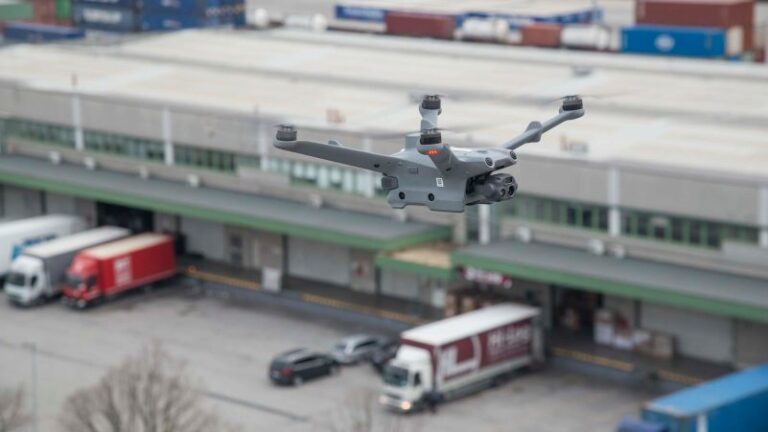
In partnership with the Remotely Piloted Aircraft Systems Academy Cardtech, Interporto Padova has launched a fully automated aerial video surveillance system based on the use of a drone able to operate around the clock. This achievement was made possible by the granting of an Operational Authorisation by ENAC, which culminated in the first official flight mission in June 2025. The authorisation, issued by the Directorate for Innovative Mobility Regulation and Research at ENAC, is the first of its kind in Italy for an inland terminal and marks a significant step towards the operational integration of drones within logistics infrastructure.
The drone is authorised to take off automatically from a robotic hangar installed on the roof of the Interporto Padova headquarters and to fly autonomously over the entire terminal, which covers an area of approximately 350,000 square metres. The whole system is managed remotely via a control room, where a qualified pilot can step in at any time to take direct control of the mission in the event of any irregularities.
The regulatory framework is set out in Commission Implementing Regulation (EU) 2019/947, which governs operations in complex and high-risk scenarios. Specifically, the authorisation falls under the “Specific BVLOS” (Beyond Visual Line of Sight) category, which allows flight beyond the pilot’s visual range, provided that strict safety standards are met and access to the airspace is secure and controlled. ENAC has also required the activation of a surveillance plan for the operation, based on audits and periodic inspections, following the model already applied in the conventional aviation sector.
The drone used for terminal surveillance is capable of autonomously identifying potentially critical situations, such as the presence of people in restricted areas or the early signs of a fire. In such cases, the onboard sensors immediately transmit an alert to the control room pilot, who can then investigate the situation and take direct action. The entire system is an advanced combination of technology, automation and safety, aimed at improving the efficiency and speed of checks in a strategic logistics area such as that of Padua.
Surveillance, however, is just the first step in a much broader project. The collaboration between Interporto Padova and the Remotely Piloted Aircraft Systems Academy Cardtech also includes further developments geared towards the logistics of the future. Among these is the creation of cargo vertiports, small airport-style platforms designed exclusively for the take-off and landing of drones. Unlike conventional airports, these facilities will be compact, have a lower environmental impact and offer greater operational flexibility, making them particularly suitable for urban and regional transport needs.
Another area of experimentation involves the development of intelligent payloads, or cargo containers designed to interact with the drone and provide real-time telematic data on transport, the condition of goods or location. Although the aerial transport of light goods by drone – between 10 and 15 kilograms – is still in its early stages, the growth prospects are considerable, especially in terms of environmental sustainability and emission reduction.