




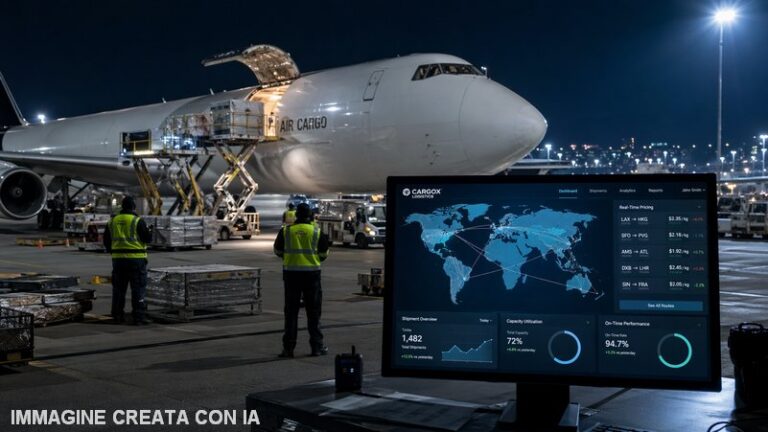
- More than half of Italian air cargo companies have already introduced artificial intelligence solutions or launched pilot projects, according to the survey presented during the eighth Convegno Osservatorio Cargo Aereo (Air Cargo Observatory Conference), organised by Anama (National Association of Air Cargo Agents). That share is expected to rise to 77% over the next three years.
- The phenomenon of "bottom-up" adoption is one of the most significant findings to emerge from the research: more than 70% of operators already use chatbot systems based on generative artificial intelligence, and 39% do so through private accounts, outside official company systems. This figure reveals a widespread urgency that is moving faster than formal management strategies.
- The future of artificial intelligence in air cargo lies not in the automation of jobs, but in commercial optimisation. Some 64% of companies expect to use it to manage rates and invoicing in real time, compared with 31% today. At the same time, 80% of companies say the aim remains to support people, not replace them.
In 2026, Italian air cargo is navigating one of the most complex business environments of recent years. Ongoing conflicts - the Russia-Ukraine war and tensions in the Middle East - international routes that must be recalculated, tariffs between China and the United States, and a European manufacturing sector struggling to regain momentum: these are the factors shaping the operating landscape for Italian freight forwarders, carriers and airport operators. Added to this is the energy variable, with fuel costs rising by 110% in March 2026 alone, further squeezing margins in a sector already under pressure.
It is in this context that artificial intelligence ceases to be a choice and becomes an operational tool. According to the 2026 survey of Italian air cargo companies, presented in April during the eighth Convegno Osservatorio Cargo Aereo organised by Anama, 51% have already introduced artificial intelligence solutions or launched pilot projects. Over the next three years, that share will reach 77%. This is not an optimistic forecast: it is the concrete response of a sector looking to technology as a buffer against external volatility.
Geopolitical instability, which forces companies to continually alter international routes, scores 7.9 out of 10 among risk factors in terms of impact. Fuel and energy costs stand at the same level. For large multinational operators, airport congestion is an additional concern, rated 8.3 out of 10, along with the pressure generated by e-commerce volumes, which scores 7.1 out of 10 for multinationals compared with 6.3 out of 10 for national operators. Artificial intelligence fits into this picture not as a long-term investment, but as an urgent response to the need to manage variability in real time.
One of the most interesting aspects to emerge from the survey concerns the way technological adoption is taking place: not from the top down, but in the opposite direction. More than 70% of respondents already use chatbot systems based on generative artificial intelligence. Of these, 39% do so through private accounts, bypassing official company infrastructure. A further 39% use standard company accounts, while only 20% use internally developed systems. This phenomenon - often described in international debate as informal or ungoverned adoption - reveals a widespread urgency among operators, who are experimenting with available tools even before company management has formalised a strategy.
It is also worth noting a figure that challenges a recurring stereotype about Italy. Although 39% of multinationals have imported solutions already tested abroad, future projections point to a clear balance: 44% of pilot projects will originate abroad and 44% directly in Italy. The country is not structurally behind, but is instead in a phase of alignment.
As for practical applications, the current picture is dominated by more operational activities. Managing data exchanges between systems is the most widespread use case, with 42% of companies already using it. Customs and documentation activities follow at 23%. But it is in the future projections that the clearest shift emerges: improving rates and invoicing in real time will rise from the current 31% to 64%, becoming the main area of application. Support for carrier selection - assessing rates and partner reliability - is also expected to grow significantly, from 8% today to 41%. This shift in priorities reflects the sector’s maturation. In the initial phase, artificial intelligence is used to solve day-to-day problems and reduce manual work on repetitive tasks. In the next phase, it becomes a commercial tool: an engine for calculating the right price at the right time in markets that change hour by hour.
In the area of work, the survey presents a picture far removed from the narrative of automated replacement. At present, 85% of artificial intelligence applications affect operational processes, but in 69% of cases the technology is used as a tool to support human operators, not replace them. Looking ahead, this approach becomes more firmly established: 80% of companies say artificial intelligence should support people, keeping humans at the centre of the decision-making process. Some 54% are also aiming for automation, but this mainly concerns standard and repetitive activities, such as the automatic entry of customs codes. The prevailing model, in the sector’s technical terminology, is the "human-in-the-loop" approach: the machine processes, proposes and optimises; the person decides and validates. This is not a fallback option, but a conscious response to the complexity of a sector in which an error in customs classification or the wrong route can have immediate and measurable consequences.
Why, then, is adoption not already more advanced? The answer does not lie in the technology. The enabling factor most frequently cited by companies is access to a large volume of structured data, rated 7.7 out of 10, followed by available computing capacity, at 7.1. But the highest barriers are not technical. Concern over data privacy and security stands at 8.0 out of 10, the highest of all the obstacles identified. The lack of technical standards and clear regulations follows at 7.8. At the same level is the need to understand how the adopted solutions work: companies do not want to rely on systems that produce results without explaining their reasoning. The so-called "black box" generates mistrust, and that mistrust slows investment decisions.
The absence of a stable regulatory framework is seen by respondents as a concrete risk: adopting a solution today that could prove non-compliant with European regulation tomorrow is a real brake on company decision-makers. The European Artificial Intelligence Act has been entering into force progressively, but its operational implications for the logistics sector are not yet fully defined.
One figure deserves critical attention: environmental sustainability. In the charts measuring the expected benefits of adopting artificial intelligence on a scale from 1 to 10, process quality scores 8.2 and service levels 7.7. Improved environmental sustainability ranks last overall: 5.1 in the current situation and 5.9 in future projections. The figure indicates that, at least at this stage, artificial intelligence in air cargo is seen as a tool for economic and operational efficiency, not as a lever to reduce the environmental impact of air freight. In a sector under growing pressure over its contribution to emissions, this priority - or rather, this non-priority - is likely to become a subject of discussion in the coming years.
A.M.B.