





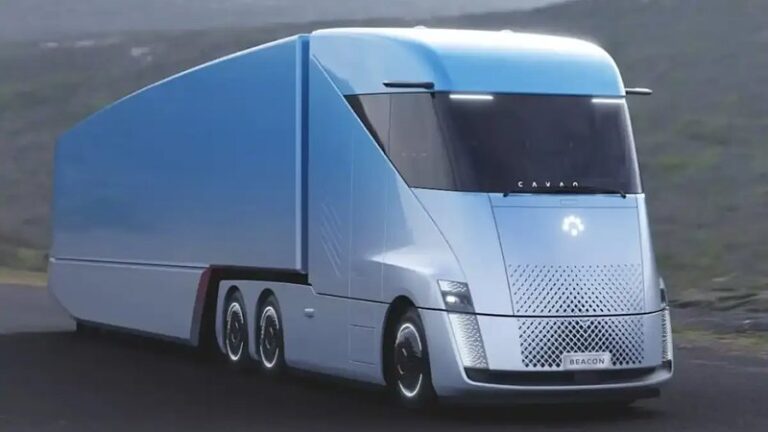
Foton is also part of the large group of Chinese industrial vehicle manufacturers that will use IAA Transportation 2026 in Hanover as a showcase for entering the European market, openly challenging the continent’s “eight sisters”. On 7 September 2026, the Chinese manufacturer, part of the state-owned Baic group, outlined its plan to enter Europe, based on zero-emission industrial vehicles and centred on the Cavan Beacon tractor unit, a model that will make its debut outside China in Germany. The vehicle uses an architecture that can accommodate 800-volt electric battery packs or fuel-cell systems powered by gaseous hydrogen at 70 megapascals, or by liquid hydrogen for long-haul operations. Alongside the Beacon, Foton will display a full range of electric vehicles, with seven models spanning light and medium vans and six proprietary powertrain components.
The European operation will involve three entities. Beiqi Foton Motor is the Baic group company specialising in the design and production of industrial vehicles, and has also overseen its exports for the past 15 years. The Cavan Beacon was developed by the joint venture Cavan Auto, established with initial capital of 500 million yuan, about €64 million, and majority-controlled by Foton with a 63.6% stake. The other shareholders are Robert Bosch Venture Capital, Chinese fuel-cell specialist SinoHytec and several institutional investment funds. Distribution and servicing in Europe will be handled by Foton Motor Germany. For spare parts, Foton will use the logistics platform in Unna, North Rhine-Westphalia, which supplies a declared after-sales network of more than 1,200 sales outlets and 1,500 authorised workshops, with spare parts deliveries guaranteed within 24 hours.
Foton has already obtained European Whole Vehicle Type Approval (WVTA) certification for its light electric commercial vehicles, while its heavy industrial vehicles have received approval for CO2 emissions calculation through Vecto. This gives the Chinese brand the necessary credentials for sales and registration in European Union countries. The Beacon architecture has a modular profile divided into three zones, cab, energy storage and traction, with half of the components shared between the battery-electric configurations, which reach up to 677 kWh of capacity, and the fuel-cell versions, ranging from 200 to 300 kW.
Foton’s European acceleration is driven by two factors. The first is regulatory, thanks to binding EU targets for industrial vehicle emissions, calculated through the Vecto system, which are pushing major logistics operators towards zero-emission solutions, an area in which Asian industry is ahead of its European counterpart in both production and technology. The second is commercial: in the first eight months of 2026, Foton exported a total of 149,000 units, up 44.3% year on year, and operates 32 overseas assembly plants that are already active, mainly in South-East Asia, Latin America and the Middle East. Entry into Europe’s heavy-duty segment represents the group’s final step in its transformation from volume exporter to technology supplier.
The Cavan Beacon is a tractor unit suited to both regional distribution and long-haul transport, thanks to the high flexibility of its powertrain: total energy storage in batteries, or fuel cells using either gaseous or liquid hydrogen. For the first configuration, Foton claims a range of more than 500 kilometres with a 600 kWh battery pack, expandable to 677 kWh, estimated consumption of less than 110 kWh per 100 kilometres and the possibility of high-voltage direct-current fast charging. This solution is designed for regional distribution on fixed routes. The gaseous hydrogen variant, with 70-megapascal cylinders, claims a range of between 600 and 800 kilometres, consumption of about 6.9 kilograms per 100 kilometres and refuelling in 10 to 15 minutes, for medium-range interurban use. The liquid hydrogen configuration, meanwhile, achieves a claimed range of up to 1,100 kilometres, thanks to two vacuum-insulated cryogenic tanks of 650 litres each, containing at least 80 kilograms of hydrogen at minus 253°C. With consumption of about 7.6 kilograms per 100 kilometres and refuelling in about 15 minutes, it is the long-haul variant.
The hydrogen version is fitted with a fuel-cell stack developed in-house by Foton, with an output of 300 kW, efficiency of at least 58% under typical operating conditions and a declared B10 design life of up to 1.6 million kilometres. The electric traction system uses dual-motor electric axles, with combined continuous output of up to 350 kW and overall peaks which, according to the manufacturer’s technical specifications, reach 700 kW, equivalent to about 952 hp. The entire system operates at 800 volts, a choice that the manufacturer says limits thermal losses, reduces cable cross-sections and speeds up charging flows.
The Beacon cab offers a drag coefficient of 0.28, thanks to a wedge-shaped front end without a traditional grille, mirrors replaced by cameras, side flaps and full underbody fairings. Foton claims a 49% reduction in drag compared with traditional tractor units, which should translate into a cut in consumption of about 16%. The modular chassis uses aluminium alloys and ultra-high-strength steels, reducing overall weight by more than 500 kilograms and allowing the 6x4 configuration to come close to the kerb weight of an equivalent diesel tractor unit. The cryogenic liquid hydrogen tank technology, developed in collaboration with the Sixth Academy of the China Aerospace Science and Corporation, claims storage density 10% higher than industry standards.
The Beacon adopts a centralised electronic platform designed for advanced Level 2+ driver assistance systems and autonomous driving on dedicated motorway corridors. The cab has a flat floor, a digital dashboard with multiple horizontal displays, touch and voice controls, and a sleeping area designed to meet long-haul transport standards, including drivers’ rest requirements.
P.R.