







- The Autoridad del Canal de Panamá has postponed the two measures affecting the maximum draft of Neopanamax vessels: the 48-foot limit, equal to 14.63 metres, originally scheduled for 26 August, will now take effect on 2 September, while the 47.5-foot limit, equal to 14.48 metres, has been moved from 3 September to 1 October.
- The tightening of transits has instead been confirmed: from 4 September the Acp will set the limit at 34 vessels a day, with nine slots reserved for Neopanamax vessels and 25 for Panamax vessels; on 15 September the ceiling will fall to 32 units overall, with Panamax slots reduced to 23, compared with a technical capacity of about 40 crossings a day.
- The reason for the measures is the shortage of water in the Canal basin: between May and August rainfall was 34% below the historical average and water inflows fell by 44%, while the Acp fears a stronger and longer-lasting El Niño in 2026-2027 than usual, with consequences for reserves in lakes Gatún and Alhajuela.
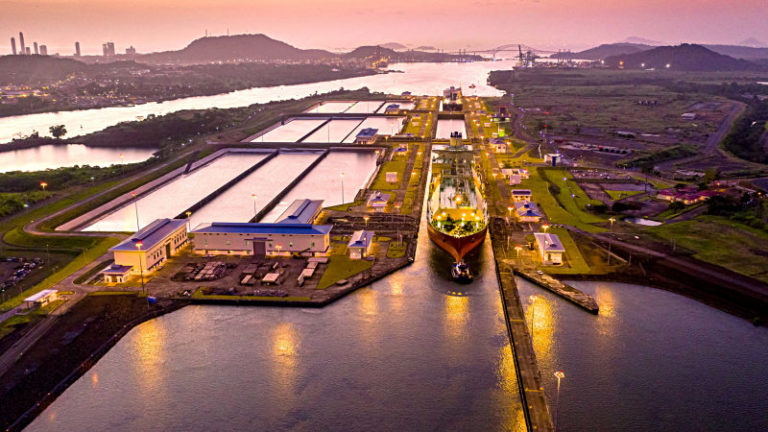
The Autoridad del Canal de Panamá (Panama Canal Authority) has postponed the two measures affecting the maximum draft of Neopanamax vessels, while announcing a reduction in daily transits. More specifically, the 48-foot limit, equal to 14.63 metres, which was due to replace the current threshold from 26 August 2026, will enter into force on 2 September, while the subsequent reduction to 47.5 feet, equal to 14.48 metres, expected on 3 September, has been postponed until 1 October. The reduction in the number of vessels allowed to transit each day remains confirmed, effectively from 4 September. The Acp had initially scheduled the move to 48 feet for 26 August and to 47.5 feet for 3 September.
The draft cut will affect cargo intake because, with less depth available at the locks, a container ship, bulk carrier or tanker must lighten its load or adopt a different voyage rotation plan. The gap between 48 and 47.5 feet is about 15 centimetres, an apparently marginal difference but a significant one for Neopanamax units already optimised in terms of hold capacity and bunker consumption.
The more immediate tightening, however, concerns the number of slots: from 4 September crossings will fall to 34 vessels a day, with nine slots reserved for the Neopanamax locks and 25 for the Panamax locks. From 15 September, the overall ceiling will be lowered further to 32 units, as Panamax slots fall to 23. The system’s technical capacity is around 40 crossings a day, compared with a recent average of about 35 daily transits.
Containers bound for US ports are among the most exposed segments, particularly on the Asia-US East Coast and Asia-US Gulf trades, but the quotas reserved for Neopanamax vessels also involve liquefied natural gas, liquefied petroleum gas, dry bulk, ro-ro ships, refrigerated cargo, tankers and chemical tankers. The Acp has reorganised the slot auction system into four commodity groups, including one specifically for containers, car carrier/ro-ro and refrigerated cargo.
The cause of these measures is the reduced availability of water in the Canal basin. Between May and August, rainfall was 34% below the historical average, while water inflows into the lake system fell by 44% compared with normal levels. The Authority also fears a stronger and longer El Niño in 2026-2027 than usual. The Canal depends on freshwater from the basin, particularly Lake Gatún, both for lock operations and for the population’s drinking water supply. For this reason, the restrictions act together on the number of vessels allowed to transit, the draft authorised at the Neopanamax locks, and the rules governing bookings and auction quotas.
Lake Gatún is not, however, yet at the crisis levels recorded in 2023. As of 21 August 2026, its level stood at 84.1 feet, about 25.63 metres above sea level, around one foot below the historical end-August average for the 1965-2020 period, but still more than four feet above the level recorded on the same date in 2023. The issue is the failure of the water level to recover during the rainy season. For the May-August 2026 hydrological period, the Acp reported cumulative rainfall in the basin 34% below the historical average and inflows into the system’s lakes 44% below normal levels: a gap that reflects a very weak hydrological response. Even when rain falls in some areas of Panama, the water may not fall in the tributary basin of Gatún and Alhajuela, or may not effectively translate into stored reserves. The gap between the decline in rainfall and the fall in actual inflows is also amplified by evaporation, temperature, the spatial distribution of weather events and previous soil and basin conditions.
Lake Alhajuela, the system’s second strategic reservoir, stood at around 239 feet according to readings on 23 August: a relatively more favourable position than in 2023, though not enough to remove the problem. The Acp must manage reserves over a multi-month horizon, taking account of both the lockages required by traffic and the population’s drinking water needs. The key seasonal checkpoint will be November, a crucial month for rebuilding reserves before the dry season. If Gatún and Alhajuela do not recover adequate levels, the system would begin 2027 with a reduced operating margin. It is precisely for this reason that the Acp has already ordered, as a precautionary measure, the reduction of daily transits from 36 to 34 units from 4 September, with a further drop to 32 from 15 September.
Antonio Illariuzzi