





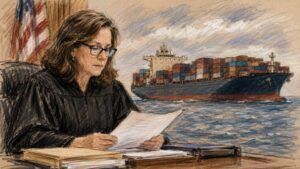
MSC filed a lawsuit on 28 July 2026 with the US District Court for the Southern District of New York against CargoLoop, a US company specialising in the auction and transport of used vehicles, seeking damages for a fire that broke out on board the containership MSC Carlotta in September 2023. According to the carrier’s reconstruction of events, the blaze was allegedly triggered by inadequate packaging of some used electric vehicles loaded by the company.
The case dates back to August 2023, when CargoLoop entrusted MSC with two containers loaded with used and already damaged electric vehicles for transport from California to Lithuania. The age of the vehicles and the relevant IMDG code were correctly declared on the bill of lading, and MSC accepted the shipment, unlike other carriers such as ACL and Matson, which refuse to carry used electric cars because of the fire risk they present. To make maximum use of space inside the 40-foot high-cube containers, CargoLoop allegedly used, according to MSC’s claim, a wooden racking system to stack the vehicles, with at least one car positioned above another. In the early hours of 2 September 2023, while the vessel was sailing off Baja California, an explosion occurred, followed by a fire in one of the two containers; the flames spread to a second CargoLoop container, also loaded with electric vehicles. The crew managed to extinguish the blaze, but the vessel had to call at a port in Mexico to unload, inspect and restow the two damaged containers.
Investigators appointed by MSC reportedly located the origin of the fire in the area between a 2018 Tesla Model S and a 2012 Ford Focus, the latter stowed beneath the former: the wooden racking may have failed during the voyage, causing the Tesla to collapse onto the Ford and damaging its battery. MSC alternatively argues that one or more battery packs may have been damaged during forklift handling, or that the safety procedure requiring the vehicles’ batteries to be disconnected was not followed, a procedure which, according to the carrier, appears to have been applied only to some of the surviving vehicles in the other container.
Through the lawsuit, MSC is seeking total compensation from CargoLoop of close to $273,000, around €237,000. The amount is made up of four main items: $60,000 for the fire investigation, the same amount for compensation already paid to other owners of damaged cargo, $86,000 for extraordinary handling and disposal, and $25,000 for the loss and damage of containers, for a total of about $230,000. Added to this are legal costs, interest and a further $43,000 incurred during pre-litigation mitigation.
The case forms part of a broader structural issue in container shipping. In 2025, there were 218 fires and explosions on board ships, the second-highest figure of the past decade, although down from 250 incidents in 2024, when accidents rose by 20% year on year. This was reported by the Allianz Safety & Shipping Review 2026. On containerships, a fire is recorded on average every 17 days, while on car carriers the frequency rises to one every 37 days. Undeclared or misdeclared dangerous goods remain among the main causes identified by the report.
Lithium batteries have become one of the risk factors most closely monitored by marine insurers, even outside the formal declaration of goods. In the case of the Genius Star XI, a bulk carrier that suffered two fires in the North Pacific in December 2023, the National Transportation Safety Board (NTSB) attributed the cause to the failure of securing straps, which allowed 41 units of battery energy storage systems (BESS) to shift during bad weather, triggering thermal runaway in three of them.
MSC is no stranger to litigation linked to shipboard fires. In the MSC Flaminia disaster, which cost the lives of three crew members in 2012, the carrier was initially involved as a defendant alongside those responsible for the cargo, but judges in the Southern District of New York cleared it of all liability, attributing blame to Stolt-Nielsen and Deltech at 45% and 55% respectively. The allocation was upheld on appeal in July 2023, when Stolt-Nielsen set aside an initial estimate of $155 million, around €135 million; in May 2024, the company then reached a settlement with MSC worth up to $290 million, around €252 million, acknowledging partial responsibility for the incident.
Antonio Illariuzzi