




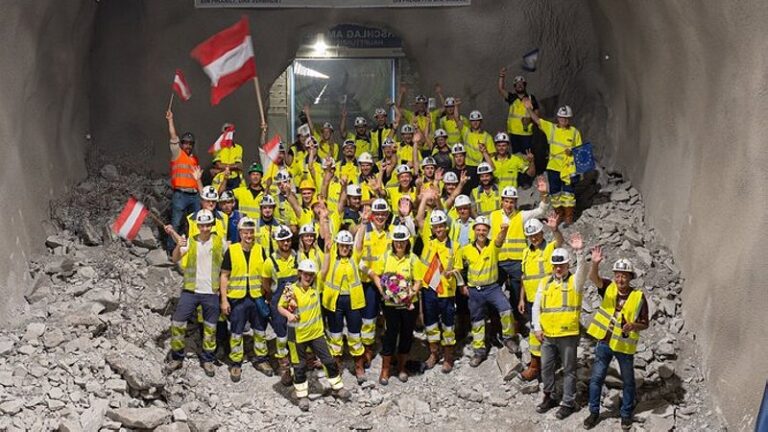
28 July 2026 is a date that is set to be remembered in the construction calendar of the Brenner rail base tunnel as an important symbolic milestone for the new transalpine railway. In the heart of the mountain, on the border between Italy and Austria, the final diaphragms in the two main tubes that make up the base tunnel were broken through at the same time. In practical terms, the two construction lots, the Austrian and the Italian one, have been joined, making it possible to pass directly across the border between the two countries.
Excavation work in the Italian H61 Mules 2-3 lot had already reached the Brenner border in May 2025, when the tunnel-boring machine “Flavia” completed its work in the west tunnel, following the TBM “Virginia” in the east tube in March 2023. Now, with the completion of excavation work carried out using the traditional method in the Austrian H53 Pfons-Brenner lot as well, the base tunnel is almost entirely passable. At this point, however, an immediate clarification is needed, not to diminish the enthusiasm or significance of the breakthrough of the final diaphragms at the Italy-Austria border, but to describe the current state of the project.
Work on the Austrian side has not yet been completed: miners still have to excavate and finish advancing along a short section of the same lot where the reconnection between Italy and Austria has now been celebrated. Only then will it be possible to enter the tunnel with a construction vehicle at Fortezza in Italy, travel through the entire base tunnel and exit at Innsbruck in Austria. This will be the definitive milestone, with the completion of the rough excavation works scheduled, according to Bbt Se, the company governed by European law, by the end of 2026. Strictly speaking, it will not be the first time that it has been possible to pass directly from Italy to Austria beneath the mountain, as this has been feasible since 18 September 2025, when excavation work on the exploratory tunnel was completed. Here too, the Austrians arrived at a later stage, as the tunnel-boring machine “Serena” in Italy had already completed its task in 2021.
It should be recalled that the exploratory tunnel is a centrally positioned service tunnel excavated about 12 metres below the two main tubes to investigate geological conditions in advance, support construction-site logistics and, once the works are completed, manage water drainage and maintenance for the whole project. Excavation of the exploratory tunnel highlighted the project’s high level of surveying precision: when the two excavation fronts, launched kilometres apart, met, they showed a deviation of only a few centimetres. This also served as the basis for excavating the main tunnels of the base tunnel. At this point, one essential date remains to be set: the commissioning of the new railway beneath the Brenner Pass. The construction company has set this target for 2032, although some observers consider that deadline too optimistic. Italian-Austrian rail services will be transformed.
The base tunnel is 55 kilometres long from the Italian portal at Fortezza to the Austrian portal at Innsbruck, but inside the mountain it connects directly with the Innsbruck freight bypass, which has been in operation since 1994 as far as the Tulfes portal. At that point, the entire underground section will reach 64 kilometres, setting a world record. The base tunnel has a design speed of up to 160 km/h for freight trains, which will be able to use a maximum gradient of 7 per thousand, compared with 27 per thousand on the historic nineteenth-century line, with the summit at about 800 metres above sea level compared with 1,372 metres at the historic pass. This will make it possible to operate freight trains of European-standard length and with a high hauled mass. The total cost of the project is estimated at €10.5 billion.
Piermario Curti Sacchi