





- On 22 July 2026, China’s General Administration of Customs (GAC) and National Development and Reform Commission (NDRC) presented their logistics infrastructure modernisation plan for the 2026-2030 five-year period. It provides for the upgrade of 57 border facilities and the inclusion of 43 priority entry points in the smart checkpoints programme.
- The scope of the plan covers all customs border entry points: seaports and river ports, land crossings, rail terminals and airports. By 2030, more than 90% are expected to have intelligent inspection equipment, with the aim of enabling uninterrupted customs clearance. Completion is scheduled for 2035.
- Chinese shipyards secured 121.06 million tonnes of deadweight tonnage in new orders in the first half of the year, up 173.1% year on year and equal to 82.3% of the global market, according to the Ministry of Industry. Clarksons, which measures volumes in compensated gross tonnage, estimates China’s share for the same period at 72%.
Only 24 hours separated the two documents with which Beijing set out its logistics agenda for the next five years. On 22 July 2026, in the press room of the State Council Information Office, the General Administration of Customs (GAC) and the National Development and Reform Commission (NDRC) presented the entry-point modernisation plan for the 15th Five-Year Plan, covering the 2026-2030 period. The following day, the Ministry of Industry and Information Technology (MIIT) released half-year data for shipbuilding: 121.06 million tonnes of deadweight tonnage (dwt) in new orders secured in the first six months of the year, up 173.1% year on year.
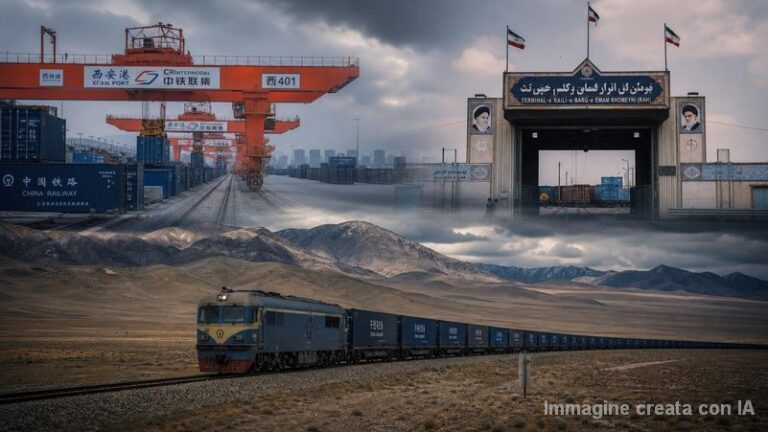
A clarification is needed on the scope of the first document, as several media outlets have presented it as a programme for ports. The Chinese text uses the term kou’an (customs port of entry), which in Beijing’s administrative vocabulary refers to any customs entry point: seaports and river ports, land crossings, rail terminals and airports. The announced measures therefore concern the country’s entire border, from the Torugart crossing towards Kyrgyzstan to Ganqimaodu towards Mongolia, and on to the port of Zhoushan, the world’s leading port for bonded bunkerage. In recent weeks, Xi’an airport has joined the smart checkpoints programme for the air sector, while Hainan and the Guangdong-Macao In-Depth Cooperation Zone in Hengqin fall under the chapter dedicated to regional co-operation hubs.
The plan sets out the modernisation of 57 border infrastructure facilities and the inclusion of 43 priority entry points in the national smart checkpoints programme, with applications for artificial intelligence, big data analytics and automated equipment. The goal is to create entry points that are "safe, efficient, intelligent, compliant with the rule of law and low-emission", the five-attribute formula that recurs throughout the document. Sun Meijun, deputy head of the General Administration of Customs, quantified the interim target: by 2030, more than 90% of entry points should have intelligent inspection equipment, using a model that combines artificial intelligence, big data and connected devices, with the aim of delivering "unperceived" customs clearance for businesses and travellers. Substantial completion of the modernisation process is set for 2035.
For land flows, the measure with the greatest operational impact is the extension of the "one location, two inspections" model and joint inspections to a wider number of cross-border crossings. The model, already tested on links between Guangdong and Hong Kong and Macao, brings checks by the two customs administrations together at a single point. This was announced by deputy director Zhang Baofeng, who also confirmed the creation of a national technical committee for the standardisation of entry points, tasked with harmonising equipment, data formats and resource sharing between checkpoints. The plan is also aligned with the integrated sea-river-rail-road transport network and with the expansion of single-document multimodal transport.
The political framework is the 15th Five-Year Plan approved by the National People’s Congress on 12 March 2026, which assigns a central role to supply chain resilience. "The reference map for national work on entry points" is how Zhang himself described the document, noting that in the previous five-year period customs authorities had already ensured the operation of the Hainan free port and the Hengqin zone. In the background remain trade tensions with the United States and the need to diversify routes for Chinese exports.
The second document, by contrast, measures an already established leadership position. The 121.06 million dwt in new orders secured during the half-year period alone exceeds the previous full-year record for Chinese shipbuilding. According to MIIT, the figure corresponds to 82.3% of the global market, while Clarksons, which measures volumes in compensated gross tonnage (CGT) rather than deadweight tonnage, attributes around 72% of global new orders to China over the same period. Deliveries rose by 51.2% to 36.50 million dwt, equal to 62.2% of global production in the half-year period, with bulk carriers, container ships and tankers accounting for more than 80% of new orders secured by Chinese yards.
The production centre of gravity remains the east coast, where China State Shipbuilding Corporation (CSSC) operates. The group was created through a USD 16 billion merger, around EUR 14 billion, with China Shipbuilding Industry Corporation, and has more than 530 vessels in its order book. South Korea, China’s main competitor, stands at a half-year share of 19-20% according to Clarksons, concentrated on higher-value units such as LNG carriers.
The reasons for the gap are largely structural: preferential interest rates and state ownership stakes, subsidised domestic steel, the availability of skilled labour that demographic decline has not yet eroded as it has in South Korea and Japan, the reactivation of shipyards that had been inactive and the expansion of capacity among established builders. On the demand side, the renewal of fleets is being driven by IMO standards on greenhouse gas emissions, which require reductions of 31% from 2035, 62% from 2045 and 80% by the net-zero target in 2050, with shipowners required to purchase carbon dioxide allowances. Ships destined for foreign customers in fact account for 92-94% of Chinese production. Among international clients, Maersk signed a contract in February 2026 for eight large container ships with New Times Shipbuilding, while MSC now has 100% of the 128 vessels in its active order book at Chinese yards.
The US attempt to curb Beijing’s naval expansion is being pursued through port fees introduced on 14 October 2025 on ships built, owned or operated by Chinese entities. However, an analysis by the CSIS think-tank, cited by Reuters, has so far found no appreciable slowdown in the flow of orders. China therefore remains the world’s leading shipbuilding nation for the 16th consecutive year and closed 2025 with 69% of new orders and 66.8% of the global order book.
M.L.