










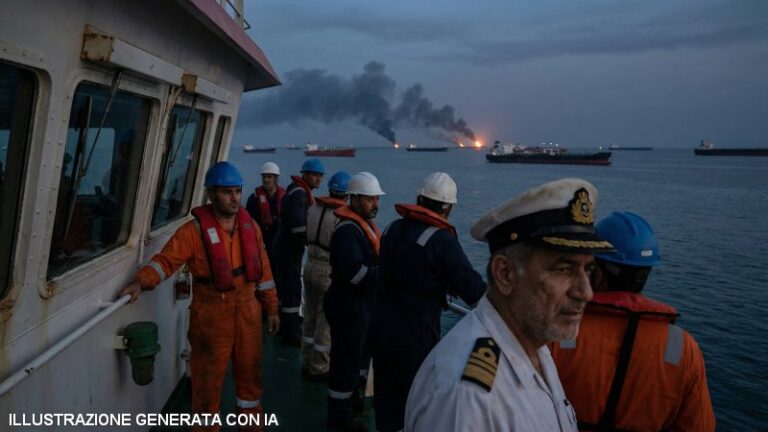
A tanker owned by Kuwait Oil Tanker Company was abandoned by its crew overnight between Monday 20 and Tuesday 21 July 2026 after being hit by an unidentified projectile about eight nautical miles north-east of Limah, Oman, in the Strait of Hormuz. It is the second vessel to have been abandoned in less than 24 hours in that stretch of water, according to the United Kingdom Maritime Trade Operations (Ukmto), the British body that monitors maritime traffic in the region. The vessel’s master, identified by maritime security company Eos Risk Group as the Kaifan (IMO 9656046), issued a distress call on VHF channel 16, reporting that the ship had been struck by a drone or missile. The impact caused a fire in the engine room, forcing the crew to evacuate in a lifeboat. Ukmto said there had been no reports of injuries or environmental impact, while the competent authorities are continuing investigations into the exact nature of the attack.
The incident came only hours after a similar attack on the Kavomaleas, a Malta-flagged tanker managed by Greece’s Dynacom Tankers, which was hit by two projectiles off Kumzar, also in Oman. In that case too, a fire broke out in the engine room: the crew activated the automatic fire-extinguishing system before evacuating, and all members were rescued, while the vessel was left drifting and ablaze. The Islamic Revolutionary Guard Corps (Irgc) claimed responsibility for strikes against both tankers, saying the two vessels had breached navigation rules by attempting to transit along the southern route indicated by the United States but described by Tehran as unsafe. The statement also accused US forces of directing the ships onto that route, renewing its warning to shipping companies not to rely on it.
Dimitris Maniatis, chief executive of Greek maritime risk consultancy Marisks, says at least nine vessels have been attacked since 6 July. The episode falls within the latest phase of the war between the United States and Iran, which flared up again after the collapse of a memorandum of understanding signed last month by Washington and Tehran: US forces have carried out a tenth consecutive night of raids against Iranian military targets, while Iran has struck US bases in Bahrain, Kuwait and Jordan. Brent crude has meanwhile risen above $90 a barrel, approaching the psychological threshold of $100.
The same Monday also saw the crisis spread to a second chokepoint. Yemen’s Houthis, allies of Iran, declared a naval blockade with immediate effect against Saudi Arabia, banning vessels travelling to or from Saudi ports from transiting the Bab el-Mandeb strait. The group’s spokesman, Yahya Saree, described the measure as retaliation for what Sana’a calls a siege of Yemeni ports and for Saudi raids, including an attack on the capital’s international airport. Riyadh rejected the Houthi account, describing the accusations of a blockade imposed on Yemen as disinformation and instead pointing to the support it has provided to the country through aid, development projects and fuel supplies.
The threat immediately led to diversions: the Chinese supertanker Xin Long Yang, carrying 2 million barrels of crude loaded at Yanbu and bound for China, reversed course in the Red Sea on Tuesday and headed towards the Suez Canal. The Rodos, managed by Dynacom Tankers Management, did the same with about 700,000 barrels on board bound for India. A third vessel, the New Prime, which was heading to Yanbu to load crude, reversed course off Oman before even entering the Red Sea.
The port of Yanbu, on the Red Sea, had in recent months become the main alternative route for Saudi crude exports, precisely because of transit difficulties in Hormuz. The overlap between the two crises now represents, according to broker Clarksons, a two-chokepoint problem for global oil markets. An average of ten tankers a day transit the Bab el-Mandeb strait. Marine insurers have already raised war-risk premiums on Red Sea routes, while British security company Ambrey has classified calls at Saudi ports as high-risk and recommended that vessels reconsider transit through the area.
A diversion towards Suez instead of leaving the Red Sea means additional weeks of navigation, with tankers that cannot cross the canal fully laden having to sail around Africa. Supertankers must in fact lighten part of their cargo to comply with the canal’s draught limits, a constraint that can be bypassed by routing crude to the Mediterranean via the Sumed pipeline.