








US Central Command (Centcom) launched a new wave of attacks against Iran at 1am on Monday 20 July: the ninth consecutive night of raids since hostilities resumed between Washington and Tehran. The command said the objective remains to reduce Iran’s military capability used to target commercial vessels and civilian seafarers transiting the Strait of Hormuz. US President Donald Trump said he had “hit Iran hard” in honour of the American soldiers killed in recent days. For its part, the Irgc, Iran’s Islamic Revolutionary Guard Corps (Pasdaran), claimed responsibility for strikes against US military targets in Kuwait and Jordan, while Iranian President Masoud Pezeshkian described the ongoing conflict as a “total” war waged by the United States against his country.
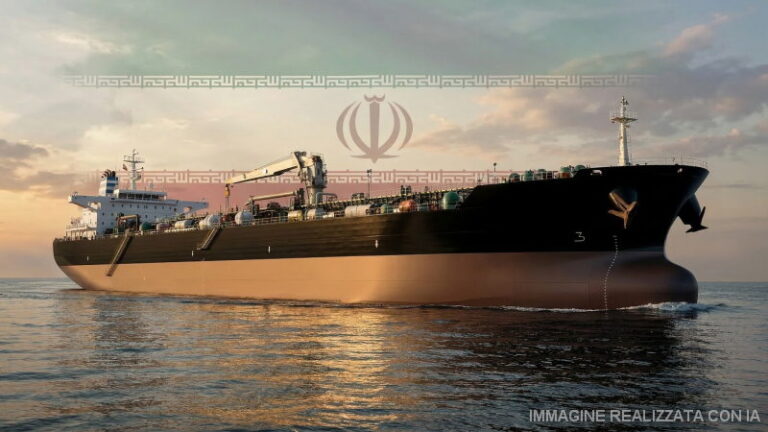
The escalation also includes the attack on the Kavomaleas, a Maltese-flagged tanker owned by Greek company Dynacom Tankers, which was hit by a projectile of as yet unidentified origin on the evening of 19 July, at 19:24 UTC, about eight nautical miles north-west of Kumzar, off the northern coast of Oman. The incident was reported by Ukmto, the UK agency that monitors maritime operations in the region and provided the coordinates of the event. The vessel caught fire after the impact and the entire crew had to abandon ship. They were rescued by a tug, while the tanker remains adrift and still burning, with no reports so far of spills or significant environmental damage.
During the same hours on Sunday, the Irgc said that “two tankers exploded and stopped” after attempting to transit what Tehran describes as an unsafe southern route through the strait, without specifying whether the incident was linked to the fire on board the Kavomaleas. The Pasdaran later claimed, during the night between Sunday and Monday, that they had also intercepted two tankers attempting to cross without authorisation. The Joint Maritime Information Centre now counts 11 confirmed incidents involving cargo vessels in the Strait of Hormuz since 25 June, with the alert level for merchant traffic officially raised to “severe”. Maritime security companies also report that vessels keeping their AIS tracking system active appear to be more exposed to interception and targeted hostile action.
Tension is also flaring up again in the Red Sea, where the Houthis have announced “the maritime blockade of Saudi Arabia”, following an exchange of fire between the Yemenis and the Saudi army in the preceding days. The blockade would take immediate effect. The decision, if implemented, will worsen the global energy and logistics crisis. Last week, the airport in the Yemeni capital Sana’a was hit by an air strike, which the Houthis attributed to Saudi Arabia, although Yemen’s internationally recognised government claimed responsibility for the action, saying it was intended to prevent an Iranian aircraft from landing. In response to the bombing, Houthi forces launched missiles and drones against Abha International Airport in southern Saudi Arabia.
Tension in the strait is being compounded by the halt to commercial air traffic over the Gulf, including cargo aircraft. The European Union Aviation Safety Agency (Easa) published a new conflict-zone bulletin on 14 July recommending that operators avoid, at any altitude, the airspace of the United Arab Emirates, Qatar, Bahrain, Kuwait and the Gulf of Oman. The bulletin remains in force until 29 July unless revised earlier. Airports in Dubai, Abu Dhabi, Doha and Kuwait City remain formally operational by decision of the local authorities, but European airlines are forced to avoid those corridors, lengthening flight times, increasing fuel consumption and reducing available capacity for freight and passengers on the same aircraft. A precedent cited by Easa, relating to the first weeks of the crisis that began in late February, had already shown a 59% collapse in connections between Europe and the Middle East, with about 1,200 fewer flights a day.
The restrictions have led to stoppages for several international cargo carriers. Cargolux has suspended all Middle East calls except Muscat, in Oman. Martinair, Klm’s cargo division, has halted services to Dubai’s Dwc airport and stopped accepting new bookings, while China Cargo has suspended operations to Abu Dhabi, Dubai and Riyadh. The longest suspensions concern the Cathay group, which has extended the suspension of cargo flights to Dubai and Riyadh until 31 August, and Lufthansa Cargo, which has prolonged cancellations until October on services to Dubai, Dammam, Riyadh and Tehran. Turkish Cargo has instead opted for reductions rather than a full suspension, cancelling some services to Bahrain, Kuwait, Iran, the United Arab Emirates, Saudi Arabia and Oman.
Among Gulf-based carriers, Emirates and Etihad cancelled several passenger flights and bellyhold cargo services on 19 and 20 July, particularly on routes to Kuwait and Saudi Arabia, because of the renewed instability. Emirates nevertheless said it had moved beyond the most acute phase of regional airspace closures and had managed to stabilise most of its freight flows across the rest of its global network.
M.L.