





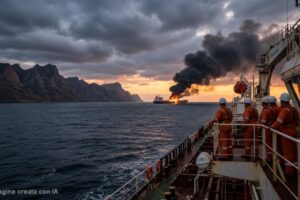


Around 1,478 containers fell from ships into the sea in 2025, out of an estimated total of 280 million units handled globally. The figure was up from 576 containers lost in 2024, mainly because of a single incident that caused the loss of 640 units, the sinking of the MSC Elsa 3, equal to 43% of the annual total. The data comes from the Safety and Shipping Review 2026 Update drawn up by the World Shipping Council and shows a sector that, while remaining structurally safe, is still exposed to isolated events capable of significantly affecting annual statistics. Despite the increase, losses in 2025 accounted for just 0.0005% of global container movements, confirming that this remains a rare phenomenon when measured against the scale of world maritime trade.
The main causes of these losses remain linked to extreme weather conditions, worsened by higher-than-normal ocean temperatures that have intensified wave energy, particularly in the North Atlantic and North Pacific. These climate-related factors are compounded by operational issues such as fires on board, cargo shifts in rough seas and collapses of container stacks, as well as vessel-specific accidents, including groundings. On the recovery front, 2025 marked a positive record, with 128 containers recovered, the highest number ever recorded. This result was attributed to better coordination between operators and more advanced tracking capabilities.
Looking at the historical series, which the report reconstructs from 2008 to 2025 using a three-year moving average, the absolute peak remains 2013, when 5,578 containers were lost, while 2023 was confirmed as the year with the lowest number ever recorded, at just 221 units. The 2025 figure therefore interrupts the sharp decline seen in the 2022-2024 period, bringing losses back above the recent three-year average, but without changing the long-term trend towards a phenomenon that remains rare compared with the steady growth in global volumes.
Preventing losses, the report stresses, requires collaboration across the entire supply chain. Shippers and freight forwarders must ensure correct packing and accurate weight declarations, which are essential for stowage planning. Terminals and stevedores, meanwhile, must manage container positioning in line with the vessel’s loading plans in order to maintain its balance, while ocean carriers use advanced tools for stowage planning and constantly monitor weather conditions to adjust routes. These practices are governed by international standards such as the CTU Code, the SOLAS Convention and the IMDG Code.
The sector has also launched several proactive initiatives. In 2025, the World Shipping Council introduced the Cargo Safety Program, a programme that combines National Cargo Bureau technologies with artificial intelligence tools to identify high-risk shipments. The system uses digital screening based on keyword analysis to detect misdeclared goods before loading, reducing the risk of fires on board. On the issue of fires, new regulations now require all coal shipments to be declared as dangerous goods under the IMDG Code, following a series of past incidents linked to this type of cargo.
Since 1 January 2026, amendments to the SOLAS Convention have also been in force, making it mandatory to report all lost or drifting containers to the International Maritime Organization, a key step for navigational safety and the protection of the marine environment. From a methodological standpoint, the report is based on responses from companies that are members of the World Shipping Council, which cover around 90% of global container shipping capacity, with proportional estimates applied to the remaining 10% of the market.
M.G.