




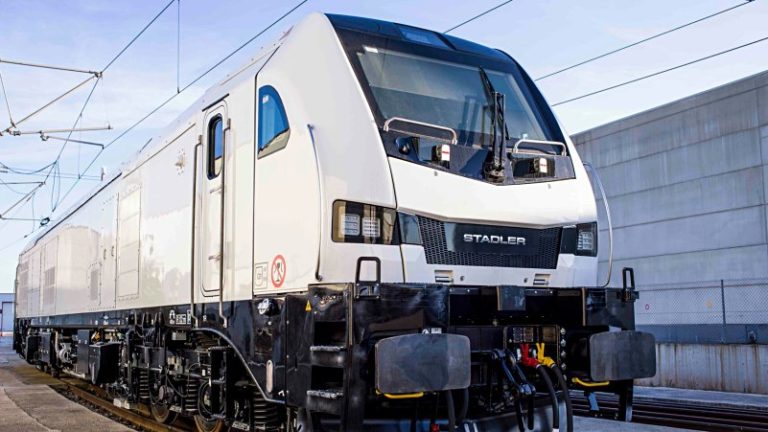
Borrowing the nickname once given to the most powerful steam locomotive of its era, the Mastodon of the Giovi, designed in the mid-19th century specifically to tackle the steep Ligurian Apennine line, we might speak of a Brenner Mastodon. Although the railway line between Verona and the Austrian border will not be its only operating ground, the fact remains that Stadler’s powerful Euro9000 made its debut in regular service in mid-June 2026 on precisely this route. The first commercial service was operated by a Rail Traction Company (Rtc) freight train, which departed from Verona Quadrante Europa bound for the Brenner, hauled by a unit supplied by leasing company European Loc Pool.
After a long phase of testing and certification before entry into service, the Euro9000 locomotives were authorised to run on the Italian rail network in January 2026. In May 2026, Rtc itself began the first operational tests on the Brenner axis to assess the suitability of deploying this powerful locomotive, whose technical characteristics and performance make it possible to avoid double traction, with a significant reduction in operating costs. The Euro9000, developed and produced by Swiss manufacturer Stadler at its Valencia plant in Spain, is already authorised to run on the networks of Germany, Austria, Switzerland, Belgium and the Netherlands, while approval procedures are under way in Poland.
Stadler’s modern, powerful locomotives are designed exclusively for freight service and, thanks to their performance, could mark a turning point in the haulage of heavy trains on Europe’s major corridors. The Euro9000 is a six-axle locomotive with an unusual wheel arrangement, featuring two bogies with three powered axles each. Thanks to electronic control, this provides high adhesion without damaging or wearing the track, something that in the past represented a major limitation for heavy historic six-axle locomotives. They are also interoperable, as they are quad-current locomotives and therefore suitable for operation across the European network, also because they are equipped with all the necessary safety systems. They can be fitted with two additional modules, a diesel engine and a battery pack, which can also work in parallel, reaching a high maximum power output of 9 MW. This compares with a modern four-axle locomotive, which on average can reach no more than 6.5 MW.
These capabilities therefore exceed those of universal electric locomotives by almost 50%, allowing the Euro9000 to haul heavy freight trains independently along Europe’s main Alpine routes without the need for reinforcement through double or triple traction on the steepest sections, a common requirement on the Brenner or Simplon routes. Its starting tractive effort reaches 500 kN, compared with an average of 300 kN for equivalent four-axle competitors. Electronic traction control also makes it easier to handle critical phases, such as starting on gradients or on wet rails. That is why, borrowing from the past, it is not inappropriate to describe the Euro9000 as a modern Mastodon.
Piermario Curti Sacchi