







The Container Port Performance Index 2025 (CPPI), compiled by the World Bank in collaboration with S&P Global Market Intelligence, confirms a widening gap within the port system of the European Union. On one side are agile, specialised ports able to absorb demand volatility without triggering chain reactions. On the other, the continent’s major historical hubs are losing ground in the ranking, squeezed by the combined impact of geopolitical crises and internal operational rigidities.
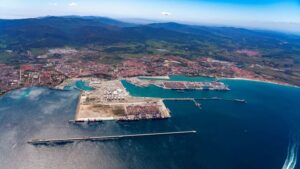
The most significant figure concerns Algeciras, the only EU port among the world’s top twenty for efficiency: the Spanish port ranks 12th with a CPPI score of 121.9, supported by a 77% share of time spent productively at berth. Its transhipment-focused operating model allows containers to be pre-positioned in yards, reducing idle time and increasing crane productivity. It is followed by another Spanish port, Barcelona, which ranks 34th with a score of 86.0 and 75% of time at berth, benefiting from excellent landside coordination and digitalised processes that limit waiting times at anchorage. Aarhus, in Denmark, also features among the higher-ranking ports, in 73rd position with a CPPI score of 86.6 and an 86% share of time at berth.
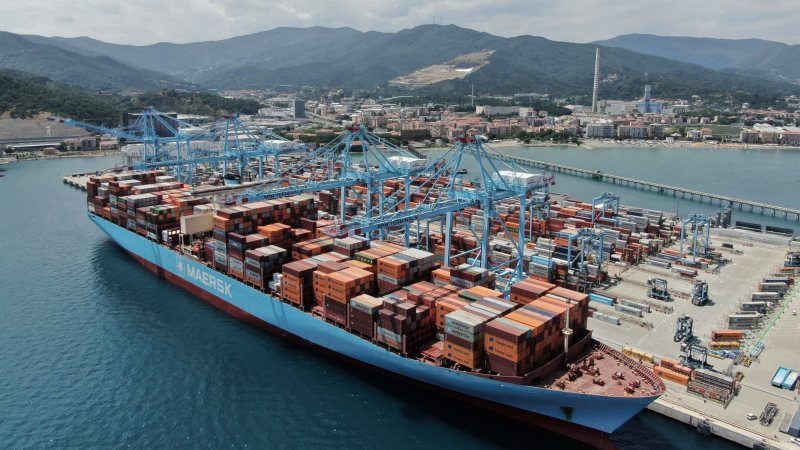
But these are exceptions, as the report stresses that the Red Sea crisis of 2024-2025 had disruptive effects across the entire European port network. The diversion of container ships around the Cape of Good Hope added 10 to 14 days to Asia-Europe transits, causing an abnormal concentration of arrivals at terminals in Northern Europe and the Mediterranean. Ports acting as relief nodes in the network, meaning those that absorb diverted flows when shipping line schedules are disrupted, suffered the heaviest consequences: long queues at anchor, yard saturation and a deterioration in vessel turnaround times.
Valencia is one of the clearest examples. The Spanish port absorbed large volumes of traffic diverted as a result of the Red Sea crisis, but the share of time spent at berth fell from 64% in 2024 to 49% in 2025, with its CPPI score sliding to -75.8 and its global ranking dropping to 368th. In this scenario, more than half of ships’ port-stay time was spent at anchorage, waiting for an available berth.
Similar dynamics, though less pronounced, affected the giants of the North Range. Rotterdam, traditionally regarded as Europe’s main gateway, ended 2025 in 333rd place with a CPPI score of -38.3 and 65% of time at berth, while Hamburg, historically known for high structural efficiency, recorded a score of -4.6 and fell to 239th place. The absorption of delayed vessels in Northern European chains increased idle times and eroded the German port’s operating margins. Antwerp ranked 306th with -21.2, while Bremerhaven was 264th with -10.4. In these cases, yard congestion translates into reduced berth availability, with knock-on effects on feeder services and rail links into the hinterland.
The middle section of the European ranking includes regional ports that show reasonable management but are not immune to temporary pressure. Lithuania’s Klaipeda ranks 118th with a CPPI score of 16.3 and 79% of time at berth, followed by Poland’s Gdynia in 185th place with 3.5 points, while Estonia’s Tallinn is 167th with 5.6. Riga and Limassol are ranked 192nd and 193rd respectively, with CPPI scores of around 2.8. These ports show enough management flexibility to avoid structural congestion, but remain exposed to seasonal traffic peaks or network disruptions.
A reading of the ranking focused on long-term improvement highlights two notable cases. Sweden’s Gothenburg posted a 68-point increase over the 2020-2025 period, placing it fourth worldwide for improvement rate, with a current CPPI score of 48.2 and 67% of time at berth. The port benefited from substantial investment in digitalisation and predictive arrival management. In the short term, however, Romania’s Constanta recorded the sharpest improvement among EU ports, gaining 68 points between 2024 and 2025. Even so, the Romanian port remains 272nd globally, with a CPPI score of -12.3 and 58% of time at berth, indicating that the relative improvement started from a still weak base.
M.L.