








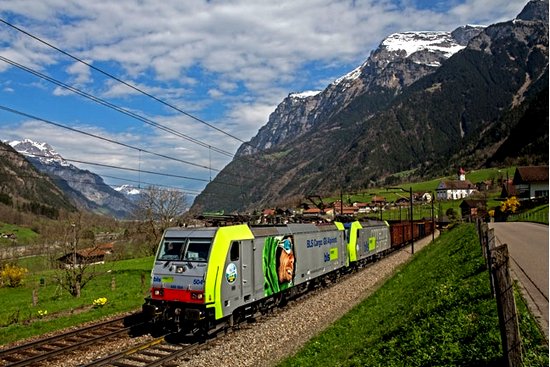
Although it is entirely legitimate to ask what concrete impact a regional motion may have, the political significance of the motion unanimously approved on 5 May 2026 by Consiglio Regionale della Lombardia (Lombardy Regional Council) should not be overlooked. The Lombardy legislative body, through motion 489, came out in favour of completing the AlpTransit project, the transalpine railway that forms a key axis between Piedmont and Lombardy and central-northern Europe via Switzerland.
Moreover, this is not simply a declaration of support, as the document sets out a clear assumption of responsibility and commits regional executive to take action in the appropriate institutional forums “so that the completion of AlpTransit and the upgrading of the southern access lines to the Lötschberg, Gotthard and Ceneri base tunnels, overcoming the infrastructure bottlenecks that still exist along the southern axis, continue to be a strategic priority for Lombardy, for the national infrastructure system and for European connections”.
Lombardy’s focus therefore renews interest in strengthening rail links with Europe, above all the TEN-T North Sea-Rhine-Mediterranean corridor, which connects Rotterdam to Genoa along the Gotthard and Lötschberg/Simplon transalpine axis. The significance of this decision should not be underestimated in light of the approach taken at national level, which has always been rather detached. This is shown by all planning documents, including Rfi plans, which have never gone beyond limited upgrade projects on the existing network, excluding investment in new high-capacity lines.
Lombardy’s decision has not gone unnoticed beyond the Alps, and in particular by Pro Gottardo-Ferrovia d’Europa, the association founded in 2016 to promote completion of the Gotthard base route and which in 2025 promoted the establishment of Alleanza sud delle Alpi (South of the Alps Alliance), a legislative and cross-border alliance joined by Lombardy, Piedmont, Liguria and Canton of Ticino.
According to Pro Gottardo, Lombardy’s decision comes at a decisive moment for the future of transport across the Alps and for the completion of access routes to the north and south of the base tunnels, particularly the Ticino section between Biasca and Chiasso, with the Bellinzona and Lugano bypasses. Soon Swiss Federal Council, the executive body of Swiss government, will discuss the “dispatch” on railway infrastructure expansion projects for the next 20 years, leading to a final decision expected in 2027. This “dispatch” will also have to outline long-term developments, beyond 2045. For Italy and Switzerland, this is therefore an opportunity to combine efforts and move together towards this goal.
Pro Gottardo recalls that for financial reasons, but above all because of the prevalence of regional interests, not to say local rivalries, completion of the access routes to the transalpine railway, although required by law, is currently not included in railway infrastructure planning. It is therefore necessary to seize the opportunity offered by the debate that has just begun to assert the case for the south of the Alps, which has not only regional but also European significance. Lombardy’s support could therefore prove to be a decisive card, the Swiss association further notes, provided that Canton Ticino is also able, with the unanimous mandate of the cantonal parliament, to take responsibility and pursue cross-border demands at national level with the necessary determination.
Piermario Curti Sacchi