






On 5 March 2026, Iranian authorities announced the partial reopening of the Strait of Hormuz — the 34-kilometre-wide chokepoint connecting the Persian Gulf to the Gulf of Oman, through which roughly 20 per cent of the world's oil and approximately 19 per cent of global liquefied natural gas have historically flowed. The declaration, delivered by a military spokesman on state television, nonetheless explicitly excluded vessels linked to the United States and Israel, effectively attaching conditions that the international shipping market is not yet in a position to accept.
A week into the crisis, transits remain at approximately one million gross tonnes per day, against the 10.3 million recorded at the start of the year — a fall of 81 per cent that has shown no sign of reversing despite Tehran's announcement. The reasons are as much technical as political: the leading international insurance underwriters have not lifted their war-risk exclusions, rendering passage economically and legally unworkable for almost all shipowners, regardless of a vessel's flag or cargo.
The crisis erupted on 28 February 2026, in the immediate aftermath of the joint US-Israeli military operation "Epic Fury", which ended with the killing of Supreme Leader Ali Khamenei. The Islamic Revolutionary Guard Corps threatened to strike any vessel in transit, triggering an instant response from the insurance market. Yet the paralysis was not solely Tehran's doing: it was also the outcome of an autonomous industry decision to withdraw coverage, placing every prospective transit outside any ordinary legal or financial framework.
The consequences have rippled swiftly across every shipping segment. On the oil side, freight costs for crude moving from the Middle East to China have risen 94 per cent, reaching $423,736 per day (approximately €390,000), while Brent crude has gained 15 per cent to trade at $83 a barrel (around €76). At least 150 tankers remain at anchor or otherwise immobilised. Compounding the picture, drone strikes have damaged Saudi Arabia's Ras Tanura refinery and caused fires at the port area of Fujairah in the United Arab Emirates — a crucial hub for crude storage just outside the Strait.
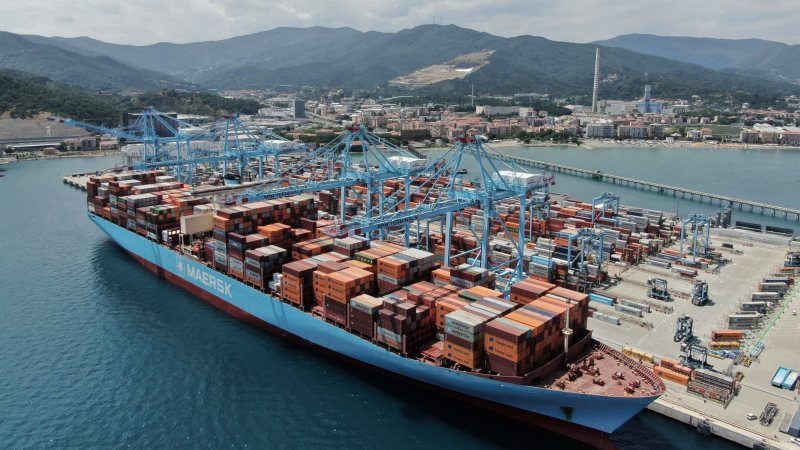
On the gas side, Qatar has suspended its entire LNG output following military attacks and the impossibility of moving carriers through the Strait safely. The stoppage affects roughly 20 per cent of global LNG supply, with direct knock-on effects on European and Asian markets. In the container and dry-bulk sectors, Hapag-Lloyd has announced the indefinite suspension of all transits through the Strait with effect from 1 March 2026, while freight rates on diverted routes have spiked sharply.
Tehran's 5 March declaration therefore carries predominantly political weight. Iran seeks to reassert strategic control over one of the global economy's most consequential bottlenecks, to draw a distinction between "enemy" states and others, and to ease mounting diplomatic pressure. But until the insurance industry reinstates standard coverage and shipowners receive concrete safety guarantees, the announced reopening will remain, for all practical purposes, a statement on paper and nothing more.