







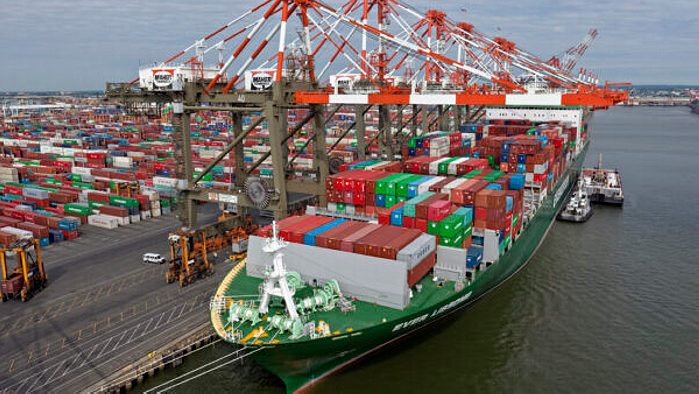
- Container imports into the United States closed 2025 largely unchanged compared with 2024, with volumes of around 25.2–25.5 million TEU, but forecasts from the Global Port Tracker by Nrf/Hackett Associates point to a contraction of about 2% year on year in the first half of 2026, to 12.27 million TEU.
- The main source of pressure is uncertainty over tariffs, compounded by a structural recalibration of global flows, with Africa, the Middle East–India and Latin America recording double-digit growth in containerised imports, while world trade reorganises itself to reduce dependence on US gateways.
- The impact on the shipping market is direct: freight rates to both US coasts are falling, load factors on transpacific and transatlantic routes are declining and some major carriers are already reporting negative returns. For importers and logistics operators, this opens up greater negotiating leverage on freight contracts, but also creates an urgent need to diversify sourcing and redesign supply networks to make them tariff-proof.
Container imports into the United States closed 2025 essentially in line with 2024, with volumes standing at around 25.2–25.5 million TEU, but projections for 2026 point to a more marked deterioration. According to the Global Port Tracker by Nrf/Hackett Associates, the first half of next year is expected to end with a contraction of about 2% year on year, at 12.27 million TEU compared with 12.53 million in the same period of 2025.
On a monthly basis, the picture is particularly heavy in the early months of the year. The Global Port Tracker estimates volumes of 2.0 million TEU in January 2026, down 10.3% from a year earlier; February is expected to reach 1.86 million TEU, a decline of 8.5%, while March marks the sharpest drop with 1.79 million TEU, down 16.8%. April is forecast at 1.97 million TEU, a decrease of 10.9%. The partial rebound anticipated for May and June is largely attributable to a favourable base effect, as volumes in the same months of 2025 had already collapsed following the announcement of the “Liberation Day” tariffs.
The Port of Los Angeles, one of the main gateways for US trade, offers an emblematic illustration of this trajectory. After a 3.3% increase in the first half of 2025, the second half recorded a 4.2% decline; in the first four weeks of 2026, import volumes are already down 2.2% year on year, confirming that the slowdown is broadening.
The most significant factor identified by Nrf and Hackett Associates is the extensive use of tariffs as a trade policy tool by the US administration. Uncertainty over timing and implementation has prompted many importing companies to frontload shipments between 2024 and the early months of 2025, building up inventories ahead of the entry into force of the new measures. This mechanism has effectively drained a significant share of demand from subsequent months, amplifying the double-digit contractions expected in the first quarter of 2026.
Overlaying this dynamic is a more structural recalibration of global trade flows. Market analysis shows that growth in container volumes to the United States has largely evaporated, while other regions — Africa, the Middle East and India, Latin America and Europe — are posting double-digit increases in imports. World trade is reorganising around routes and bilateral relationships that exclude or marginalise US ports: the strengthening of trade ties between the EU and India, between Canada, the EU and China, and the multiplication of regional agreements are reshaping supply chains away from the US market. Economists speak openly of a “global recalibration”, in which part of the flows is reallocated to reduce dependence on the United States and to mitigate tariff risk.
Repercussions for the shipping market are immediate. Hackett and Nrf report that container freight rates to the United States are falling on both the West Coast and the East and Gulf coasts, in line with weaker demand for slots to US ports. The reduction in volumes from Asian hubs and the Europe–Mediterranean area to the US is freeing up capacity that major carriers are struggling to fill, contributing to downward pressure on global freight indices, including the Drewry World Container Index.
The decline — or stagnation — in US imports is combining with a very large orderbook for new vessels and the gradual normalisation of transit times after disruptions linked to the Red Sea. The result is lower load factors on the main transpacific and transatlantic routes, with a consequent squeeze on operating margins. Hackett notes that, after years of record profits, some major carriers — including Maersk and One — are already reporting negative returns and could face further deterioration as new capacity enters service in the coming months.
In response to weaker US-bound demand, carriers are making more aggressive use of blank sailings and redeploying services towards faster-growing markets such as Africa, the Middle East–India and Latin America. For US importers, this may translate into greater volatility in available capacity and reduced schedule reliability, despite the broader context of global overcapacity.
Operationally, the implications for importers and logistics operators are significant. The combination of declining volumes and tariff uncertainty suggests the need to adopt multiple planning scenarios, adjusting orders to avoid fresh waves of inventory build-up followed by periods of depressed demand. Many companies with global supply chains are accelerating diversification of sourcing through nearshoring and friend-shoring strategies, with the aim of reducing concentrated exposure on routes subject to high tariffs. This process is reshaping logistics networks and influencing the choice of ports of entry towards gateways less exposed to tariff volatility.
The backdrop of stagnant or falling volumes, coupled with global overcapacity, gives importers greater negotiating leverage when concluding annual or biennial contracts with carriers and NVOCCs, particularly on the Asia–US West Coast and Asia–US East Coast trades. However, carriers’ tendency to protect revenues through blank sailings and service cuts means negotiations cannot focus solely on freight rates: capacity guarantees, cancellation penalties, rerouting flexibility and reliability clauses are becoming equally critical bargaining elements.
For major US container ports — Los Angeles and Long Beach, New York and New Jersey, Savannah — a 2% year-on-year decline in a high fixed-cost environment could compress operating margins and prompt a review of investment plans and port tariffs. Smaller or more specialised ports risk a proportionally greater impact if carriers choose to concentrate calls at primary gateways to optimise vessel utilisation in a weak demand environment.
The formula “zero growth” therefore describes not merely a cyclical pause but a deeper shift in trend: the United States risks losing its role as the engine of global container traffic growth and is lagging behind other regions as a result of the combined effects of tariff policies, domestic costs and the diversification strategies adopted by trading partners. The risk that the downturn extends into 2026 lies in the political and structural nature of these factors — tariff policy, reallocation of investment, new trade alliances — which are unlikely to fade in the short term. Even with domestic consumption still relatively solid, the share of that consumption served through containerised imports could contract on a lasting basis.
P.R.