




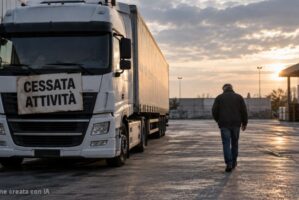
As the extensive investigation into the alleged exploitation of foreign drivers continues in Lithuania, tensions have grown in recent weeks between the road haulage sector and the Vilnius Regional Prosecutor’s Office (Vilniaus Apygardos Prokuratūra). Following a lengthy interview given by prosecutor Edita Ignatavičiūtė to the public broadcaster Lrt, the Lithuanian Transporters’ Association Ttla openly criticised the tone and methods of the judicial authority, describing them as overly generalising and damaging to the image of the entire sector. The representative of the Prosecutor’s Office stated that labour exploitation had become the cornerstone of the Lithuanian transport sector, which she accused of operating on a system of modern slavery.
According to Ttla, which represents twenty-five of the country’s largest companies, this narrative is entirely misleading and risks portraying Lithuanian road haulage in a distorted light. The companies objected in particular to the use of the term “systemic”, arguing that the investigation is still ongoing and cannot in any case be considered representative of the entire industry. The association also urged the authorities to communicate more carefully, warning that inappropriate wording could foster a climate of distrust towards all Lithuanian operators, including those fully compliant with the law.
In a statement, the association’s secretary general explained that “in our view, these are extreme phrases that inevitably create the impression that this is not about individual possible cases of exploitation, but about the criminalised essence of the entire sector. Considering that the tone of the Prosecutor’s Office, as the leader and organiser of criminal proceedings, has a particularly significant influence on the formation of public opinion, institutions must be extremely careful in their choice of metaphors and analogies expressed publicly, especially those that naturally imply the moral discrediting of the entire sector”. He also stressed that the investigation concerns only six companies out of a total of around 7,000 operators.
Ttla called on the Prosecutor’s Office to distinguish between illegal conduct, which must be prosecuted without hesitation, and an entire category that operates fully within the law and employs more than 90,000 people. However, the high proportion of foreign workers in the sector, which in Lithuania stands at nearly 80 per cent, appears to confirm the industry’s dependence on overseas labour and could represent an initial indicator of systemic exploitation. As the investigation continues, the risk of growing friction between institutions and the business community remains real and could persist throughout what, as the Prosecutor’s Office has noted, will be a long and complex inquiry. The case has meanwhile brought renewed attention to the unresolved issue of exploitation of non-EU drivers in Europe. In this context, the Lithuanian prosecutors’ investigation could mark a significant turning point for the future of European transport and for drivers’ working conditions across the continent.
Marco Martinelli