







- From 1 to 22 February 2026, on the occasion of the Milano Cortina Winter Olympics, extraordinary bans on the circulation of freight transport vehicles will apply in competition areas. These measures are in addition to the national 2026 calendar and particularly affect Valtellina and the Cortina area, with differentiated thresholds, timetables and rules.
- In the province of Sondrio, the bans concern freight vehicles over 3.5 tonnes on provincial roads in Alta Valtellina from 6.00 to 10.00, extended until 11.00 for ADR transport, from 4 to 22 February. In the province of Belluno, on the main access routes to Cortina, a 24-hour absolute ban is planned for vehicles over 7.5 tonnes.
- Business associations speak of a “double level of bans”, combining Olympic and national restrictions, and warn of operational risks for deliveries, costs and scheduling. While acknowledging security needs, they are calling for adjustments to the 2026 calendar and a more active role in managing exemptions and time windows for essential supplies.
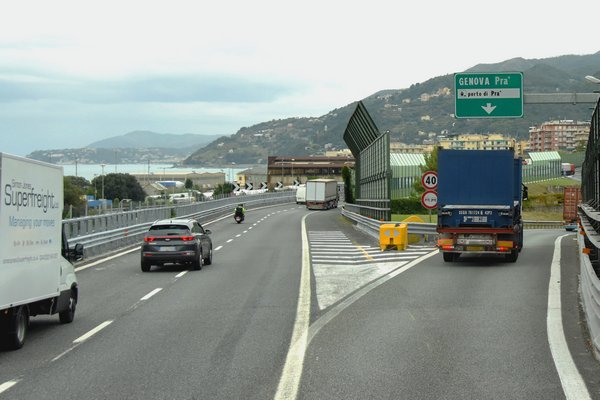
The Milano Cortina 2026 Winter Olympics will not only affect sporting organisation and spectator mobility, but will also introduce an extraordinary system of restrictions on the circulation of freight vehicles, directly impacting hauliers, logistics operators and businesses in the territories involved. During the Games period, ordinary rules give way to a maze of prefectural and provincial orders, temporary ZTLs and highly selective exemptions, significantly altering access to Alpine areas and certain urban contexts.
The core of the restrictions is concentrated between Valtellina and the Cortina area, where the road network is structurally fragile and access routes coincide with the arteries used to reach competition venues. Here the bans affect not only heavy vehicles but, in some cases, also commercial vehicles over 3.5 tonnes, with rigid time slots or continuous blocks that drastically reduce operational delivery windows. Added to this are the limitations imposed by Olympic ZTLs and temporary closures linked to institutional events in host cities.
The focal point of the restrictions lies in the valleys hosting the competitions. In the province of Sondrio, the most significant measure is the provincial order governing transit on provincial roads in Alta Valtellina, an area required to handle simultaneous flows of athletes, staff, spectators and services. The aim is to reduce freight traffic during morning peak hours, when movements towards venues and operational areas are concentrated. In Valtellina, the perimeter is defined both by weight threshold and by road network. The threshold is lower than the national one: the ban applies to vehicles with a gross vehicle weight exceeding 3.5 tonnes not used for passenger transport. This is a decisive operational point, as it includes part of the light commercial vehicle fleet that, under normal conditions, is not subject to national holiday bans for vehicles over 7.5 tonnes.
The time slots set by the Province of Sondrio are twofold. For freight vehicles over 3.5 tonnes, transit is prohibited from 6.00 to 10.00 from 4 to 22 February 2026, while for vehicles carrying dangerous goods under ADR regulations the ban is extended by one hour, from 6.00 to 11.00, over the same period. The decision to start at 6.00, rather than at midnight as initially reported in some communications, shifts the focus to the organisation of the first delivery rounds and night departures, which in many cases become ineffective as they “crash” into the ban window upon entering the most sensitive areas.
On the Valtellina road network, the order lists several provincial routes connecting the valley floor axis with access to higher-altitude locations. Among the arteries cited in operational communications to businesses are the SP 24 Tirano–Stazzona on a section defined by kilometre markers, the SP 26 del Campone along its entire length, the SP 26 branches towards Sernio and Valchiosa, and the SP 27 to the Stelvio Pass along its full extension of over 31 kilometres. In practical terms, these are precisely the roads that connect the state road to the competition areas, thus affecting the last mile towards Bormio and Livigno.
As noted, the Valtellina mechanism is not a full-day absolute ban: outside the 6.00–10.00 and 6.00–11.00 windows, transit is permitted. In real-world planning, however, this option clashes with three factors: the impossibility of spreading all supply needs into the later hours, the risk of congestion concentrated between late morning and early afternoon, and the effect of Olympic ZTLs, which may introduce additional gates and controls on competition days. This is where local associations stress the need to reschedule delivery rounds and time slots, and to factor in additional costs linked to distances travelled and waiting times.
If Valtellina operates with time windows, the Cortina area adopts a more drastic approach on its two key arteries. In the province of Belluno, the main access route to the Ampezzo basin, the SS 51 di Alemagna, and the SR 48 delle Dolomiti are subject to an absolute 24-hour ban from 1 to 22 February 2026 for heavy vehicles over 7.5 tonnes. In a territory with limited alternative routes and mountain passes that can be difficult in winter, the continuous closure aims to clearly separate Olympic and tourist traffic from heavy freight traffic.
Alongside the continuous ban, the operational framework in the Belluno area includes a calendar aligned with the most sensitive days and times, with slots that, depending on the day and on the Olympic or Paralympic period, may extend from 9.00 to 20.00, stretch from 7.00 to 23.00 on 6 February, and revert to 6.00 to 20.00 during the central phase of the Games, in line with the operation of ZTLs and control areas. The difference compared with Sondrio lies not only in the mass threshold, 7.5 tonnes instead of 3.5, but in the combination of stretches closed without windows and the need for authorisations for exemptions.
Exemptions in both territories are designed restrictively. The orders cite permitted categories such as emergency and rescue vehicles, winter maintenance activities and interventions on behalf of road operators and authorities, leaving limited scope for ordinary freight transport. In the Belluno area, operational communications indicate greater attention to the continuity of food supplies for retail distribution and logistics directly linked to the Games, provided they are equipped with a dedicated pass.
It is precisely on exemptions that some territorial associations take on an interface role. Appia, in the Cortina and Belluno area, informs companies of the arrival of orders imposing strict limits on vehicles over 7.5 tonnes and clarifies that exemption requests for essential needs, such as food, fuel and biomass supplies, would be collected and forwarded through trade associations, acting as a filter and coordination channel with the Prefettura (Prefecture). Operationally, this means that requests are not merely individual acts, but enter a structured process aimed at making the flow of applications more manageable and strengthening their documentation.
Olympic ZTLs add a second level of control, distinct from bans on provincial and state roads. These ZTLs are temporary and activated on competition days and during defined time slots, following a regulated access logic: entry is conditional, exit remains free, and operations vary from municipality to municipality. In Lombardy they affect Bormio, Valdisotto, Valfurva, Livigno and Valdidentro; in Veneto Cortina d’Ampezzo and the northern area of San Vito di Cadore, with internal articulations that, in Cortina’s case, distinguish zones with different timetables in the pre-Olympic, Olympic and Paralympic periods.
Access to ZTLs requires specific passes. The Fondazione Milano Cortina 2026 has activated a platform for requesting the Pass Auto for the territories, with multi-day passes for ongoing needs and daily passes for occasional access, also intended for those carrying out deliveries and logistics services in regulated areas. For businesses, the critical issue is not only obtaining the permit, but aligning delivery windows, ZTL schedules, gates and controls, in a context where “useful” windows can narrow further if a day coincides with national bans or if traffic is slowed by security measures.
At national level, the 2026 calendar of national bans for vehicles over 7.5 tonnes remains the backdrop against which Olympic measures are layered. In February, on Sundays 1, 8, 15 and 22 February, the ban applies from 9.00 to 22.00. The combined effect is clear: an operator working across regions and valleys must juggle ordinary bans, local orders with different thresholds, ZTLs with location-specific calendars and, for certain supply chains, specific requirements linked to the type of goods transported, such as ADR.
On this point, road haulage associations reiterate a recurring message. Confartigianato Trasporti of Verona speaks of a “double level of bans”, between national restrictions for vehicles over 7.5 tonnes and extraordinary measures linked to the Games, describing 2026 as a “particularly delicate” year requiring more complex planning. CNA Fita takes the discussion to a political and structural level, calling on Transport minister for a “profound revision” of circulation bans, arguing that the current structure, with fragmented time slots and numerous affected days, impacts the day-to-day operations of businesses. The association links this request to 2026 as a “special” year due to the additional burden created by the combined effect of the national calendar and Games-related measures, and proposes more dynamic traffic management, including the use of intelligent transport systems and artificial intelligence, to reduce reliance on rigid bans.
Alongside Alpine restrictions, there are urban impacts which, while not “truck bans” in the strict sense, can interfere with local distribution. In Milan, between 2 and 6 February, closures and restrictions linked to institutional events and the opening ceremony are planned, with perimeter controls in central areas and in the San Siro zone on 6 February, as well as additional measures for the lighting of the Olympic cauldron at Arco della Pace on the same day. For carriers operating in the city, the result is reduced accessibility in concentrated time windows, with possible diversions and restrictions on parking and loading and unloading in affected areas. Verona, hosting ceremonies at the Arena on 22 February and 6 March, will see traffic changes mainly concentrated in the historic centre and Piazza Bra area, with greater impact on private and tourist traffic, but still relevant for urban distribution and access to central zones on event days.
Antonio Illariuzzi