







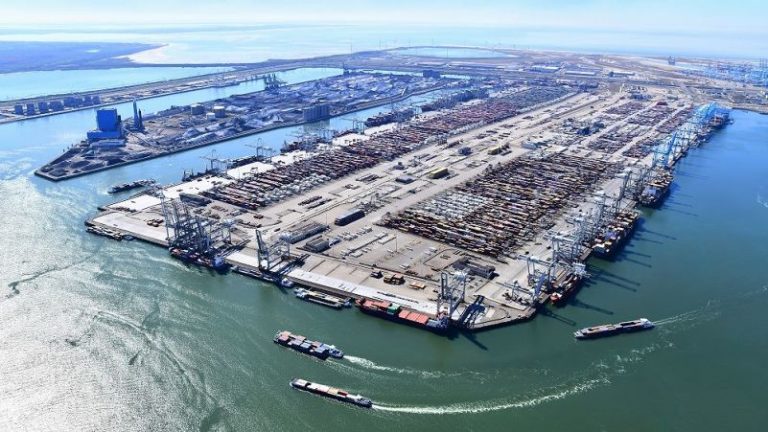
According to the report “The Leading Container Ports of the World 2025”, produced by DNV and Menon Economics, competition is entering a more complex phase in which connectivity, real productivity and sustainability strategies matter more than absolute volumes. The data show that the main Asian hubs continue to dominate relations with carriers and long-haul networks, while significant differences are emerging in quay efficiency and in the ability to reduce environmental impact. Regional analyses also highlight divergent trends across North America, Europe and the Middle East, driven by infrastructural specialisation and targeted investment.
The report notes that connectivity remains the most distinctive factor in global competition. Singapore, Shanghai, Ningbo-Zhoushan, Qingdao and Shenzhen all serve the world’s fifteen largest shipping lines, a presence that continues to support stable flows even during swings in demand. Major European and North American ports such as Rotterdam, Antwerp, Los Angeles and New York & New Jersey rank around twenty-eighth in terms of the number of carriers served, reflecting a more selective network structure.
UNCTAD’s maritime connectivity index confirms Shanghai as the world’s leading port thanks to 237 liner services linking it to over 400 ports, while Singapore retains first place for direct long-haul services, reinforcing its central role in intercontinental trade. The report also highlights a subjective evaluation: international operators place Singapore first for responsiveness and procedural simplicity, an operational factor that influences route choices as much as infrastructure availability.
The productivity analysis highlights a recurring paradox: the largest ports do not always record the best berth-side performance. Ningbo-Zhoushan shows a berth-utilisation rate of 92%, among the highest globally, with infrastructure in constant use. However, smaller ports such as Kobe in Japan and Qinzhou in China lead the productivity ranking per metre of quay, supported by lower operational complexity.
The report clarifies that transhipment tends to reduce apparent speeds: Singapore, although the world’s top port, ranks fifteenth for pure productivity. More than 75% of its volumes are linked to transfers between mother vessels and feeder units, a system that requires complex planning and slows average movement speeds. Operational resilience is instead a key advantage for the major hubs. Ningbo-Zhoushan is considered the most efficient port in managing peaks, capable of increasing capacity by 20% within 48 hours through a blend of automation and flexible labour.
The chapter on sustainability highlights markedly different regional strategies. Los Angeles is the port with the highest shore-power capacity, with 40 megawatts installed enabling vessels to shut down engines during port calls. Hamburg follows with 30 megawatts, while many Asian ports still show limited equipment despite high volumes.
Rotterdam stands out as a benchmark for alternative fuels, with 70,949 cubic metres of green storage capacity and a range that includes bio-LNG and methanol. Singapore has 46,200 cubic metres, a smaller figure but still significant given its intercontinental role. The report also notes that Shenzhen records the lowest emissions per container handled, confirming that operational efficiency is currently one of the most effective tools for reducing relative environmental footprint, often more so than technologies still in early development.
Regional analysis shows highly differentiated competitive dynamics. In North America, New York & New Jersey emerges as the region’s top port thanks to direct access to a consumer base of 23 million people and a regional GDP of USD 1.8 trillion (around EUR 1.65 trillion). Savannah is experiencing the fastest growth on the East Coast and continues to invest in handling large-capacity vessels, strengthening its competitive edge in operational efficiency.
In Europe, Rotterdam leads not only in volumes but also in digital applications, with the use of digital twins to improve flows and large-scale automated processes already in place. The report gives particular attention to Tanger Med. Although located in Africa, the port is functionally integrated into the Mediterranean and European network, and with nineteenth place globally it surpasses many of the continent’s historic ports in connectivity and transhipment capacity.
In the Middle East, Jebel Ali in Dubai remains the main port for volumes and connections, but Khalifa Port in Abu Dhabi is the region’s fastest-growing hub. According to the report, the port has recorded a 57.6% increase over three years and stands out for its automation investments and partnerships with shipping groups such as Cosco and MSC, which are reshaping its regional positioning.
The document concludes that competition among ports will increasingly focus on operational resilience and the ability to deliver credible medium-term expansion plans. Shipping operators prefer ports capable of ensuring predictable capacity over a three-to-five-year horizon and offering multi-fuel bunkering options, from today’s liquefied fuels to methanol and ammonia, a factor that could redefine the geography of the central nodes of future low-emission fleets.
Antonio Illariuzzi