






The largest and most ambitious enhancement programme for the federal railway network in Germany is to be revised and updated after firm objections from stakeholders. In a statement dated 25 June 2025, DB acknowledged the project’s critical issues. From the outset, the methods and timing of the proposed interventions had sparked sharply divided opinions. At the heart of the debate lies the strategy launched by DB in 2024 under the so-called “comprehensive refurbishment” plan, which called for closing entire lines for several months to carry out all necessary works in one go and then reopen the routes fully upgraded.
The rail operator has pointed to the pilot project on the Frankfurt–Mannheim line, also known as the Riedbahn, as a significant and successful example. This line is one of the busiest in the country and a key axis in the Rhine–Alpine corridor. The 78 kilometres forming the core of the main route connecting central Germany to the south and to Switzerland were closed to all traffic for five consecutive months from 15 July 2024. According to Deutsche Bahn, the operation was a success. However, for freight operators it came at an unacceptably high cost.
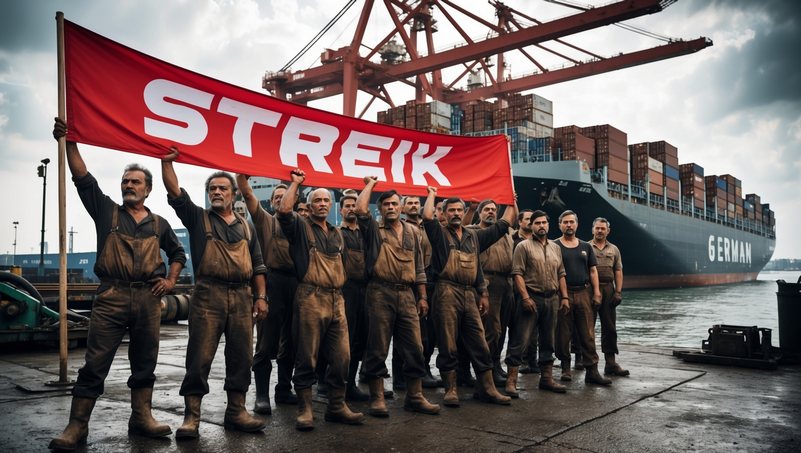
Meanwhile, DB InfraGo, the infrastructure manager, has scheduled a similar intervention to overhaul the 278-kilometre mainline between Hamburg and Berlin, with a nine-month closure starting on 1 August 2025. This decision has been challenged by Die Güterbahnen, an association representing around one hundred rail freight companies committed to the vision of a single European railway network. Operators argue that the strategy adopted by DB InfraGo, based on prolonged closures, is extremely harmful—particularly for freight transport—and that the alternative routes offered during the Frankfurt–Mannheim works proved inadequate.
Die Güterbahnen has called on the transport minister to revise the railways' current planning strategy, in line with the promises made during the last election campaign that led to the formation of the new government. Operators warn of the risk of failing to address the issue promptly, thereby implicitly endorsing DB InfraGo’s decisions and the projects already scheduled through to the end of 2026. The association accuses the government of passively accepting the assessments made by the federal infrastructure manager without critical scrutiny. Operators, by contrast, are calling for direct involvement in the planning process through institutional dialogue with DB InfraGo to identify more widely supported solutions with less damaging consequences for freight transport.
After months of criticism over delays and disruptions caused by total line closures, the rail operator has now agreed to lessen the severity of its shutdowns, extending the overall intervention timeline by up to five years beyond the original 2030 target. Nonetheless, the projects already planned up to 2026 are expected to proceed unchanged, particularly the complete closure of the 278-kilometre mainline between Berlin and Hamburg for nine months starting 1 August 2025. In practical terms, this means that the entire “generalsanierung” initiative—which encompasses the renewal of 42 rail corridors over a total length of 4,000 kilometres—will not be completed before 2035.
Reportedly, works on the Lübeck–Hamburg line will be delayed by one year, from 2027 to 2028, while the refurbishment of the Frankfurt–Heidelberg line will be pushed back from 2027 to 2030. Only four lines will be upgraded in 2028, compared to the nine originally planned. The last line to be fully modernised will be the Flensburg–Hamburg route, for which completion is not expected before 2035.
Piermario Curti Sacchi