





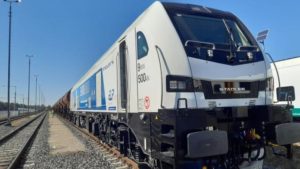
Testing is nearing completion for the introduction into service in Italy of one of the most innovative locomotives, and one of the few specifically designed and built for freight operations. It is the Euro 9000, produced by the Swiss company Stadler. The novelty of the design only partly explains the long development timeline. The first unit arrived in Italy in July 2021, when initial certification tests began, but it is only in March 2025—nearly four years later—that in-line testing has commenced.
This speaks volumes about the complexity of bureaucratic procedures. It is worth noting that the Euro 9000 series has been in production by Stadler since 2020 and, as an interoperable machine, has already received authorisations from several other European networks in the meantime—Germany and Austria in March 2023, and Belgium and the Netherlands in December of the same year. In Italy, the infrastructure manager RFI has shown great caution, partly because the Euro 9000 features a non-standard technical solution: traction is distributed over six axles arranged in two bogies, with three axles each, following the Co’Co’ configuration typical in railway classification.
It has been years since the FS Group abandoned six-axle locomotive designs. The most recent examples, dating from the late 1980s and early 1990s, belonged to the E.652 series, known as "Tigers", but featured three bogies with two axles each. The six-axle design gradually fell out of favour for two main reasons. First, technological advances made the simpler four-axle models increasingly reliable, powerful and versatile, suitable for both passenger and freight services. Second, six-axle locomotives exert more force on the track, leading to higher maintenance costs for the infrastructure.
However, new technologies and electronics have now overcome these traditional limitations. In the Euro 9000, the three axles on each bogie are powered by asynchronous three-phase motors and, crucially, each axle is controlled individually to prevent slippage and ensure optimal traction effort, thereby reducing stress on the track. This advancement has enabled the creation of a remarkably powerful locomotive, a true market leader in terms of performance. Borrowing the nickname of a nineteenth-century locomotive built for the Giovi railway, it could aptly be called the Mastodon of the mountain passes.
Under the highest-performing 25 kV alternating current system, the Euro 9000 reaches a power output of up to 9 MW, compared to an average of 6 MW delivered by the most modern four-axle locomotives. Thanks to this, it can haul heavy freight trains on steep gradients that would usually require double traction, whereas in this case a single locomotive suffices, bringing significant operational cost savings.
The Euro 9000 is intended for operation along major European freight corridors. For this reason, it is a multi-voltage locomotive, specifically quadri-current, operating under 1.5 and 3.0 kV direct current, and 15 and 25 kV alternating current (using four different pantographs). It is also equipped with a diesel module and a battery pack, enabling three distinct propulsion modes: electric, diesel and battery (the latter at reduced power).
It goes without saying that it comes standard with the European Train Control System (ETCS), but it can also be fitted with various national safety packages, including automatic protection systems, making it a truly pan-European locomotive. According to the classification universally adopted by European railways, its configuration is listed as Dachinlb, meaning it is authorised to operate without restrictions in Germany, Austria, Switzerland, Italy, the Netherlands and Belgium. Or at least, it will be in Italy once the Amis—authorisation for entry into service—is finalised. At that point, it will be able to demonstrate its full capabilities on mountain routes, with numerous units already acquired by leasing companies for their traction fleets.
Piermario Curti Sacchi