






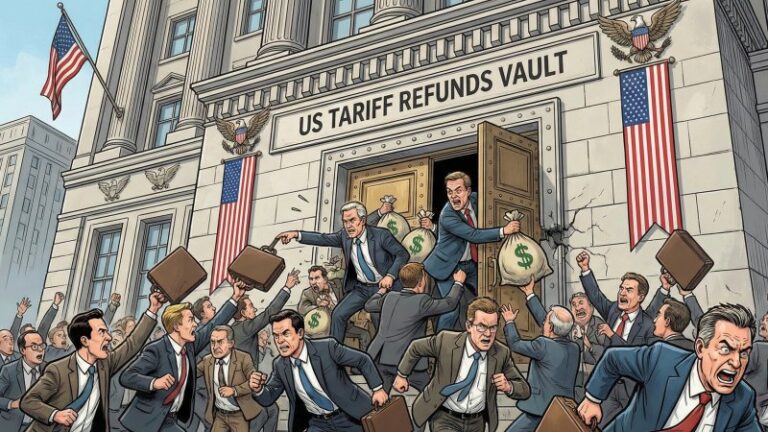
- The US Supreme Court has ruled that the Ieepa tariffs collected between February 2025 and February 2026 were unlawful from the outset, for an estimated value of up to 175 billion dollars. Exclusive jurisdiction over refund claims lies with the Court of International Trade (Cit) in New York.
- Importers have three routes to recover sums paid: individual or class actions before the Cit, electronic administrative corrections through the Cbp’s Ace portal for entries not yet liquidated, and court-ordered reliquidation. The Treasury estimates 12 to 18 months just for the first instalments of refunds.
- The Government is preparing to challenge claims by invoking the statute of limitations — 180 days from liquidation to file a protest — and the pass-through argument, namely the transfer of tariff costs to final consumers. A secondary market is already emerging, with specialist funds buying tariff credits at a discount.
The 20 February 2026 ruling of the US Supreme Court in the case of Learning Resources v. Trump declared unlawful the tariffs imposed by the administration during 2025 under the 1977 International Emergency Economic Powers Act (Ieepa). By a six-to-three majority, the Court held that the law did not grant the President authority to impose customs duties. The direct consequence is the opening of one of the largest recovery disputes in US trade history: cumulative Ieepa tariff revenues are estimated at between 130 and 175 billion dollars, collected between February 2025 and February 2026 by Customs and Border Protection (Cbp).
The scale of potential refunds stems from the very nature of the Ieepa tariffs. Having been declared unlawful from the moment of their introduction, they are deemed “unduly paid” and therefore subject to reimbursement with interest. All nine Supreme Court justices agreed on one point: exclusive jurisdiction for handling claims rests with the New York-based Court of International Trade (Cit), which oversees civil actions against the United States arising from customs laws.
Determining who is entitled to seek reimbursement requires an examination of how the economic burden of the tariffs was distributed along the supply chain. Research by the Federal Reserve Bank of New York and the Yale Budget Lab indicates that for every percentage point of tariff imposed, foreign export prices fell on average by only 1.4%, leaving 8.6% of the cost borne by the US importer. Overall, American importers absorbed between 50% and 55% of the total burden through direct payments to Cbp and margin compression, while final consumers shouldered between 35% and 40% through higher retail prices. Foreign exporters bore only between 4% and 14% of the cost. Despite this distribution, the law is clear: the right to a government refund belongs exclusively to the importer, regardless of how much of the cost was passed downstream.
From a procedural standpoint, importers have three distinct routes to recover the sums paid. The first is to file individual or class actions directly with the Cit. A number of companies had already launched “protective actions” while the main case was still pending, including Costco, Revlon and EssilorLuxottica, thereby preserving their rights regardless of the outcome. The second route is administrative. For import entries not yet “liquidated” — that is, not finalised by Cbp — electronic corrections may be submitted via the Ace portal, removing the Ieepa tariff codes and securing recalculation without recourse to the courts. The third route, considered the most likely in most cases, is court-ordered reliquidation. The Cit may order a recalculation of duties for all affected transactions and instruct Cbp to issue refunds with interest.
Timelines, however, are unlikely to be short. The federal Treasury has estimated that processing the first instalments of electronic refunds alone will take between 12 and 18 months, and Justice Kavanaugh noted in his opinion that the process will be complex. The administration has already indicated that it does not intend to facilitate refunds voluntarily, and the Department of Justice is preparing to raise several objections to limit the state’s financial exposure.
The first defence the Government may invoke concerns time limits. Importers generally have 180 days from the liquidation of a customs entry to file a formal protest with Cbp. Those who did not act within that window — in many cases because the main litigation was still ongoing — may now need to seek a retroactive extension from the courts, with uncertain outcomes.
The second objection centres on the pass-through argument. The Government may contend that companies which have already recovered the cost of the tariff by raising prices to their customers are not entitled to further reimbursement from the state, characterising such claims as “unjust enrichment”. However, previous case law tends to favour importers, recognising the importer as the sole party with standing, regardless of downstream pricing decisions. A third challenge is purely administrative: Cbp will have to handle millions of reliquidation requests, an operation unprecedented in scale and complexity.
Amid this uncertainty over timing, an unexpected financial development is taking shape: the emergence of a secondary market for tariff credits. Hedge funds and institutional investors have begun purchasing refund rights at a discount from companies facing liquidity pressures after months of heavy tariff payments. The mechanism mirrors established practices for tax credits and class actions: companies assign their future refund rights in exchange for immediate liquidity, while investors bet on the legal certainty of reimbursement and the timing of payment. The phenomenon underscores the market’s confidence, despite bureaucratic complexity, in the enforceability of the refund right established by the ruling.
Contractual disputes along the supply chain add a further layer of complexity. During 2025, purchase prices were often increased to incorporate the cost of the tariff, sometimes on the basis of explicit agreements between foreign suppliers and US buyers. In such cases, the question of who is entitled to the government refund is not always straightforward. Although the refund legally belongs to the importer, some foreign suppliers may assert claims based on indemnity clauses or prior cost-sharing agreements. Legal departments and freight forwarders must therefore scrutinise contracts signed during 2025 to assess potential exposure.
For logistics and freight transport companies, the picture is further complicated by the new tariff regime activated by the administration just hours after the ruling. The President issued a proclamation under Section 122 of the Trade Act of 1974, introducing tariffs of up to 15% for 150 days — due to expire on 24 July 2026 — to address balance-of-payments imbalances. This means that while operators begin procedures to recover Ieepa tariffs paid in 2025, they must simultaneously manage new tariff costs and revise landed cost estimates for ongoing imports.
M.L.