





Since the morning of Saturday 10 October, the port of Rijeka has been without a rail connection to Zagreb following the derailment of a freight train at 9:25 am. The Transagent train, carrying grain and heading towards the port, derailed on the points at the entrance to Meja station, on the M202 line, sending eleven wagons down an embankment, while the locomotive and two other wagons remained within the station area. No injuries were reported. The closure affects Meja station and the section between Plase and Meja. HŽ Infrastruktura has introduced replacement buses for passengers between Rijeka and Plase, where trains continue towards Zagreb. Freight services, however, have been suspended in both directions, preventing cargo unloaded at the port from being forwarded by rail and goods intended for shipment from reaching the Croatian port. The disruption could reduce grain volumes handled during this period and affect vehicle traffic. The most immediate problem concerns the Bakar terminal, where a vessel carrying bulk cargo is expected to arrive with a shipment that can only continue its journey by rail.
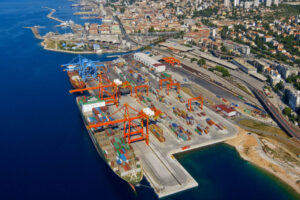
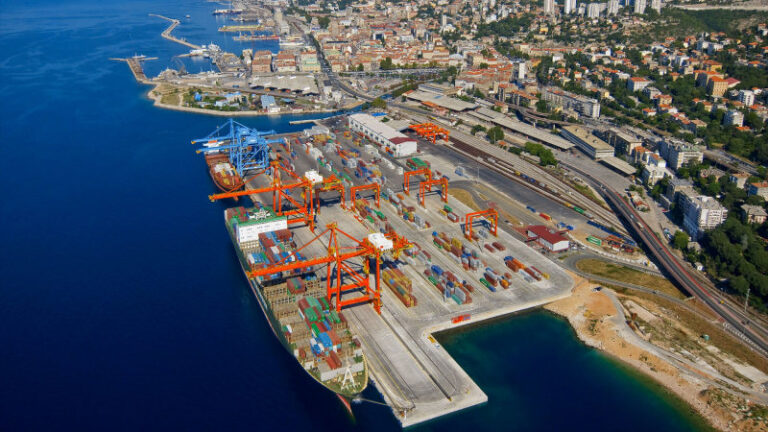
The two container terminals, Jadranska Vrata at Brajdica and Rijeka Gateway, have yet to assess the consequences, as the duration of the closure remains uncertain. Both terminals, however, remain accessible by road. The Port Authority has confirmed that truck collections and deliveries are continuing at Brajdica, while Rijeka Gateway manages vehicle arrivals through a booking system. Nevertheless, both terminals were designed for a landside transport split of 60% rail and 40% road. The port's other rail connection, through Šapjane, Pivka and Ljubljana in Slovenia, is not an equivalent alternative. For several markets served by Rijeka, the route is longer and more expensive, while a 20-tonne axle-load limit on one section of the Slovenian network restricts heavy freight trains.
Croatia's Air, Maritime and Railway Traffic Accident Investigation Agency (AIN) has opened an investigation into the cause of the derailment. It has been established that, before the accident, the driver of train 82318 informed the traffic controller that he was unable to stop the train. The Minister of the Sea, Transport and Infrastructure, Oleg Butković, said the line was fit for operation and that the accident could have resulted from a technical fault or human error, stressing that the investigation would establish the cause. Damir Lončarić, president of HŽ Infrastruktura, called for more thorough inspections of wagons and locomotives, particularly those operated by private companies. If the problem involved the braking system, he observed, the railway infrastructure was not responsible.
The Croatian train drivers' union, Sindikat Strojovođa Hrvatske, has raised concerns about the wagons. Its president, Nenad Mrgan, told broadcaster HRT that the union had previously reported safety problems involving this type of grain wagon and that HŽ Cargo had agreed not to use them for such shipments. Union representative Miroslav Krulčić questioned the reliability of the braking system after prolonged use on steep downhill gradients. Krulčić also referred to an accident in the same area at the end of 2023. On 11 December 2023, a Rail Cargo Carrier-Croatia freight train carrying 19 wagons of grain towards Rijeka failed to stop at Meja, where stopping was mandatory. Between Meja and Škrljevo, it collided with an HŽ Infrastruktura maintenance vehicle, causing most of the train to derail.
Antonio Illariuzzi