






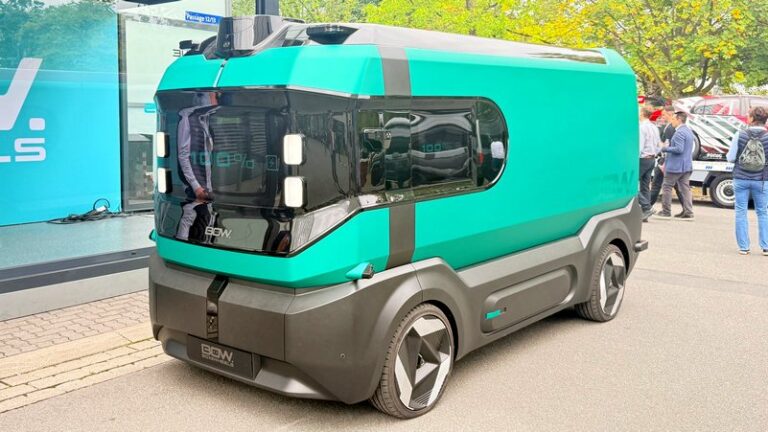
Stellantis Pro One, the commercial vehicle division of the Franco-Italian group, unveiled Bow, an acronym for Box on Wheels, at IAA Transportation 2026. The electric, autonomous and connected prototype is designed for urban distribution. Developed with China’s Uqi Robotics, the project is intended as a technology platform through which Stellantis is exploring the evolution of logistics operations in urban centres. The starting point is the changing requirements of distribution: deliveries need to become faster and more flexible, while operators are seeking to contain costs and gain greater control over their fleets. At the same time, city authorities want to reduce traffic, emissions and noise, particularly in low-emission zones and restricted-traffic areas. Against this backdrop, automation could complement traditional professional mobility.
Bow combines electric propulsion, autonomous driving, connectivity and digital services on a single platform. The aim is not simply to remove the driver from the vehicle, but to rethink the entire process of moving goods: the “box” becomes a mobile logistics module designed to carry out repetitive, programmable missions in urban or controlled environments. To develop the prototype, Stellantis Pro One worked with Uqi Robotics, a company specialising in artificial intelligence, robotics and autonomous driving technologies. The Chinese joint venture was established in 2020 by Ubtech and Miracle Automation, companies active respectively in robotics and industrial automation. The partnership aims to assess how automation can be integrated into professional operations, moving beyond simple driver-assistance functions towards fully driverless transport missions.
The trial is particularly relevant in environments where routes are more predictable. Bow is designed to operate in urban distribution and in settings such as industrial plants, hospitals and airports, where routes, speeds, loading and unloading points and operating procedures can be defined with a greater degree of standardisation than on ordinary roads. Fully electric propulsion eliminates tailpipe emissions and reduces noise during operations, an important factor for deliveries carried out during periods when traffic is restricted.
“Professional customers are increasingly looking for solutions that go beyond the vehicle itself,” said Eric Laforge, Global Senior Vice President of Stellantis Pro One. “Through this collaboration with Uqi Robotics, we are exploring how autonomous technologies, connectivity and services can contribute to the future of commercial mobility.” Alongside the prototype, Stellantis Pro One also brought a working demonstrator to Hanover, showing it in operation outside the exhibition area to illustrate how the platform can be adapted to different logistics missions. The company has not yet released any technical specifications: battery capacity, driving range, payload, motor power and the level of autonomous driving all remain undisclosed. Testing, which will assess performance, customer benefits and the potential to scale up the project, will initially focus on Europe, with possible expansion into other international markets at a later stage.
Massimiliano Barberis