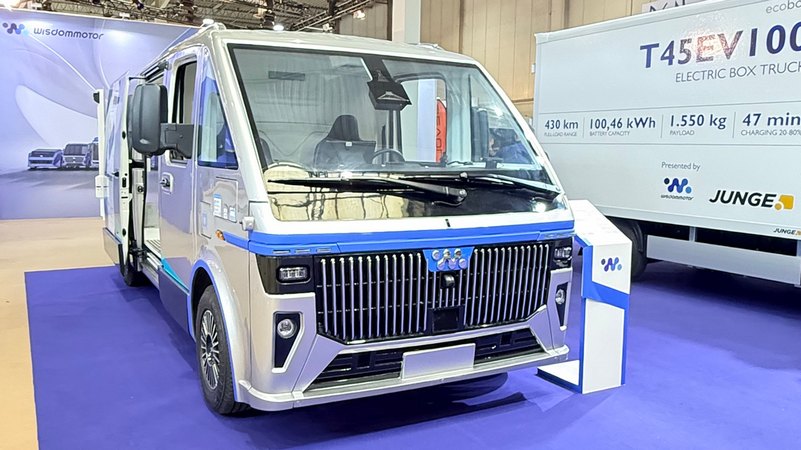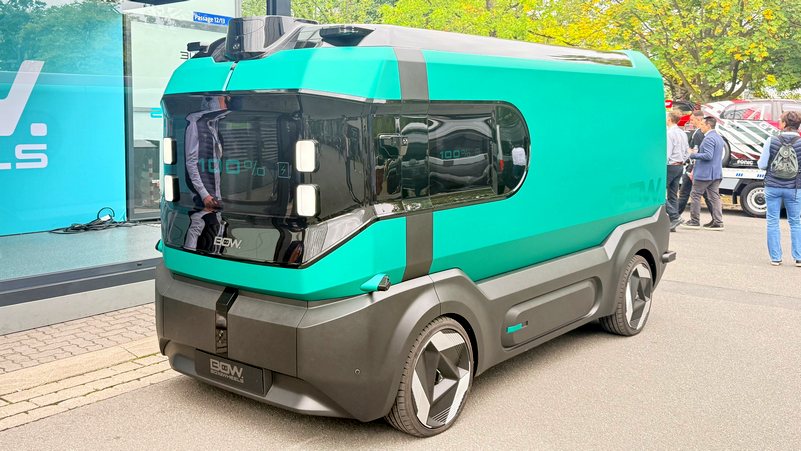





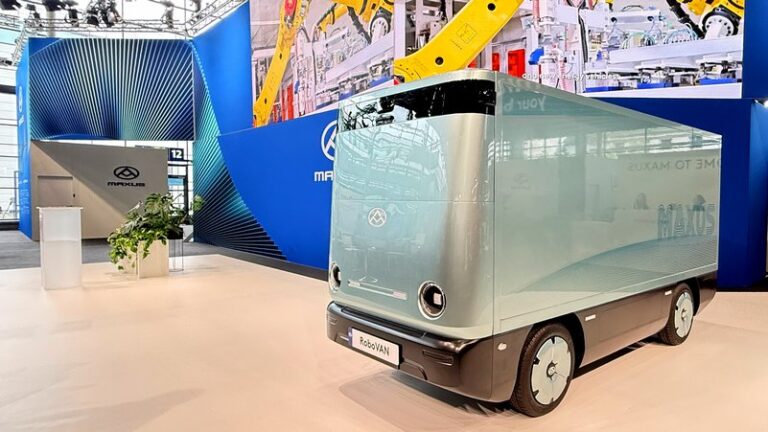
Among the vehicles presented by SAIC Maxus at IAA Transportation 2026 in Hanover is the Robovan, a commercial vehicle developed for autonomous logistics that can operate according to SAE Level 4 autonomous driving principles. The project is one of the most advanced elements of the Chinese group's strategy for intelligent commercial vehicles. SAIC has included the Robovan in its European push alongside electric vehicles, new commercial models and solutions for heavy-duty transport. The most striking figure is the experience it has already accumulated: the vehicle has covered more than ten million kilometres in trials.
The Robovan's autonomous driving system is based on a perception platform comprising three Lidar sensors and eleven cameras, designed to provide the system with a continuous representation of its surroundings and support autonomous driving functions. The vehicle retains characteristics suited to logistics operations, with more than 6 cubic metres of cargo space and a payload of up to 1,500 kg. These figures position it for urban and last-mile applications, precisely where automation could find some of its most interesting uses: repetitive deliveries, predefined routes, logistics centres and connections between hubs and distribution points.
However, the presentation in Hanover should not be interpreted as the announcement of a van intended to replace drivers on European roads in the short term. Level 4 is linked to specific operating environments and to a regulatory framework that still needs to evolve, particularly for widespread use on public road networks. The industrial significance of the vehicle is therefore broader. SAIC is simultaneously developing electrification, connectivity, automation and energy management, viewing these elements as components of a single ecosystem for freight transport. This strategy is also reflected in the range presented in Hanover, which includes different energy technologies and solutions for a variety of professional applications.
Automation is therefore not merely an additional vehicle function, but a possible new way of organising distribution. In this sense, the Robovan is a laboratory on wheels: today it is primarily a technology platform undergoing testing and validation; tomorrow it could become one of the tools through which delivery services are redesigned. SAIC has already gained experience with Level 4 technology in other areas, including autonomous vehicles for logistics and operations in controlled environments. The real novelty, then, is not simply seeing a driverless van in Hanover. It is seeing how a major Chinese manufacturer is seeking to bring electric vehicles, software, sensors, data and energy infrastructure together on an equal footing, laying the foundations for a transport model in which the commercial vehicle becomes part of a broader digital platform.
Massimiliano Barberis