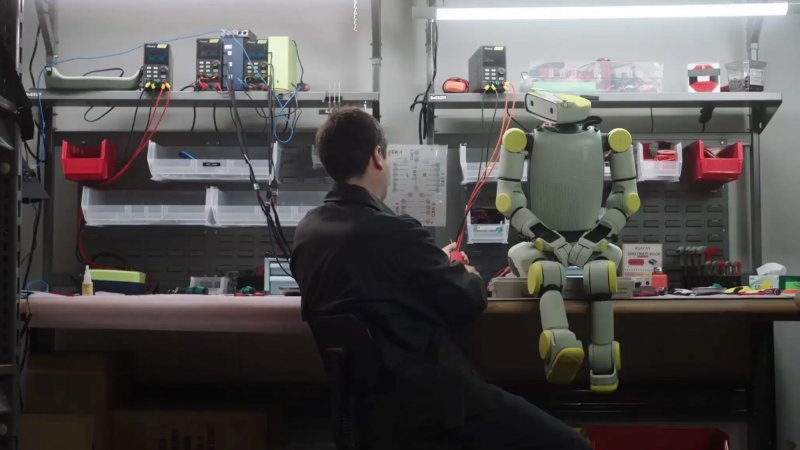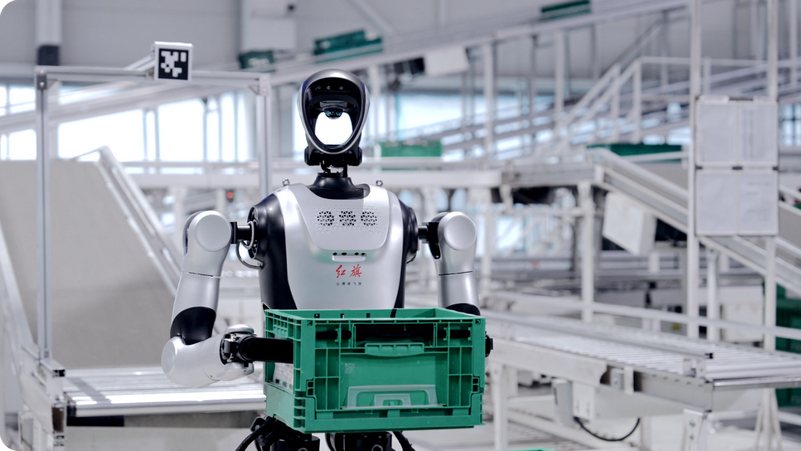






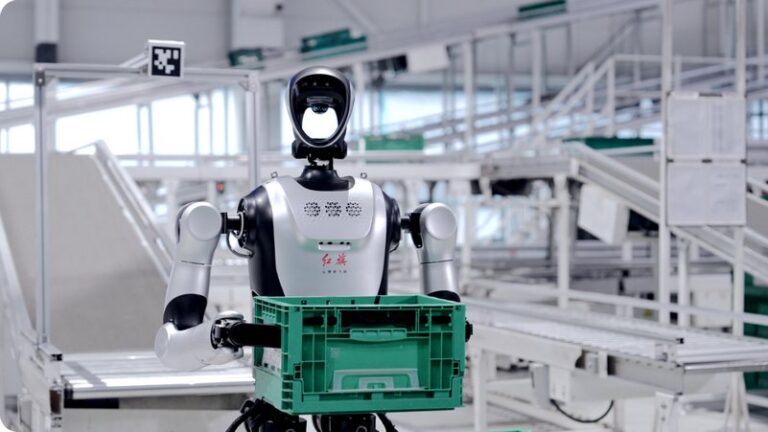
According to institutional sources and Chinese media, an automated production line dedicated to humanoid robots came into operation on 29 March 2026 in Foshan, in Guangdong province. The facility has been developed by Guangdong Dongfang Precision Science & Technology in collaboration with Leju (Shenzhen) Robotics and is described as the first of its kind in the country. The declared capacity exceeds 10,000 units per year, with a stated production pace of one robot every thirty minutes.
Technical details released indicate a production structure organised into 24 fully digitalised precision assembly stages, supported by 77 quality control and testing procedures. This setup aims to industrialise a process that has so far been characterised by semi-manual or low-repeatability operations, introducing more extensive traceability across the entire line. In this sense, the project marks a transition from demonstration production to scalable manufacturing of humanoid robots.
There is some ambiguity regarding the plant’s location. The most precise sources identify Foshan as the manufacturing site, while Shenzhen is referenced due to the role of Leju Robotics, which is embedded in the city’s technology ecosystem. This distinction is significant as it reflects the functional division within Guangdong: Shenzhen as a hub for research, development and supply chains, and Foshan as a manufacturing platform. The regional context helps explain the speed of the initiative’s development. In Shenzhen, the robotics supply chain has a local integration level exceeding 60%, involving more than 200 companies and institutions and generating a total value of over 40 billion yuan, equivalent to around €5.2 billion. This ecosystem supports the availability of components, expertise and suppliers, reducing industrialisation times and facilitating the transition to more structured production.
The project represents an attempt to introduce advanced manufacturing principles into the humanoid robotics segment, which until now has been dominated by prototyping and limited production runs. The ability to manage multiple models on the same line while maintaining consistent quality standards is cited as one of the plant’s main objectives. It should be noted that the capacity of more than 10,000 units per year refers to the plant’s nominal capacity and not to output already achieved or backed by orders. Sources do not provide details on line utilisation rates, unit costs, production yields or scrap levels, all of which are necessary to assess the project’s actual industrial maturity.
Leju Robotics’ industrial track record nevertheless suggests that the initiative is not starting from scratch. According to local sources in Shenzhen, the company had already delivered its hundredth full-size unit by January 2025, with applications in industrial, commercial and educational contexts. Some deployments are reported to have delivered productivity gains of between 30% and 50% compared with human labour, although these claims are also based on statements that have not been independently verified.
The language used by Chinese sources reflects a strong industrial policy orientation, with the project presented as a strategic step towards large-scale production and national technological leadership. This approach tends to merge technological innovation, regional development and the country’s competitive positioning. Humanoid robots may also find applications in logistics, particularly in picking small items or handling boxes and crates.
Antonio Illariuzzi