


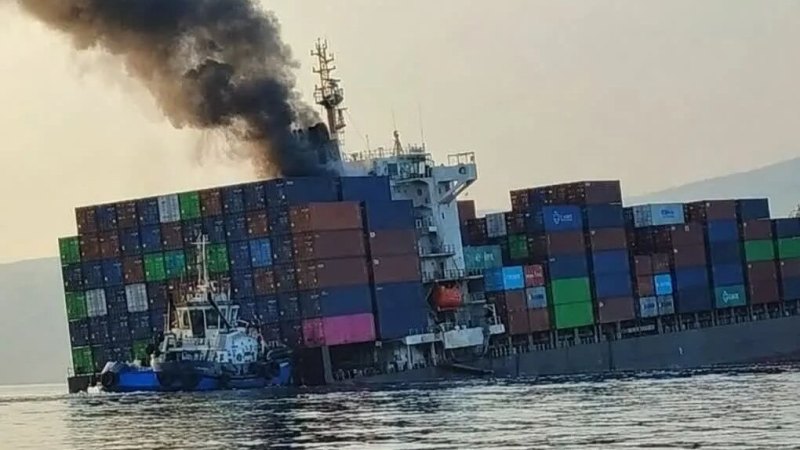




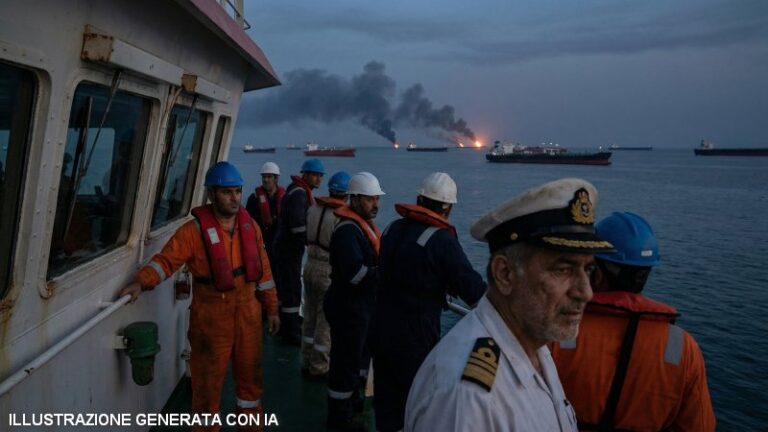
While global attention is largely focused on the cargoes of ships stranded in the Persian Gulf due to the de facto blockade imposed by Iran, it is often overlooked that thousands of people live and work on those vessels, effectively as prisoners. There are around 20,000 seafarers, and the International Maritime Organization (IMO) has described their situation as “unacceptable and unsustainable”. These men make up the crews of around 3,000 ships unable to transit the Strait of Hormuz to reach the Indian Ocean. The blockade affects container ships, tankers, bulk carriers, gas carriers and offshore units, with crews forced to remain on board amid growing instability. Cruise ships are also involved, adding at least another 15,000 people to the “prisoners”.
Most of the ships currently stranded are in waters near Iran, Iraq, Kuwait, Saudi Arabia, the United Arab Emirates, Qatar and Bahrain, or anchored off ports in the region. IMO Secretary-General Arsenio Dominguez has repeatedly called on the international community, stressing that “seafarers must not be targets” and that no attack on civilian shipping can be justified. His statements follow a series of serious incidents in the Strait of Hormuz, including an attack on 6 March that left at least four seafarers dead and three injured. In the preceding days, further deaths and missing crew members were reported in incidents involving commercial shipping, including a deep-sea tug struck by a missile.
Conditions on board are becoming increasingly difficult. The IMO reports severe psychological stress among crews forced into prolonged stays in a high-risk environment, with uncertainty over disembarkation and repatriation. Extended periods on board beyond contractual limits, already seen during the Covid-19 crew change crisis, are once again becoming a tangible risk. The call to uphold the Maritime Labour Convention of 2006 is explicit, particularly regarding the right to repatriation and crew rotation.
From a contractual and trade union perspective, the International Transport Workers’ Federation and the Joint Negotiating Group classified the “Strait of Hormuz – Gulf of Oman – Persian Gulf” area as a “Warlike Operations Area” between 5 and 6 March 2026. This decision, taken במסגרת the International Bargaining Forum, introduces additional protections for seafarers, including the right to refuse assignments in war zones, wage bonuses and enhanced insurance cover.
According to the unions and employers’ organisations involved, hundreds of ships were already stationary at the time of the designation, with numbers rising in the following days. Shipowners have been advised to adopt security measures equivalent to the highest levels set out in the International Ship and Port Facility Security Code. However, these measures do not resolve the core issue, which remains the inability to guarantee minimum safety conditions for transit.
In the IMO’s assessment, the current crisis goes beyond its economic and logistical impact. The central issue is the protection of seafarers as workers and as civilians. The agency explicitly recalls the obligations of states and operators: ensuring access to medical care, psychological support, leave and the possibility of disembarkation, as well as physical protection in conflict situations. It also calls for the creation of safe corridors to allow stranded ships to leave the area and, where requested, to enable crew evacuation. Coordination between coastal states, flag states and international organisations is identified as essential to managing a crisis that simultaneously affects safety, labour and the continuity of trade flows.
Antonio Illariuzzi