




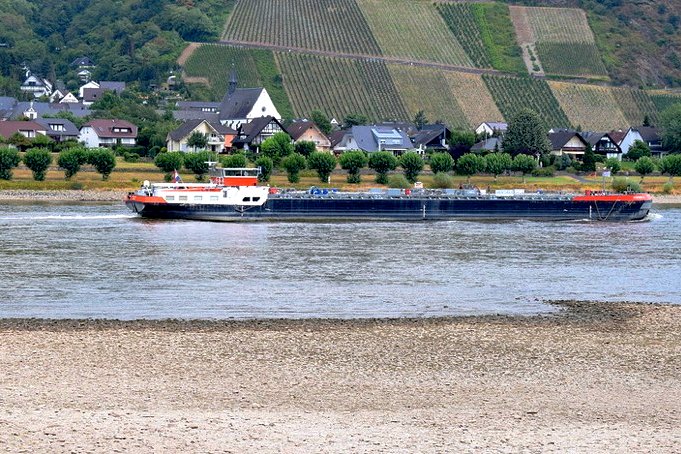
Despite some rainfall in northern Europe, the level of the Rhine remains at seasonal lows: at 10.00 on 27 August 2026, the level recorded at Kaub, the point on the Middle Rhine most closely watched by operators because it determines the permissible load on barges heading towards Bingen and Koblenz, stood at 59 centimetres, after a peak of 64 centimetres recorded at midnight. Forecasts issued by German hydrological bodies indicate a further fall in the following days: 61 centimetres on 28 August, 60 centimetres on 29 August and 56 centimetres on 30 August.
The situation is not uniform along the full course of the river. At Duisburg-Ruhrort, on the Lower Rhine, the level rose to 195 centimetres at 05.00, up 14 centimetres from the previous day, but it remains 32 centimetres below the 227-centimetre Gleichwertiger Wasserstand (GlW, equivalent water level), the benchmark used by German navigation authorities to determine the permissible loading capacity of inland vessels. Koblenz also showed a recovery, at 68 centimetres, while still remaining below the local GlW of 77. In Cologne, the level began falling again, with 112 centimetres recorded on 27 August and a further decline to 106 expected the following day, also below the local GlW of 139 centimetres.
Rainfall in the previous week produced a limited improvement in some basins, according to Bundesanstalt für Gewässerkunde (Bfg, the German Federal Institute of Hydrology), but on the Rhine the trend remains weak, with levels stable or slowly falling, and the institute does not expect any significant easing of the low-water situation before mid-September. The emergency therefore continues for inland waterway operators. The further decline expected at Kaub entails severe loading restrictions for vessels crossing the Middle Rhine, while the recovery at Duisburg-Ruhrort does not amount to a return to normal water conditions. The continuing drought suggests that low-water surcharges, draught reductions and the need to split cargoes will remain in place, particularly for bulk goods and energy products.
While the situation is serious in Germany, it could be an opportunity for Italy. In a note issued on 27 August, Federlogistica president Davide Falteri said the crisis on the German river highlights four elements he considers underestimated: the first concerns the ability of climate and security factors to overturn established logistics structures; the second points to possible short-sighted infrastructure choices behind crises such as the Rhine emergency; the third is increasingly tough competition between European countries affected by the production crisis in some dominant industrial supply chains. The fourth is the most significant for Italy, as it identifies the current situation as an opportunity for Mediterranean ports to recover traffic currently routed through northern European ports, provided rapid decisions are taken on the congestion already affecting Alpine rail and motorway links towards the Upper Tyrrhenian and Upper Adriatic.
Climate and geopolitical variables, Falteri added, are no longer a temporary emergency but a stable scenario in which the competitiveness of manufacturing companies must operate, taking decisions often described as traumatic. For the president of Federlogistica, the steady rise in transport costs should long ago have triggered alarm signals. In this context, Italy’s logistics and infrastructure system maintains reaction times comparable to those of steam locomotives, both among institutions and among parts of the business community accustomed to treating northern European ports and Mediterranean ports, more than a thousand kilometres apart, as interchangeable options.
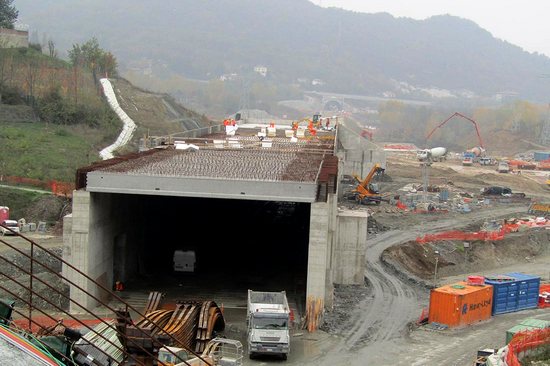
For Falteri, this crisis should turn into a strategic question managed without bureaucratic delays, capable of offering Swiss and European companies a credible southern alternative. Genoa and La Spezia, Falteri concluded, can become a natural gateway for Switzerland and central Europe to the Mediterranean and international markets, provided concrete investment is implemented: adequate rail capacity, reliable links through the Terzo Valico and the Alpine crossings, efficient terminals, rapid customs procedures and specialised services for chemical, pharmaceutical, hazardous and temperature-controlled products.
Antonio Illariuzzi