





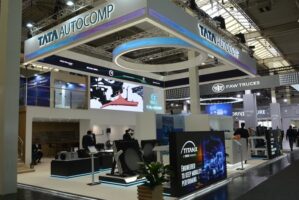

On 30 July 2025, a chapter in Iveco’s history came to a close, one that had begun exactly fifty years earlier with the merger of the industrial vehicle brands developed or acquired by Fiat up to 1975. The end of this era was marked by the announcement of the sale of 27% of Iveco’s share capital — corresponding to 43% of voting rights — held by Exor (Agnelli family), to Indian automotive giant Tata Motors. The company is expected to launch a public offer for the remaining shares in order to take full control. How Tata will manage Iveco remains to be seen. But who is the new owner?
More than a century of history
Tata Motors’ story began eighty years ago, on 1 September 1945, with the incorporation of Tata Locomotive and Engineering Company (Telco) as a joint-stock company. As the name suggests, the company initially focused on the production of locomotives and boilers to support India’s industrialisation, just emerging from the Second World War and on the verge of independence, which would come two years later. The company was not born in a vacuum; it was an offshoot of the industrial group founded in 1868 by Jamsethji Nasarwanji Tata, initially in the cotton industry and later expanding into steel with the launch of Tata Steel in 1907 and into energy production with Tata Hydro-Electric Power Supply Company in 1910. The group would later diversify into consumer goods, aerospace and chemicals.
A turning point came in 1954, when Tata Motors signed a licensing agreement with Daimler-Benz to manufacture Mercedes industrial vehicles in India. The Tata Mercedes-Benz brand became India’s first truck manufacturer, establishing Tata as a leader in this segment. (Today, Daimler operates in India through its own subsidiary, BharatBenz Trucks, based in Chennai.) In 1961, Tata Motors exported its first truck to Sri Lanka, and in 1966 established its R&D centre in Pune. In 1969, the company officially introduced the Tata brand under the Telco umbrella.
In 1991, Tata Motors entered the passenger car segment with the Tata Sierra SUV, fully designed and manufactured in India, and in 1998 presented the Tata Indica at the Geneva Motor Show, making its debut in the European market. In 2005, Tata Motors launched the Tata Ace, a mini-truck nicknamed “Chota Hathi” (little elephant), which revolutionised local distribution and became the most widespread light commercial vehicle in India. Three years later, Tata made another decisive move by acquiring the British Jaguar and Land Rover brands from Ford, an act viewed by many as symbolic revenge against the country’s former colonial power.
In 2025, Tata Motors initiated a major corporate restructuring, separating its passenger vehicle operations from its industrial vehicle division into two independently listed entities. Today, Tata Motors is considered to be in solid financial health, enabling it to spend €3.8 billion on acquiring Iveco. The company also leads India’s electric car market, holding a 70.5% share thanks to the sale of 64,530 units in 2024.
Dominance in India’s industrial vehicle sector
Tata Motors enjoys a dominant position in the Indian industrial vehicle market, with a 36% market share — rising to 53.9% in the heavy vehicle segment — and aims to increase this to 40% by 2027 through new products, particularly in the light vehicle segment. Its dedicated sales and service network for industrial vehicles spans the entire Indian territory, with 2,553 dealerships and 177 service centres. The company’s product range includes everything from 1.8-tonne minivans to 55-tonne heavy-duty trucks. The product offering is divided into eight specialised verticals: trucks, buses, small commercial vehicles, application-based vehicles, international business, spares and service, digital solutions, and powertrain systems.
At the top of the product range are the Prima and Signa series. The Prima series, including models from the Prima 2823.K to the Prima 5530.S, is designed for construction, mining and long-haul applications, offering up to 220 horsepower and payload capacities of up to 35 tonnes. The more recent Signa series includes the Signa 3523.TK, which also reaches a gross weight of 35 tonnes. In the mid-range segment, Tata offers the Ultra and LPT (Light Platform Truck) series, while the light commercial vehicle segment features the Tata Ace, available in numerous variants, and the newer Intra series.
Energy transition and digitalisation
Tata is also investing in energy transition and digitalisation. In the former, it is developing battery-electric and hydrogen fuel cell trucks, while continuing to explore hydrogen, natural gas, biodiesel and ethanol as fuels for internal combustion engines. At Auto Expo 2025, the company unveiled six new electric industrial vehicles, including the flagship Prima E.55S, which delivers 470 kW of power and offers battery capacities ranging from 300 to 450 kWh, ensuring a range of 200 to 350 kilometres and a total weight of 55 tonnes.
In digitalisation, Tata Motors offers the Fleet Edge fleet management platform, which now connects over 55,000 industrial vehicles — the largest such fleet in India. The platform provides real-time data on vehicle conditions, location and driver behaviour for each connected vehicle. The company has also integrated machine learning technologies, using data and insights from Fleet Edge to develop advanced predictive models. Artificial intelligence is applied across multiple areas, from fuel consumption optimisation to predictive maintenance, route planning and driving behaviour analysis. In 2024, Tata Motors increased its R&D spending by 45% compared to the previous year, reaching €2.5 billion, making it the largest investor in automotive R&D among the Rest of World (Row) countries.
Manufacturing and exports
On the production side, Tata Motors operates a network of manufacturing facilities designed to serve both the domestic Indian market and international ones. The Jamshedpur plant, opened in 1945, is the company’s historic site and manufactures the Tata 697/497 Naturally Aspirated and Turbo Charged engines used across most of its industrial vehicle range. The Pune facility, spread across two distinct locations in Pimpri and Chinchwad, is one of the region’s most versatile and serves as a hub for the production of medium and heavy commercial vehicles. The Pantnagar plant in Uttarakhand specialises in the production of light commercial vehicles.
Outside India, Tata Motors is primarily active in emerging markets across Asia and Africa, where Asian manufacturers such as Isuzu, Mitsubishi, Dongfeng, Sinotruk, Tata itself and Ashok Leyland collectively control 73.1% of the total industrial vehicle market. Tata Motors’ global presence in forty countries, including all SAARC nations, South Africa, the Middle East and Southeast Asia, gives it a major competitive advantage through economies of scale and geographic diversification of revenue. With the acquisition of Iveco, Tata Motors will also enter the European market, which has thus far remained largely dominated by European manufacturers.
The Iveco acquisition
The acquisition of Iveco is Tata Motors’ largest to date, worth nearly twice as much as its purchase of Jaguar and Land Rover. To complete the deal, Tata Motors will establish a Dutch-registered entity called Tml CV Holdings Pte. The newly combined group will have annual sales exceeding 540,000 units and total revenue of around €22 billion, geographically distributed across Europe (50%), India (35%) and the Americas (15%).
Operationally, the acquisition involves minimal overlap between the two companies in terms of products and markets, which should facilitate integration without requiring significant restructuring. Tata Motors has committed to keeping Iveco’s headquarters in Turin and to refraining from plant closures or workforce reductions for at least two years after the transaction’s completion.