



FS Logistix orders eight locomotives
Mercitalia Shunting & Terminal, an FS Logistix company, has ordered eight Eurolight Dual bi-mode locomotives from Stadler as part of a fleet renewal programme aimed at improving operations on the Italian rail network. The model has been developed to meet the specific characteristics of the national network and combines 3 kV DC electric traction with a Stage V diesel engine, allowing it to operate on non-electrified sections without changing locomotives. The Bo’Bo’ locomotive has a 20-tonne axle load, delivers a maximum output of 3 MW in electric mode and provides starting tractive effort of 330 kN. It is also equipped with ETCS B3R2, SCMT and SSC safety systems. The bi-mode configuration allows electric traction to be used wherever overhead power is available, while regenerative braking enables energy to be fed back into the grid. The purchase is part of FS Logistix’s overall investment programme of around €1 billion, which also covers fleet renewal and measures to reduce the environmental impact of logistics operations. Mercitalia Shunting & Terminal provides rail shunting services at ports, terminals and stations and owns a fleet of more than 200 locomotives.
Kombiverkehr links Regensburg and Verona
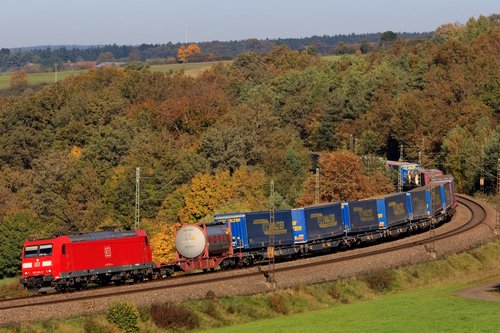
Kombiverkehr’s new intermodal rail service between Regensburg, Bavaria, and Interporto Quadrante Europa in Verona has been operating since 8 September, with two round trips a week. For the first time, the service connects Ctr Container terminal Regensburg to the German operator’s European network and can carry maritime containers, semi-trailers, swap bodies and tank containers. Departures from Regensburg are scheduled for Mondays and Thursdays, with services from Verona leaving on Tuesdays and Fridays. The connection gives freight forwarders a rail alternative to road transport on the Alpine corridor between Germany and Italy, where heavy goods vehicle metering, sectoral traffic bans and environmental restrictions affect road freight operations. Rail transport on the route can cut CO2 emissions by around 80% compared with the equivalent road journey. Ctr can also arrange first- and last-mile road transport in the Regensburg area through its own road haulage operation, integrating the rail service with local collection and distribution of loading units. The Regensburg-Verona service forms part of Kombiverkehr’s expansion of its European network. In September, the operator also launched a Duisburg-Malmo service with two weekly round trips and increased frequencies on the Cologne-Basel route from three to five.
Hapag-Lloyd expands in Africa
Hapag-Lloyd and DP World are expanding their cooperation in Africa through an agreement aimed at securing long-term terminal capacity and supporting the development of port infrastructure. The agreement covers five ports considered important to the growth of the carrier’s network across the continent. Hapag-Lloyd will secure terminal capacity in Dakar, Senegal, Luanda, Angola, and Dar es Salaam, Tanzania. The partnership will also support the development of port infrastructure in Banana, Democratic Republic of the Congo, and Maputo, Mozambique. Hapag-Lloyd expects its transport volumes in Africa to exceed one million TEU in 2026. The aim is to support this growth with sufficient capacity, reliable services and a network capable of expanding in line with customer demand. The agreement with DP World forms part of the carrier’s broader terminal strategy, which also relies on a diversified portfolio of operators to maintain competitive and flexible access to port and inland infrastructure. Hapag-Lloyd will also continue to expand its terminal portfolio through Hanseatic Global Terminals.
Battery logistics in Germany
DP World is investing €50 million to expand its chemical logistics hub in Wolfenbuttel, Lower Saxony, strengthening its specialisation in regulated goods and the battery supply chain. The project includes a new 30,000 sq m warehouse for lithium-ion batteries and a rail terminal for dangerous goods, described as the first facility of its kind in the region. The site will continue to serve agricultural customers while expanding its activities into the automotive sector, particularly the electric vehicle supply chain. The facility will be able to handle receiving, preparation, packaging, dispatch and returns. Lithium batteries are classified as Class 9 dangerous goods, and their international transport by rail is governed by RID regulations. Integrating a specialised warehouse with rail infrastructure is therefore intended to create a dedicated hub for handling flows that require specific procedures. DP World also says it handles around four million lithium-ion modules a year and operates more than 20 dangerous goods warehouses worldwide. Wolfenbuttel is one of the group’s 19 European chemical warehouses and, once completed, is expected to become DP World’s main European hub for chemical storage. The investment complements the 28,000 sq m battery facility in Sarstedt, which has helped increase battery warehousing capacity by 50%. Work at Wolfenbuttel is under way, although no firm date has been given for the facility to become operational. Storage capacity, the operational specifications of the rail terminal, rail partners and commercial contracts already secured have also not been disclosed. The hub’s eventual intermodal role will therefore depend on the capacity installed, the characteristics of its rail connection and the industrial flows it will serve.
Containers lost overboard in the Philippines
The Philippine Coast Guard has issued a navigation warning after 46 containers were lost overboard off Batangas province, with operations under way to locate the missing cargo units. The incident involved the container ship Span Asia 39, an 8,300-deadweight-tonne vessel measuring 115 metres in length and with a capacity of 564 TEU. The containers were reported lost about 1.5 nautical miles off Hamilo Point after the vessel encountered rough seas and severe, continuous rolling that is believed to have loosened the lashing systems. Thirty 20-foot containers, 11 40-foot containers and five open containers went overboard. According to the shipping company, the containers were empty. The vessel subsequently reached an anchorage north of Manila, where another container fell overboard during manoeuvring and is believed to have sunk. At least one of the missing containers has since washed ashore. The Philippine Coast Guard deployed a response vessel and a drone for the search operation. The operation includes monitoring the drift of containers that may still be afloat, which prompted the navigation warning.