




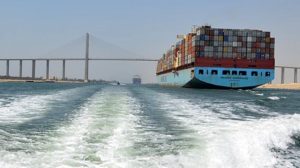
On 19 December 2025 Maersk completed its first transit through the Red Sea and the Suez Canal after almost two years of diversions around Africa due to Houthi attacks. The container vessel Maersk Sebarok, sailing from India to the United States, passed through the Bab el-Mandeb Strait between 18 and 19 December, marking a symbolic moment for container shipping, which continues to be shaped by geopolitical tensions in the region.
The Danish group was quick to clarify that the operation does not represent a structural return to trans-Suez routes. The transit was described as a test passage, part of a gradual approach that does not, at this stage, imply a comprehensive revision of the east–west network. Maersk reiterated that any future decisions will depend on the stability of security conditions and their consistency over time.
This cautious stance is consistent with the strategy pursued by the company throughout 2025. Earlier in the year, Maersk had already indicated that disruptions to Red Sea traffic were likely to continue until the end of the financial year, despite diplomatic signs of de-escalation. Chief executive Vincent Clerc has repeatedly stressed that the priority remains the protection of crews, vessels and cargoes, even if this means maintaining longer and more costly routings.
Across the major container lines, positions remain differentiated. CMA CGM appears to be the operator most inclined towards an earlier resumption of transits. The French group has continued in recent months to carry out selective passages through the Red Sea, including under military protection, and has announced that from January 2026 the Indamex service between India and the United States will return to using the Suez Canal. This strategy reflects a more positive assessment of the security outlook and a greater willingness to absorb residual risks.
MSC’s position is more nuanced. The Swiss carrier has repeatedly stated that routing around the Cape of Good Hope is not an optimal long-term solution, but has yet to communicate timelines or operational tests for a return to Suez. Contacts with the Suez Canal Authority are ongoing, but without public commitments to experimental transits.
Hapag-Lloyd maintains a largely wait-and-see approach. The German group continues to divert its vessels, reiterating that a return to the Red Sea will only be considered when conditions are deemed fully safe. A similar position is taken by Evergreen, which conditions any resumption of transits on lasting stability, while COSCO links the security issue to a broader normalisation of the market, particularly in terms of the balance between demand and available capacity.
From an operational perspective, the central issue remains the cost of risk. War risk insurance premiums continue to weigh heavily on transits in the area, standing at around 1% of hull value, making passage economically burdensome even in the presence of protected corridors. Insurers, for their part, are waiting for prolonged signs of stability before revising cover downwards. In this context, the extension of the European naval operation Eunavfor Aspides until 28 February 2026 provides a framework, but not yet a sufficient guarantee for a generalised reopening.
There are also commercial incentives encouraging some carriers not to accelerate a return to the Suez Canal. Diversions around the Cape of Good Hope have increased tonne-mile demand for container ships by around 17%, helping to support fleet utilisation and line profitability in a market otherwise characterised by excess capacity. A rapid return to shorter routes would reduce this effect, releasing capacity back into the market.
According to industry analysts, a widespread return to normality would result in a reduction in global container ship demand of around 10%, with the risk of renewed pressure on freight rates and greater spot rate volatility. For this reason, many carriers are studying a phased transition, starting with the deployment of vessels below 10,000 teu, before gradually increasing capacity up to the reintroduction of 18,000 to 24,000 teu ships. In this scenario, full realignment of service schedules would require between one and two months.
The transit of Maersk Sebarok therefore fits into a phase of fragile equilibrium, in which operational signals and public announcements do not always coincide. The Suez Canal authorities continue to promote the return of traffic, while shipping lines adopt a cautious stance, closely monitoring incident trends, insurance costs and the overall resilience of the security environment in the weeks ahead.
Pietro Rossoni