







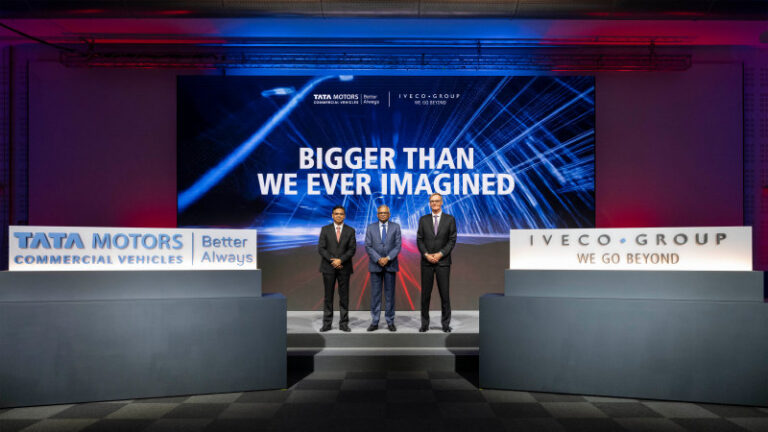
Tata Motors completed the acquisition of an 89.42% stake in Iveco on 30 October 2026, and on 3 November 2026 executives from the two groups presented the future of the new company in Turin. Turin remains the heart of Iveco Group, but the company's industrial and commercial operations are expanding to a global scale. The press conference was held at Iveco's stand at Ecomondo, with a live link to Turin, marking the manufacturer's first public appearance as part of the Indian group. It was also the first appearance of the new leadership: N. Chandrasekaran, chairman of Tata Sons, Tata Motors and Iveco Group, and Girish Wagh, managing director and CEO of Tata Motors. Olof Persson remains CEO of Iveco Group.
Chandrasekaran, Wagh and Persson outlined a strategy based on the complementary strengths of the two organisations, industrial continuity and the opportunity to accelerate technological development and international expansion. Complementarity was the word repeatedly emphasised by all three executives, with Chandrasekaran explaining: "Two strong and successful organisations, united by shared values, a common commitment to sustainable mobility and the ambition to shape the future of commercial transportation, have come together to create a truly global commercial mobility enterprise." He added that "we will invest for the long term", identifying the sharing of expertise, technologies and manufacturing capabilities as the main value of the transaction. The aim is to build a company capable of developing safer, smarter, more connected and sustainable commercial mobility, with knowledge and solutions flowing from India to Europe and vice versa.
Wagh described the deal as a compelling opportunity to create greater value for customers and stakeholders: "Our complementary portfolios, capabilities and geographical strengths provide a solid foundation for growth, while ensuring continuity from day one for customers, dealers and partners." The ambition, he added, is to build a stronger company by combining strengths in engineering, new technologies, sourcing, distribution and customer networks, accelerating innovation, expanding market reach and delivering advanced solutions to customers more quickly and competitively. Tata Motors and Iveco Group will therefore begin cooperating across all areas, united by a shared ambition for growth and green mobility.
The most important reassurance for Italy's manufacturing sector concerns the decision to retain Iveco Group's headquarters in Turin. The group will preserve the identity of its brands, its workforce and its industrial presence, while Tata will support Iveco's existing strategy and investment plans. The two organisations will work to make the most of their respective capabilities. "This is not a consolidation exercise," Chandrasekaran stressed, emphasising the importance of respecting the characteristics of individual markets, local expertise and customer requirements. This statement appears to reduce, at least in terms of declared intentions, the risk of a straightforward rationalisation of the European organisation. However, it is still too early to define the future of individual plants in detail.
The combined business ranks as the world's fourth-largest commercial vehicle manufacturer, with revenues of approximately €21 billion, more than 590,000 vehicles sold, over 73,000 employees and a presence in more than 130 countries. Its operations include 27 manufacturing sites, 25 research and development centres and a network of around 9,300 sales and service outlets. The complementary strengths are clear: Tata has an established position in India and emerging markets, while Iveco brings a strong presence in Europe and Latin America, together with FPT Industrial's expertise in powertrain systems.
Among the opportunities being explored is the introduction of selected Iveco models in India, initially through semi-knocked-down (SKD) assembly, followed by localised production. At the same time, Tata products could find new markets in regions where Iveco is already established, starting with Latin America. Persson described joining Tata as "a historic day" and the beginning of a new chapter for the group's brands, people and industrial heritage. He highlighted the strength of the Indian partner and their shared long-term vision, with the aim of turning opportunities into projects and products.
The immediate priority remains ensuring continuity for customers, dealers, suppliers and partners. In the medium term, the challenge will be to translate the greater industrial scale into innovation, competitiveness and growth. The joint plan will need to clarify how technologies will be shared, which products will emerge from the integration and where investments will be concentrated. For Turin and Italy's commercial vehicle industry, this is where the tangible value of the new alliance will be measured.
Massimiliano Barberis