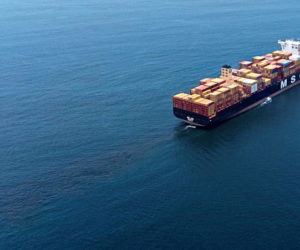







In 2025 the Western Ligurian Sea port system achieved an unprecedented result in container traffic, coming close for the first time to the threshold of three million TEU handled. Total volumes reached 2,999,486 TEU, up 6.3% compared with 2024, according to data released by the Autorità di Sistema Portuale del Mar Ligure Occidentale (Western Ligurian Sea Port Authority). The milestone was reached in an international context still marked by geopolitical uncertainty, the reorganisation of global supply chains and tensions on the main maritime routes.
Growth was driven above all by gateway traffic, which is more directly linked to trends in the real economy. Over the year, 1,919,700 full TEU were handled in import and export, representing a 4.8% increase year on year. Net of monthly fluctuations, the figure confirms the resilience of flows connected to international trade and the national production system.
A significant contribution also came from transhipment traffic, which reached 547,790 TEU, up 31.5%. The expansion of transhipment activities is largely due to an increase in the handling of empty containers, linked to the strategies adopted by major shipping lines to reorganise services and container cycles in response to trade tensions and changes in maritime routes. As for overall cargo volumes, in 2025 the Western Ligurian Sea port system handled 62,922,508 tonnes of goods, recording a slight decline compared with 2024 (-0.8%).
Looking at individual ports, Savona–Vado Ligure closed the year with around 590,000 TEU handled, up 58.4% on 2024, with a largely predominant transhipment component. The port of Genoa, by contrast, handled a total of 2.4 million TEU, posting a slight decrease (-1.6%), mainly attributable to lower transhipment volumes, against broadly stable gateway traffic.
Solid bulk cargoes ended the year with an increase of 2.3%, totalling 2,457,728 tonnes. The positive trend was supported above all by the fourth quarter, which recorded growth of 24.3% compared with the same period in 2024. The port of Genoa handled 713,321 tonnes (+3.8%), while Savona reached 1,744,407 tonnes (+1.6%). Among the main commodities, there was a recovery in coal traffic, particularly in Genoa (+17.4%), and growth in other solid bulks (+29.8%), driven by demand for metallurgical products.
Conventional cargo, which accounts for around 21% of the port system’s total volumes, stood at 12.99 million tonnes in 2025, down 3.3% year on year. However, the segment shows signs of strengthening in the final part of the year: the fourth quarter recorded growth of 4.5% compared with the same period in 2024, with positive results both in the port of Genoa (+3%) and in Savona (+3.2%).
Within the segment, ro-ro traffic and cars improved towards the end of the year, while the handling of steel and metal materials grew by 1.3%, driven by Genoa. Particularly strong was the performance of forest products, which closed 2025 with an increase of 30%. Overall dynamics reflect the cyclical slowdown in some key industrial supply chains, particularly automotive, steelmaking and construction. As for liquid bulk, 2025 closed with a slight decline in energy products (-1.9%), totalling around 18 million tonnes. Other liquid bulks, by contrast, increased by 4.7% year on year, driven by food-grade liquid bulks, up 39%.
In 2025 rail traffic related to non-containerised cargo showed a 17% increase in the number of trains handled, thanks to the launch and consolidation of new services at the port of Savona. Overall gateway volumes also showed a positive trend, with growth of 2%. Overall, however, rail utilisation was affected by disruptions on the national network linked to infrastructure works. Trains handled totalled 7,935 units (-14.2%), while volumes in loading units fell to 322,451 TEU (-11.6%), with a modal share of 13.2%, down two percentage points compared with 2024.